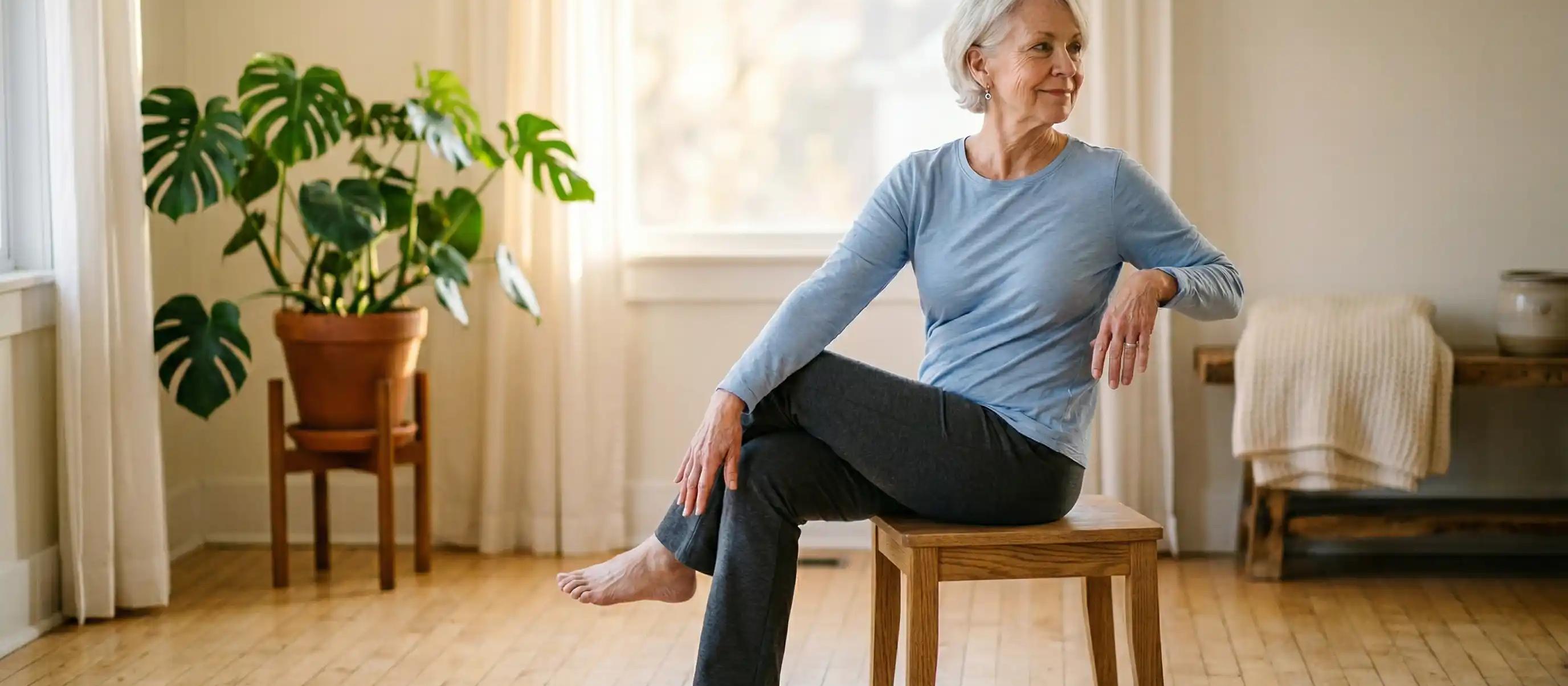
Joint stiffness, chronic pain, and the fear of falling keep millions of Canadian seniors from exercising - even though movement is exactly what their bodies need. Traditional yoga sounds appealing, but getting down to the floor and back up again can feel risky or impossible when your knees ache and your balance is unreliable.
That gap between wanting to move and being afraid to move is more than frustrating. It accelerates the exact problems you're trying to avoid: muscles weaken faster, joints stiffen further, and fall risk climbs. According to Canada's Public Health Agency, falls caused over 78,000 hospitalizations among adults 65 and older in 2022 alone, costing the healthcare system $5.6 billion.
Chair yoga changes the equation. It delivers the proven benefits of traditional yoga - improved flexibility, better balance, reduced pain, a calmer mind - from the stability of a sturdy chair. No mat required. No getting on the floor. No fear of falling mid-pose.
And the research is stronger than you might expect. A landmark randomized controlled trial found that just eight weeks of chair yoga significantly reduced pain, improved walking speed, and decreased fatigue in older adults with osteoarthritis, with a 95% participant retention rate and zero adverse events.
This guide covers everything you need to get started: what chair yoga actually is, the science-backed benefits, 10 beginner-friendly poses with step-by-step instructions, safety guidelines, and a simple breathing practice to pair with your movements.
Table of Contents
- What Is Chair Yoga?
- 7 Science-Backed Benefits of Chair Yoga for Seniors
- 10 Chair Yoga Poses for Beginners
- Breathing Techniques to Pair with Your Practice
- Safety Guidelines and Getting Started
- How Often Should You Practice?
- Where to Find Chair Yoga Classes in Canada
- Start Where You Are
What Is Chair Yoga?
Chair yoga is a modified form of traditional yoga where poses are performed while seated in a chair or standing with the chair used for support and balance. Nearly any yoga pose - twists, stretches, forward bends, even warrior poses - can be adapted to a seated or chair-supported version.
The practice originated as a way to make yoga accessible to people who can't comfortably participate in floor-based classes. That includes older adults with limited mobility, anyone recovering from surgery, and people managing chronic conditions like arthritis or osteoporosis.
What makes chair yoga different from simply "stretching in a chair" is the integration of yoga's core elements: intentional breathing, mindful movement, and body awareness. Clinical research programs like the Sit 'N' Fit Chair Yoga method, developed at Florida Atlantic University, incorporate four specific components - physical postures, breathing exercises, deep relaxation, and meditation - all performed from a seated position.
The chair itself serves two purposes. First, it provides physical stability so you can focus on the movement rather than worrying about your balance. Second, it creates a lower barrier to entry. You don't need special clothing, a yoga mat, or prior experience. A kitchen chair and 15 minutes is enough to get started.
7 Science-Backed Benefits of Chair Yoga for Seniors
Chair yoga isn't just gentle movement for the sake of staying active. A growing body of peer-reviewed research shows measurable improvements across several areas that matter most to older adults.
1. Reduces Joint Pain and Stiffness
Roughly half of Canadian adults aged 65 and older live with arthritis - the most common chronic disease in this country - making pain management a daily concern. Chair yoga offers a low-impact way to keep joints moving without the strain of weight-bearing exercise.
A 2017 randomized controlled trial published in the Journal of the American Geriatrics Society studied 131 older adults with lower-extremity osteoarthritis. After eight weeks of twice-weekly chair yoga sessions, participants experienced significant reductions in pain and stiffness. Those improvements in pain interference were still measurable three months after the program ended. Notably, zero adverse events were reported across the entire study.
A separate 2023 study of 85 women with knee osteoarthritis found that 12 weeks of chair yoga significantly improved functional fitness and daily activity scores compared to a control group.
2. Improves Balance and Reduces Fall Risk
Falls are the leading cause of injury-related hospitalization for Canadian seniors, responsible for 89% of all injury-related hospital admissions among adults 65 and older. Anything that meaningfully improves balance deserves attention.
A 2025 case series published in the International Journal of Exercise Science tracked four women aged 77 to 92 through eight weeks of once-weekly chair yoga. Using the Tinetti Balance and Gait Assessment, every participant improved enough to move down at least one fall-risk category - from high to moderate, or moderate to low. All improvements exceeded the minimum clinically important difference.
An earlier pilot study of 16 seniors with a median age of 88, all of whom used assistive devices, found that eight weeks of chair yoga significantly reduced fear of falling. Three participants were able to stop using their assistive devices entirely.
3. Builds Functional Strength
Age-related muscle loss (sarcopenia) affects balance, mobility, and the ability to perform everyday tasks like climbing stairs or getting up from a chair. Chair yoga builds strength through sustained holds and controlled movements that engage the core, legs, and upper body.
Research consistently shows that regular chair yoga practice improves hand grip strength, arm strength, and leg strength in older women. A 2019 study of 31 community-dwelling older women found measurable strength improvements across all three areas after 12 weeks of chair yoga, along with improved agility, gait, and flexibility.
4. Increases Flexibility and Range of Motion
Stiff muscles and joints make everyday tasks harder and sometimes painful - reaching into a cupboard, turning to check a blind spot while driving, bending to tie shoes. Chair yoga addresses this through gentle, progressive stretching.
Because poses are adapted to a seated position, you can safely stretch muscles that might otherwise be difficult to target without risking a fall. The chair provides stability so you can hold stretches longer and explore your range of motion with confidence rather than caution.
5. Supports Mental Health and Emotional Well-Being
The mental health benefits of chair yoga are among the most compelling findings in recent research, particularly for older adults dealing with isolation, anxiety, or depression.
A 2024 study published in the Journal of Applied Gerontology examined chair yoga among care home residents aged 80 to 101, including some with dementia. After eight weeks of twice-weekly sessions, participants showed significant reductions in anxiety, depression, and negative affect. These benefits appeared regardless of cognitive impairment level.
A review published in Aging and Mental Health analyzed 15 studies on relaxation techniques for older adults and found that yoga was the most effective intervention for both depression and anxiety, providing the longest-lasting effects compared to alternatives like massage, music therapy, and progressive muscle relaxation.
6. Accessible for People with Chronic Conditions
Chair yoga has been studied and shown to be feasible across a wide range of health conditions common among Canadian seniors. Beyond osteoarthritis and general mobility limitations, published research has demonstrated its safety and potential benefit for people with:
- Alzheimer's disease and dementia
- Hypertension
- Bilateral knee replacements
- Chronic pain
The scale of need in Canada makes this especially relevant. Over 2.4 million Canadians aged 65 and older have osteoarthritis. Another 1.6 million have osteoporosis. More than a quarter of seniors in private households and 38% of those in long-term care facilities report chronic pain. Chair yoga represents an intervention that can reach many of these populations safely.
7. Easy to Maintain Consistently
Perhaps the most practical benefit of chair yoga is its stickiness. The landmark 2017 trial reported a 95% retention rate - far higher than most exercise programs for older adults. Because the barrier to entry is so low (no special equipment, no driving to a gym, no getting on the floor), seniors are more likely to actually do it regularly.
Consistency matters more than intensity. The Canadian Society for Exercise Physiology recommends that adults 65 and older get at least 150 minutes of moderate physical activity per week, including:
- Muscle and bone strengthening activities at least two days per week
- Balance exercises for those with poor mobility
A regular chair yoga practice can contribute meaningfully to all of these targets.
10 Chair Yoga Poses for Beginners
The following poses are drawn from the most commonly recommended chair yoga sequences in clinical research and certified yoga therapy programs. You can do them individually or as a complete 15- to 20-minute routine. All you need is a sturdy, armless chair on a flat surface with enough room to extend your arms and legs.
Before you begin: Sit toward the front edge of your chair with your feet flat on the floor, hip-width apart. Keep your spine tall but not rigid. Relax your shoulders away from your ears.
1. Seated Mountain Pose (Tadasana)
Targets: Posture, core awareness, alignment
Sit tall with your feet flat on the floor, parallel and hip-width apart. Press your sitting bones evenly into the chair. Lengthen your spine as though a string is gently pulling the crown of your head toward the ceiling.
Rest your hands on your thighs, palms down. Roll your shoulders up, back, and down. Hold for five to eight slow, deep breaths.
This is the foundational pose for all chair yoga. It teaches proper spinal alignment and builds awareness of your posture - something that pays dividends in every other pose and in daily life.
2. Seated Cat-Cow (Marjaryasana-Bitilasana)
Targets: Spinal mobility, back and neck stiffness
Place your hands on your knees. On an inhale, arch your back gently and lift your chest toward the ceiling, letting your belly move forward (cow). On an exhale, round your spine, tuck your chin toward your chest, and draw your belly button in (cat). Move slowly between the two positions for five to eight breath cycles.
This is one of the most effective poses for loosening a stiff back. The alternating motion improves spinal flexibility and helps relieve tension that builds from prolonged sitting.
3. Seated Spinal Twist (Ardha Matsyendrasana)
Targets: Spinal rotation, lower back tension, digestion
Sit tall with your feet flat on the floor. Place your left hand on the outside of your right thigh, just above the knee. On an exhale, slowly rotate your torso to the right, allowing your chest, shoulders, and head to follow.
Let the twist come from your mid-back, not by forcing your shoulders. Hold for three to five breaths, deepening the twist slightly with each exhale. Return to center and repeat on the other side.
Osteoporosis modification: Keep the twist gentle and your spine lengthened upward rather than rounding forward. Do not twist to the point of discomfort. Those with spinal disc issues should consult a healthcare provider before attempting twists.
4. Seated Forward Bend (Paschimottanasana)
Targets: Hamstring and lower back flexibility
Sit at the front edge of your chair with your feet flat on the floor. Place your hands on your knees. On an inhale, lengthen your spine. On an exhale, hinge forward at the hips, sliding your hands down your legs toward your shins or ankles.
Go only as far as is comfortable. Hold for three to five breaths, then slowly return to sitting upright on an inhale.
Osteoporosis modification: Keep your back flat rather than rounding forward. Only hinge as far as you can while maintaining a straight spine. Consider placing your hands on yoga blocks on the floor if reaching your shins creates strain.
5. Seated Warrior I (Virabhadrasana I)
Targets: Leg strength, hip opening, balance
Turn your body sideways in the chair so your right thigh is supported by the seat and your left leg extends behind you. Straighten your left leg, tucking your toes under if comfortable. Square your hips forward as much as possible.
If you feel stable, raise your arms overhead with palms facing each other. Hold for three to five breaths. Switch sides.
This is one of the most important poses for fall prevention because it strengthens the legs and hips while challenging your stability in a supported position.
6. Seated Pigeon Pose (Kapotasana)
Targets: Hip flexibility, glute tension
Sit tall with both feet flat on the floor. Lift your right ankle and place it on top of your left thigh, just above the knee, creating a figure-four shape. Flex your right foot gently to protect your knee.
If you feel a stretch in your right hip already, stay here. For a deeper stretch, inhale to lengthen your spine, then exhale and lean forward slightly from the hips. Hold for three to five breaths. Switch sides.
Hip replacement modification: Skip this pose if you've had a posterior approach hip replacement, as crossing the legs is typically restricted. Consult your surgeon or physiotherapist before attempting it.
7. Seated Eagle Arms (Garudasana Arms)
Targets: Shoulder tension, upper back relief, posture
Sit tall and extend both arms forward at shoulder height. Cross your right arm over your left at the elbows. Bend both elbows and try to bring your palms together (or as close as comfortable).
Lift your elbows slightly while keeping your shoulders relaxed and down. Hold for three to five breaths. Unwind and repeat with the left arm on top.
This pose is excellent for relieving the rounded-shoulder posture that develops from sitting for long periods. It opens up the space between the shoulder blades and stretches the upper back.
8. Seated Side Stretch
Targets: Lateral spine flexibility, breathing capacity
Sit tall with your feet flat on the floor. On an inhale, raise your right arm overhead, reaching your fingertips toward the ceiling. On an exhale, lean gently to the left, feeling the stretch along the right side of your body.
Keep both sitting bones firmly on the chair. Hold for three to five breaths. Return to center on an inhale and switch sides.
This stretch opens the ribcage and intercostal muscles, which can improve your breathing capacity - especially helpful for seniors who tend to take shallow breaths.
9. Seated Knee-to-Chest
Targets: Hip flexors, lower back relief, circulation
Sit tall with both feet on the floor. On an inhale, lift your right knee toward your chest. Clasp your hands around your shin or behind your thigh (whichever feels better on your knee).
Gently draw the knee closer on each exhale. Hold for three to five breaths, then slowly lower your foot back to the floor. Repeat on the other side.
This pose stretches the hip flexors and lower back while improving circulation in the lower body. It's especially helpful if you spend much of the day seated.
10. Seated Relaxation Pose (Savasana)
Targets: Stress reduction, nervous system reset
Close your practice with this restful pose. Sit back comfortably in your chair with your feet flat on the floor. Rest your hands on your thighs, palms facing up. Close your eyes or soften your gaze downward.
Let your shoulders drop. Breathe naturally and allow your entire body to relax. Stay here for two to five minutes, simply noticing the sensation of your breath moving in and out.
This pose allows your body and mind to absorb the benefits of your practice. It activates the parasympathetic nervous system and promotes a sense of calm that often carries into the rest of your day.
Breathing Techniques to Pair with Your Practice
One of the things that separates chair yoga from basic chair stretching is intentional breathwork. Clinical research programs consistently include breathing exercises as a core component alongside physical postures - and for good reason.
A 2021 study published in Scientific Reports found that just five minutes of deep, slow breathing significantly decreased anxiety and increased parasympathetic nervous system activity in both younger and older adults. The notable finding: the calming effect was significantly greater in older adults than in younger ones, suggesting that breathing practices may be particularly effective for seniors.
Here are three breathing techniques well-suited for chair yoga beginners:
Diaphragmatic (Belly) Breathing
Sit comfortably with one hand on your chest and one on your abdomen. Inhale slowly through your nose, directing the breath into your belly so your lower hand rises while your chest stays relatively still. Exhale slowly through your mouth or nose. Repeat for eight to ten breath cycles.
This is the foundational breathing technique. It improves lung capacity and activates the calming branch of your nervous system. Use it at the beginning of your practice to centre yourself.
Equal Breathing (Sama Vritti)
Inhale through your nose for a count of four. Exhale through your nose for a count of four. Gradually extend the count to five or six as it becomes comfortable. Keep the inhale and exhale the same length.
This simple technique creates a sense of balance and calm. It's effective for managing racing thoughts and can be used anytime - during your practice, before bed, or during a stressful moment.
Three-Part Breath (Dirga Pranayama)
Inhale and fill your belly first, then feel your ribs expand, and finally feel your upper chest lift. Exhale in reverse: chest lowers, ribs contract, belly draws inward. Each breath becomes a slow, wave-like motion through your torso.
This technique builds deep body awareness and is particularly effective at the beginning or end of your practice. It encourages a full, complete breath rather than the shallow breathing that many of us default to throughout the day.
Safety Guidelines and Getting Started
Chair yoga is one of the safest forms of exercise for older adults, but a few precautions will help you get the most out of your practice without any setbacks.
Choose the Right Chair
Your chair matters. Look for one that is:
- Sturdy and stable - no wheels
- Armless - allows full range of motion for side stretches, twists, and warrior poses
- Proper height - your feet should rest flat on the floor with knees at roughly 90 degrees
Place the chair on a flat, non-slip surface before you begin.
Start Slowly
If you're new to chair yoga or haven't exercised in a while, begin with 15- to 20-minute sessions, two to three times per week. Most clinical trials showing significant results used twice-weekly sessions of 30 to 45 minutes over 8 to 12 weeks.
Even once-weekly sessions have shown measurable improvements in balance and fall risk. Increase duration and frequency gradually as your strength and confidence grow.
Talk to Your Doctor First If You Have Any of These Conditions
While chair yoga is generally safe, consult a healthcare provider before starting if you have:
- High blood pressure or heart disease
- Osteoporosis or osteopenia
- A recent joint replacement
- Severe arthritis or spinal disc issues
- Dementia or a neurological condition
- Glaucoma
- COPD or severe asthma
This isn't a reason to avoid chair yoga. Research has shown it to be safe and beneficial for many of these conditions. But your doctor or physiotherapist can help you identify which poses to modify or skip based on your specific situation.
Listen to Your Body
No pose should cause sharp pain. A gentle stretch is normal and desirable; pain is not. If something doesn't feel right, ease out of the pose.
Chair yoga is meant to be progressive. Your flexibility and strength will improve over weeks and months of consistent practice. There is no benefit to pushing too hard on day one.
Consider Specific Modifications
If you have osteoporosis: Avoid deep forward bends and twists that round the spine. Focus on poses that lengthen the spine upward. Osteoporosis Canada specifically advises against combining bending and twisting while seated, as sitting increases pressure on spinal bones.
If you've had a hip replacement: Avoid crossing your legs (skip seated pigeon) until you have full medical clearance, which typically comes at six or more months post-surgery. Follow the movement restrictions specific to your surgical approach (posterior or anterior).
If you have severe arthritis: Reduce the depth of all stretches and move in and out of positions rather than holding for extended periods. Use props like yoga blocks or straps to reduce strain.
How Often Should You Practice?
The research points to a clear and encouraging answer: consistency matters more than duration, and even modest amounts of practice produce results.
Most clinical trials that showed significant benefits used twice-weekly sessions of 30 to 45 minutes over 8 to 12 weeks. But a 2025 study demonstrated measurable improvements in balance and fall risk with just one session per week for eight weeks. The key is regularity.
Recommended starting point: Two to three sessions per week, 20 to 30 minutes each. This aligns with the Canadian Society for Exercise Physiology's guidelines recommending at least 150 minutes of moderate activity per week with balance exercises on multiple days.
As your practice becomes comfortable, you can add sessions or extend the duration. Many seniors find that a short 10- to 15-minute morning routine becomes the most sustainable habit. It loosens overnight stiffness, sets a positive tone for the day, and is short enough that you'll actually do it consistently.
Where to Find Chair Yoga Classes in Canada
If you prefer guided instruction over practising on your own, there are several accessible options across the country.
SilverSneakers offers virtual and on-demand chair yoga classes. Many Canadian seniors enrolled in supplemental health plans may have access to similar fitness programs - check with your benefits provider.
Local community centres and senior centres across Canada frequently offer chair yoga as part of their programming. These classes often have the added benefit of social connection, which research links to improved longevity and well-being in older adults.
YouTube is a rich resource for free chair yoga classes. The current top-ranking result for "chair yoga for seniors" is a YouTube video, which speaks to how many people are finding and following along with video-based instruction at home.
Certified yoga therapists who specialize in working with older adults can provide personalized modifications based on your health conditions. Look for instructors with credentials from recognized yoga therapy organizations who have experience with seniors.
Start Where You Are
You don't need to be flexible. You don't need experience. You don't even need to get out of your chair.
Chair yoga meets you exactly where you are and builds from there. One breath, one gentle stretch, one small improvement at a time. The research is clear that it works. The barrier to entry is as low as it gets. And the potential benefits - less pain, better balance, improved mood, greater independence - are exactly what most seniors are looking for.
Pick two or three poses from this guide, pair them with a few minutes of belly breathing, and try it tomorrow morning. That's all it takes to begin.