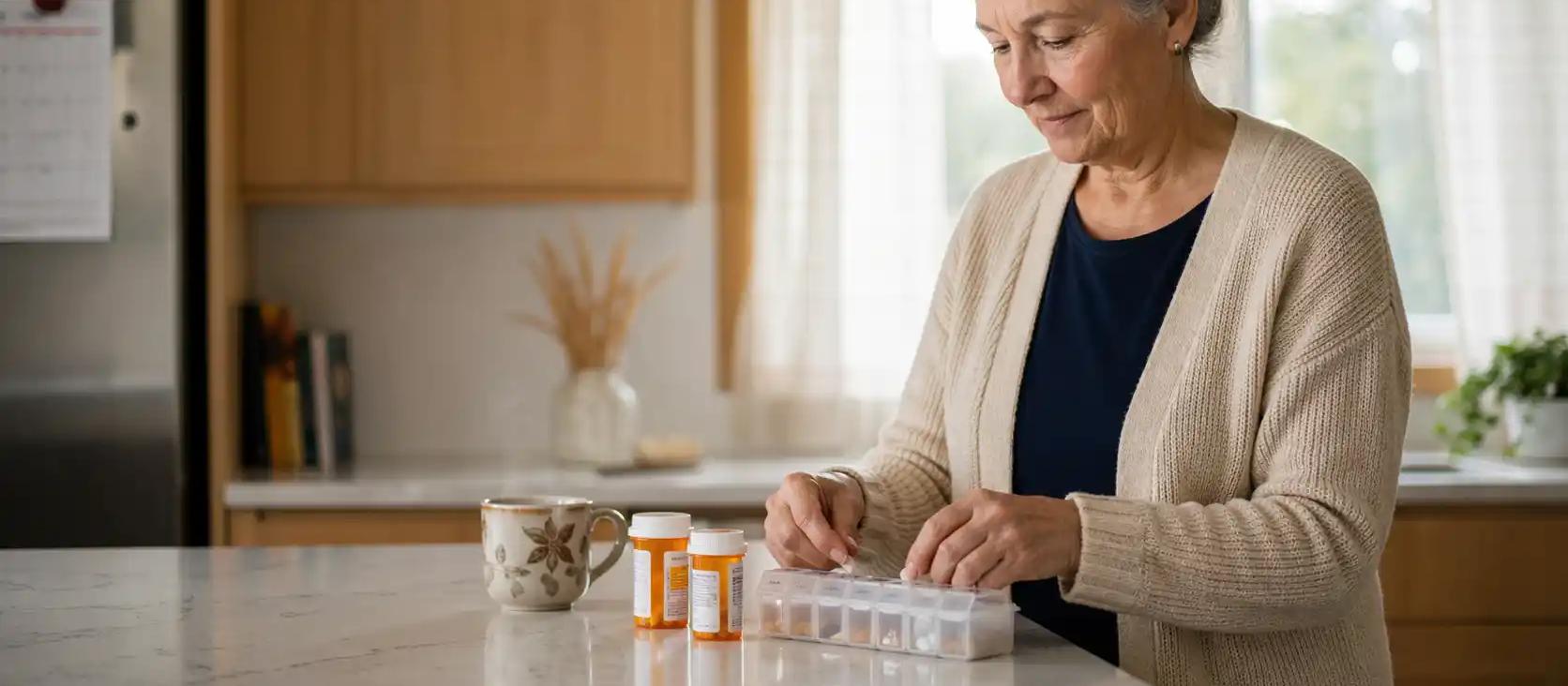
Your mom has a pill box on the counter, a note on the fridge, and an alarm on her phone. She still forgot her blood pressure medication three times last week.
This is not a memory problem. It is a system problem.
One in four Canadian seniors is now prescribed ten or more different drug classes in a single year, according to the Canadian Institute for Health Information. When a routine stretches across breakfast, lunch, dinner, and bedtime, across with-food and without-food rules, across daily pills and weekly inhalers, the old system of "I'll remember" quietly stops working. The cost of that gap is not abstract: CIHI data shows seniors taking ten or more drug classes make up just 21% of the senior population but account for nearly 59% of adverse drug reaction hospitalizations.
The good news is that medication reminders work, and the best ones are simple, layered, and cheap. This guide walks Canadian families through how to set up a system that fits your parent's life, not someone else's.
Table of Contents
- Why Medication Reminders Matter After 60
- The 4 Reasons Canadian Seniors Miss Medications
- 7 Medication Reminder Strategies That Actually Work
- How to Build a Medication Reminder System in 5 Steps
- When Reminders Alone Aren't Enough
- Frequently Asked Questions
Why Medication Reminders Matter After 60
Canadians in their sixties and seventies now carry a heavier medication load than any previous generation. Statistics Canada reports that 52% of Canadians aged 60 to 79 took three or more prescription medications in the past month, and the number of prescriptions typically climbs with each passing decade.
That complexity compounds risk. The World Health Organization's long-standing estimate is that adherence to long-term therapy in developed countries averages only about 50%. Translation: roughly half of people with chronic conditions do not take their medication as prescribed. For Canadian seniors specifically, a CMAJ Open analysis found that 8.3% of Canadians aged 55 and over skipped doses or failed to fill a prescription because of cost in 2014, which works out to roughly one in twelve.
The consequences show up in the data. Certain medications increase fall risk on their own, and missing a dose of others (blood pressure, heart, diabetes, or seizure medications) can be just as dangerous as missing the wrong one. If you are not sure which prescriptions in your parent's cabinet raise their fall risk, we covered that topic in detail here: medications that increase fall risk in older adults.
Key takeaway: Medication reminders are not about memory. They are about removing decisions from a routine that gets longer every year.
The 4 Reasons Canadian Seniors Miss Medications
Before picking a reminder tool, understand what you are actually solving for. Most missed doses come down to one of four causes:
- Schedule complexity. Three medications at different times, two with food, one that cannot mix with another, a weekly injection. The mental load adds up.
- Natural memory and attention changes. Perfectly healthy people in their seventies can still struggle to track a routine that had five steps at fifty and now has fifteen.
- Vision and dexterity limits. Small pill labels, childproof caps, and look-alike tablets make verification hard.
- Routine disruptions. Hospital discharge, a cottage weekend, daylight saving changes, or a grandchild's visit can all break a working medication routine in one day.
Match the reminder tool to the actual cause. A simple weekly pill box solves problem 1 beautifully but does nothing for problem 2. A smart speaker solves problem 3 but cannot travel to the cottage. Good systems stack two or three tools so the failure of any one does not become a missed dose.
7 Medication Reminder Strategies That Actually Work
1. Weekly Pill Organizers
The classic seven-day, four-compartment plastic organizer costs under $15 at any Canadian pharmacy and solves more problems than any app. Filling it once a week turns a daily decision into a weekly habit. Look for organizers with large compartments, clear lids, and AM/PM/Noon/Bedtime labels, especially if your parent takes medications at more than two times of day.
Best for: Seniors with a steady routine and three to ten daily pills.
2. Automatic Pill Dispensers
These countertop devices lock the week's medications inside and release only the correct dose at the correct time, usually with an audible alarm and flashing light. Some models call a family member if a dose is missed after a set window. In Canada the landscape is narrower than in the United States:
- Philips Medication Dispensing Service has a dedicated Canadian page, though availability can fluctuate.
- Hero, a leading U.S. smart dispenser with strong caregiver features, currently ships only in the U.S. and its territories, so most Canadians cannot order it directly.
- TabTime and MedMinder market to Canadians through international ordering, but retail availability varies.
Before ordering, confirm Canadian shipping, warranty, and customer service directly with the manufacturer.
Best for: Complex schedules, dementia caregivers, or when a caregiver lives out of town.
3. Smartphone Reminder Apps
Apps are the cheapest reminder layer and the easiest to adjust when a prescription changes. The strongest caregiver-oriented option in 2026 is Medisafe, which rates 4.5 stars on Google Play across roughly 248,000 reviews and includes a "Medfriend" feature that notifies a family member if a dose is missed. MyTherapy is a clean, free self-management option. Round Health is simple and pairs with Apple Watch for seniors who prefer minimal setup.
A note of caution: "pill reminder" is a generic category name and dozens of apps use it. Stick to well-reviewed, actively maintained apps from recognizable developers.
4. Smart Speakers and Voice Assistants
Alexa and Google Home can run a daily medication routine with voice confirmation. A 2026 randomized clinical trial published in JAMA Network Open tested a smart-speaker medication and glucose reminder system in 112 adults over 60 with type 2 diabetes and found significant improvements in mental distress, quality of life, diabetes self-care, and glycemic control over 12 weeks.
For many Canadian families the speaker already sits in the kitchen. A voice reminder that says "Good morning, Mom. Time for your blood pressure pill" feels human in a way a beep does not.
Best for: Seniors already comfortable with voice assistants, or households where a family member can help with the initial setup.
5. Pharmacy Blister Packs (Compliance Packaging)
This is the single most underused tool in Canadian medication management. Your pharmacist sorts every pill into a sealed card organized by day and time. No pill boxes to fill. No bottles to open. The Alzheimer Society of Canada notes that blister packs "eliminate possible confusion of when a medication should be taken."
Availability in Canada is strong:
- Rexall RightDose offers blister card packaging free of charge to individuals and caregivers.
- Most community pharmacies, including independents, provide some form of compliance packaging, often at no direct cost.
- BC PharmaCare reimburses dispensing fees for prescribed blister packs, weekly dispensing, or compliance packaging, up to five dispensing fees per drug per supply.
A 2025 review found that blister packaging improved adherence in all included clinical studies, with one showing patients on blister packs were 59% closer to perfect adherence at one year while the bottle group's adherence dropped by more than a third.
Ask your parent's pharmacist this week. It is often the fastest single upgrade to the system.
Best for: Complex medication lists, cognitive decline, or anyone who finds pill box filling tedious.
6. Caregiver Coordination Apps
A reminder is only as strong as the person watching whether it worked. Caregiver apps let family members see in real time whether a dose was taken, receive alerts when one is missed, and coordinate check-ins across siblings or spouses.
For Canadian families caring from a distance, this layer matters. Holo Alert's Holo Pro pendant pairs with a caregiver app that provides location services, alerts, and the ability to ring the device, which is useful for adult children balancing work and a parent's safety from a different city. We wrote about this scenario in depth in our guide to long-distance caregiving for parents in another province.
7. Paper-Based Anchor Methods
Not every senior wants a screen. A paper medication log taped inside the cabinet, a wall calendar with each dose checked off, or a sticky note on the coffee pot still works beautifully, especially for once-daily medications. The Alzheimer Society of Canada specifically recommends leaving medications in a frequented spot as a visual cue and marking the time immediately after each dose.
The best system is often the one your parent will actually use.
How to Build a Medication Reminder System in 5 Steps
Step 1: List Every Medication in One Place
Include prescriptions, over-the-counter medications, vitamins, and herbal supplements. Bring the list to every pharmacist and doctor appointment. A single interaction between a supplement and a prescription can undo months of careful adherence.
Step 2: Book a Pharmacist Medication Review
Canadian pharmacists can consolidate duplicate prescriptions, flag interactions, recommend de-prescribing for medications that are no longer needed, and set up blister packaging in a single appointment. The Canadian Pharmacists Association notes that pharmacists are positioned to "increase medication adherence, avoid harmful interactions, and de-prescribe for unnecessary medications." Most provincial plans cover these reviews.
Step 3: Match a Reminder Tool to the Real Problem
Look at the four causes in the section above. A busy schedule needs a blister pack or pill box. A memory concern needs an automatic dispenser plus a second reminder. A travel disruption needs a smartphone app that goes everywhere. Do not buy a $300 dispenser when the problem is a $12 pill box away from being solved.
Step 4: Trial the System for One Week
Before trusting the new routine, run it for seven days with a family member checking in. Watch for confusion about AM versus PM doses, trouble opening a package, or a tool that keeps getting ignored. Fix the friction points now, not after a hospital admission.
Step 5: Build a Safety Backup
Even the best reminder system has an off day. Build a second layer:
- A weekly call from a family member to verify the week's adherence.
- A smart speaker alarm as a secondary cue.
- A medical alert system so that if a missed dose leads to a dizzy spell, fall, or cardiac event, help is one button away.
Holo Alert's devices include one-press SOS and 24/7 monitoring by trained Canadian operators, and fall detection is included on every plan. If independence is the goal, the backup layer is what protects it.
Fall detection does not detect all falls. Gradual slides, slow collapses, or certain movements may not trigger an alert. Customers should press the SOS button manually if able.
When Reminders Alone Aren't Enough
Medication reminders are a prevention tool. They are not a response tool.
If a dose is missed, doubled, or mixed up with another prescription, the consequences can unfold in minutes. Blood sugar crashes, blood pressure spikes, heart rhythm changes, and dizziness from sedatives all create fall risk. Many happen when the senior is alone.
This is where a medical alert system earns its place. A pendant, wrist device, or smartwatch with an SOS button and fall detection closes the gap between "something went wrong" and "help arrives." 24/7 monitoring by trained Canadian operators means a family member does not need to live next door to make independent living safe.
If your parent is resistant to the idea, you are not alone. We wrote a full guide to that conversation in how to convince parents to use medical alert systems.
Holo Alert does not replace 911 or emergency medical services.
Frequently Asked Questions
Is there an app for senior medication reminders?
Yes. Medisafe is the most widely used and highest-rated option for families, with caregiver sharing through its "Medfriend" feature. MyTherapy and Round Health are strong self-management alternatives. All three are free with optional paid upgrades.
Are automatic pill dispensers worth it?
For simple schedules of three to ten pills a day, a $15 weekly pill organizer plus a smartphone alarm does nearly the same job. Automatic dispensers shine when the schedule is complex, when cognitive decline is a factor, or when a caregiver needs remote confirmation that a dose was taken. Confirm Canadian availability and shipping before ordering, since several popular U.S. brands do not ship to Canada.
Do medication reminders actually help seniors?
The clinical evidence is strong. A 2025 pilot study in adults 60 and over found that mobile device reminders significantly improved adherence scores. A 2026 trial in JAMA Network Open found that smart-speaker reminders improved mental distress, quality of life, and glycemic control in older adults with diabetes. A 2025 review found that blister packaging improved adherence in every study examined.
How do you help a parent with dementia remember medications?
The Alzheimer Society of Canada recommends a layered approach: blister packs from the pharmacist, a visual cue in a frequented spot, a marked calendar, a set alarm, and a reminder from a family member. The key is stacking two or three of these, not relying on any one alone. For a deeper look at dementia caregiving, see our essential tips for dementia caregivers and family members.
Your Parent's Medication System Is Worth 30 Minutes This Week
The strongest medication reminder system is not the most expensive one. It is the one that still works on a Tuesday in February when the grandchildren are visiting and the power flickers and daylight saving just changed the clocks.
Start with a pharmacy blister pack consultation this week. Add one digital tool (an app or a smart speaker routine). Finish with a safety layer that covers the moments when the system does not hold.
To see how a medical alert device fits into the backup plan, explore Holo Alert's devices or call our Canadian team at 1-888-445-0192. Every plan includes a 10-day risk-free guarantee, 24/7 monitoring by trained Canadian operators, and fall detection at no extra cost.
If you are building a fuller plan for keeping a parent safely at home, our complete aging in place checklist for Canadian homes walks through every room in the house.