The family home is starting to feel like a second job. The driveway needs shovelling. The basement is stacked with three decades of paperwork. The stairs have become something to plan around, not walk up. And the parent who raised you is quietly beginning to wonder whether this house still fits the life they want next.
Putting that conversation off has a real price. A stumble on basement stairs. A winter where the walkway doesn't get cleared in time. Decisions made in a hospital hallway instead of around a kitchen table. Most Canadian seniors are still in their long-time homes well into their 80s - recent CMHC-referenced reporting found that the rate at which Canadians 75 and older sell their homes has fallen over the last three decades, and a Toronto realtor who specializes in senior moves told The Canadian Press, "Almost all seniors do not want to move."
This guide is built for the in-between season - when the house is still working but the warning signs are showing. We'll walk through how to start the conversation without turning it into a fight, how to sort decades of belongings without burning anyone out, the Canadian financial mechanics that change the math, and how to set up the next home so it actively supports independence instead of slowly working against it.
Table of Contents
- When Is It Time to Downsize? Six Honest Signals
- How to Have the Downsizing Conversation Without Hurting Anyone
- Three Downsizing Paths Canadian Seniors Choose
- A 12-Month Downsizing Timeline
- The Room-by-Room Sorting System
- Where the Stuff Actually Goes in Canada
- Setting Up the New Home for Safe Aging in Place
- Financial Realities Canadian Seniors Should Know
- A Day-One Checklist for the New Home
When Is It Time to Downsize? Six Honest Signals
There is no single age. There are signals.
Stairs have become a daily obstacle. A handful of trips up and down to the bedroom, the laundry, the basement freezer. If even one of those has quietly stopped happening, the home is already shrinking around its occupant.
Rooms haven't been used in a year. A formal dining room used twice. A guest bedroom that's become a storage locker. The home has been bigger than the life inside it for a while.
Maintenance is winning. Statistics Canada reported that homeowner maintenance and repair prices climbed 19.2% from September 2018 to September 2024, and Scotiabank's general guidance is to budget about 1% of a home's value annually - closer to 3% to 5% for older homes. On a fixed retirement income, those numbers compound.
A recent fall or near-miss. This is the signal most caregivers wish they had taken seriously sooner. If you're already thinking about what to do after a senior falls, the home is voting.
The neighbourhood has changed. Friends moved, the corner store closed, the bus route was rerouted. A house can stay the same while everything around it makes daily life harder.
The house is too quiet. Canadians living alone make up a meaningful share of every senior age band: 20.7% at 65-69, 32.0% at 80-84, and 41.8% at 85 and over, according to Statistics Canada's 2021 Census data. A home built for a family can become a long, lonely hallway for one.
If two or three of those land, the conversation is overdue. Some of these signals overlap with other transitions worth thinking about - the seven signs an aging parent should stop driving often show up in the same season.
How to Have the Downsizing Conversation Without Hurting Anyone
This is rarely a logistics problem. It's an identity problem dressed up as a real-estate one. The home is where children were raised, holidays happened, a partner was lost, a life was built. Asking someone to leave that is asking them to fold up something irreplaceable.
Lead with autonomy, not loss. "What would you want the next chapter to look like?" lands better than "We need to talk about the house." Let your parent name what they want next before anyone names what they want them to give up.
Pick the right time. Not at a holiday dinner. Not in the hospital parking lot. A quiet weekday afternoon, in their kitchen, with no agenda visible.
Use specifics. "I noticed the railing in the basement is loose" is harder to wave away than "I'm worried about you." Specifics are evidence. Generalities feel like judgement.
Expect resistance, and don't take it personally. The Toronto-area widower Bill Cheng put it this way to CBC Docs while he downsized after his wife's death: "Objects are easy to get rid of. But when objects are attached with memories, it's so hard." The resistance isn't about the house. It's about everything the house holds.
Bring siblings in early. Family disagreements at this stage are common and predictable. A short read on managing family conflicts in caregiving for Canadian families is worth the time before the first hard conversation.
Three Downsizing Paths Canadian Seniors Choose
Most Canadian downsizes fall into one of three shapes. Naming them helps a senior place themselves on the map instead of feeling shoved off it.
| Path | Best for | Key trade-off |
|---|---|---|
| Smaller single-family or bungalow | Seniors who want to stay in their city, garden, drive, and own | Still a home to maintain, just less of one |
| Condo or apartment | Seniors who want to walk to amenities and stop fighting the lawn | Strata or condo fees, less storage, neighbours close by |
| Senior living community | Seniors who want social connection and on-site support | Higher monthly cost, bigger lifestyle shift |
There's also a fourth option that gets less airtime: stay put and modify. For some families, the right answer isn't a smaller house - it's the same house, with grab bars, better lighting, and a primary bedroom moved to the main floor. Compare the math and the lifestyle fit honestly. Our breakdown of the cost of home care vs. retirement home in Canada is a useful side-by-side.
A 12-Month Downsizing Timeline
A year is enough time to do this without panic. Less than a year is doable but compresses the emotional work into a smaller window. Keep the order even when you compress the timeline.
Months 12 to 9 - Decide and assess. Have the conversation. Talk to a real-estate agent who specializes in senior moves. Get a financial advisor's read on what the sale would actually free up. Tour two or three options for the next home so the choice is concrete, not abstract.
Months 9 to 6 - Sort and shed. Start with the easiest rooms (linen closets, garage) and work toward the hardest (bedrooms, basement). Short sessions, two to three hours at a time. Bigger sessions burn people out and turn the project into a fight.
Months 6 to 3 - Logistics. Book the mover. Schedule estate-sale or donation pickups. Call utilities, internet, insurance, and the post office about transfer dates. Update the will and any legal documents tied to the house.
Months 3 to 0 - Move and settle. Pack with the new home in mind, not the old one. Confirm address changes with CRA, OAS/CPP, the provincial health card, the bank, and the pharmacy. Set up emergency contacts and safety equipment in the new home before the first night there, not after.
If you're moving sooner than 12 months, compress the timeline, but don't skip the conversations or the financial review. Those are where regret hides.
The Room-by-Room Sorting System
The single most useful framework for sorting forty years of belongings is also the simplest: four piles, and only four.
- Keep - going to the new home
- Pass down - going to a specific named person who has agreed to take it
- Sell or donate - leaving the household, going somewhere useful
- Recycle or trash - leaving the household, no use left
Naming the recipient on the "pass down" pile is critical. The instinct is to assume children or grandchildren will want the china, the dining set, the silver. Canadian reporting has documented for years that they often don't - smaller homes, more casual entertaining, and changing tastes mean the family heirloom may not have a destination, and pretending it does just delays the decision.
Mississauga senior Barbara Dodds, 79, told CBC Docs while preparing her own move, "Where am I going to put everything? And that's where I get overwhelmed. How am I going to decide what is the most important thing to me in my life?" That overwhelm is the project. Working room by room, not category by category, breaks it into manageable pieces.
Living room. Measure the new space first. A sectional that anchored a 14-foot family room won't fit a condo. Photograph sentimental items before donating - a photo of the chair preserves the memory without the volume.
Kitchen. Two of every gadget. Three sets of "company" dishes. Expired baking supplies from a decade ago. The kitchen is almost always the room with the most volume and the least sentiment, which makes it a good early win.
Bedrooms. Sort clothing by season and last-worn date. Anything not worn in two years is a candidate. Paperwork archives - tax returns, old warranties, expired insurance - can usually be shredded with the help of provincial guidelines on retention.
Bathroom and medicine cabinet. Pharmacies across Canada take expired medication for safe disposal. Don't flush them. Take this moment to consolidate the active medication list, too - it's a natural pairing with a conversation about medication reminders for seniors, especially since transitions are a known risk window for missed doses.
Basement, garage, storage. This is where decades pile up. Budget more time here than feels reasonable. If the volume is overwhelming, consider hiring a senior-move manager - they exist in most major Canadian cities and bring professional pacing to a job that defeats most families on their own.
Sentimental items. Photos, letters, hobby materials. Digitize what you can, give away what has a clear recipient, and keep a single curated box rather than ten boxes of "I'll go through this later."
Where the Stuff Actually Goes in Canada
The "donate" pile is only useful if it actually leaves the house. Canada has solid pickup infrastructure if you know where to look.
Diabetes Canada's Declutter for Diabetes program schedules pickups by address and accepts bagged or boxed clothing, textiles, small household items, books, cookware, tableware, small appliances, electronics, and sporting goods. Items generally need to be sealed and under 40 pounds.
Habitat for Humanity ReStore has more than 100 locations across Canada and accepts furniture, housewares, appliances under 10 years old, electronics under 5 years old, cabinetry, fixtures, lighting, doors, windows, and renovation materials. Pickup availability depends on the location and item.
Furniture Bank (Toronto area) provides professional pickup of gently used furniture and household goods and routes them to families transitioning out of furniture poverty.
Estate sales and auctions. Canadian appraisal guidance puts estate-sale company commissions at roughly 30% to 40% of gross sales, with auction commissions running 20% to 50%. Vet companies the way you'd vet a contractor: check reviews from both buyers and sellers, confirm bonding and insurance, ask what fees are included, and attend one of their sales before signing anything.
E-waste, paint, and batteries. Recycle My Electronics (operated by EPRA) lists regulated electronics-recycling drop-offs in nine provinces. Product Care Recycling runs paint take-back programs in eight provinces. Call2Recycle handles household batteries across most of the country. None of these should end up at the curb.
Setting Up the New Home for Safe Aging in Place
The first 30 days in a new home are the most dangerous. Health Canada's fall-prevention guidance flags clutter, loose cords, scatter mats, poor lighting, unclear bedroom-to-bathroom paths, slippery bathrooms, missing grab bars, and stair hazards as modifiable risks - every one of which is in flux during the unpacking period. Boxes in walkways. Furniture that hasn't been anchored. Lamps not yet plugged in.
Set the new home up like the safety move it is.
Pick a home with safety in mind. Single-floor living. Walk-in shower. Low-pile flooring. Good natural light. The choice itself is the biggest safety decision you'll make. Our essential home modifications for aging in place safely in Canada goes deep on what to look for.
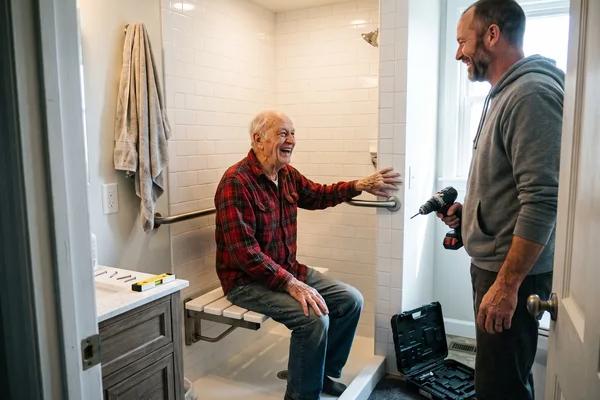
Address bathroom safety on day one. Bathrooms are responsible for a disproportionate share of senior falls. Grab bars near the toilet and inside the shower, a non-slip mat, and a raised toilet seat if needed. More detail in our bathroom safety tips for elderly in Canada.
Get the lighting right. Darker hallways and unfamiliar floor plans are a fall waiting to happen. Plug-in nightlights along the bedroom-to-bathroom route, brighter bulbs in stairwells, and motion-activated fixtures in the entryway. Our piece on how better home lighting reduces fall risk for Canadian seniors is worth a five-minute read before unpacking.
Set up 24/7 protection from the first night. A new home is the most natural moment to add a medical alert device to the routine. Habits form fast in the first weeks - building "wear it every day" into the new normal is far easier than retrofitting it six months in. Holo Alert's devices work anywhere in Canada with a wireless connection, include fall detection, and connect a senior to a Canadian-staffed monitoring centre at the touch of a button. Our complete aging in place checklist for Canadian homes walks through everything that should be in place.
To talk through which device fits - pendant, wrist-worn, or watch-style - call 1-888-445-0192.
Fall detection does not detect all falls. Gradual slides, slow collapses, or certain movements may not trigger an alert. Customers should press the SOS button manually if able. Holo Alert does not replace 911 or emergency medical services.
Financial Realities Canadian Seniors Should Know
This is not financial advice. It's a list of the things to ask a Canadian financial planner or accountant about before signing anything.
Principal Residence Exemption. If a home was the seller's principal residence for every year owned, the capital gain on the sale can generally be fully sheltered. Sales from 2016 onward must still be reported to CRA on the tax return for the exemption to apply. Only one home per family unit can be designated as the principal residence in any given year, which matters for families with a cottage or secondary property.
Provincial property-tax help.
- British Columbia offers a property tax deferment program for homeowners 55 and over, surviving spouses, or people with disabilities. It's a low-interest loan secured against the home - useful while still in the current house and considering whether to move.
- Alberta offers a Seniors Property Tax Deferral Program for homeowners 65 and over with at least 25% home equity. It's not income-tested.
- Ontario offers a Senior Homeowners' Property Tax Grant for low- to moderate-income seniors, and most municipal deferral programs run at the city or regional level rather than provincially.
- Nova Scotia offers a senior property tax rebate of 50% of municipal property tax paid, up to $800, for eligible GIS or Allowance recipients.
Land transfer tax. Ontario and BC offer first-time homebuyer rebates on land transfer or property transfer tax, but neither has a downsizing-specific seniors' rebate. Budget for the full transfer tax on the new home.
Moving costs. A Canadian local move typically lands somewhere between $650 and $1,500. Long-distance or interprovincial moves run $2,000 to $7,000 depending on distance, weight, packing, and season. A 2026 Vancouver pricing guide estimated $600 to $900 for a one-bedroom move and $1,100 to $2,000 for a three-bedroom house, before extras like packing supplies, strata fees, or tips.
Other money worth budgeting for. Real-estate commissions, staging, legal fees, deep cleaning of the old home, and a few weeks of overlap rent or mortgage if the timing slips. It's normal for total transition costs (commissions plus moving plus setup) to land in the 5% to 8% range of the home's sale price.
For a broader look at what financial supports Canadian families can lean on during this stage, our complete guide to financial support for Canadian caregivers covers the federal and provincial programs worth checking.
A Day-One Checklist for the New Home
The boxes will get unpacked over weeks. These don't get to wait.
- Update the address with CRA, OAS/CPP, the provincial health card, banks, pension plans, and the pharmacy
- Test smoke alarms and CO detectors in every room
- Post emergency contacts on the fridge - family, family doctor, pharmacist, monitoring contact
- Confirm the medical alert device is charged, paired, and the monitoring profile reflects the new address
- Walk the home for trip hazards before fully unpacking - scatter rugs, low cords, dim hallways, loose stair treads
- Locate the breaker panel, water shut-off, and gas shut-off, and label them
- Identify the fastest route from the bedroom to the bathroom and clear it
- Schedule the first "how's it going" check-in for two weeks after move-in, not move-day
Downsizing Isn't Loss. It's Design.
Right-sizing the family home is one of the most consequential decisions a Canadian senior will make in their last quarter of life. Done early and done well, it protects independence, reduces fall risk, frees up cash, and makes the next chapter actually livable. Done in a panic, it doesn't.
Start the conversation before the crisis. Sort with patience, not pressure. And set up the next home so the home itself is on your parent's side.
When you're ready to talk through 24/7 monitoring options for the new home - pendant, wrist, or watch - call 1-888-445-0192 or explore our complete aging in place checklist for Canadian homes. Every Holo Alert plan is backed by a 10-day risk-free guarantee.