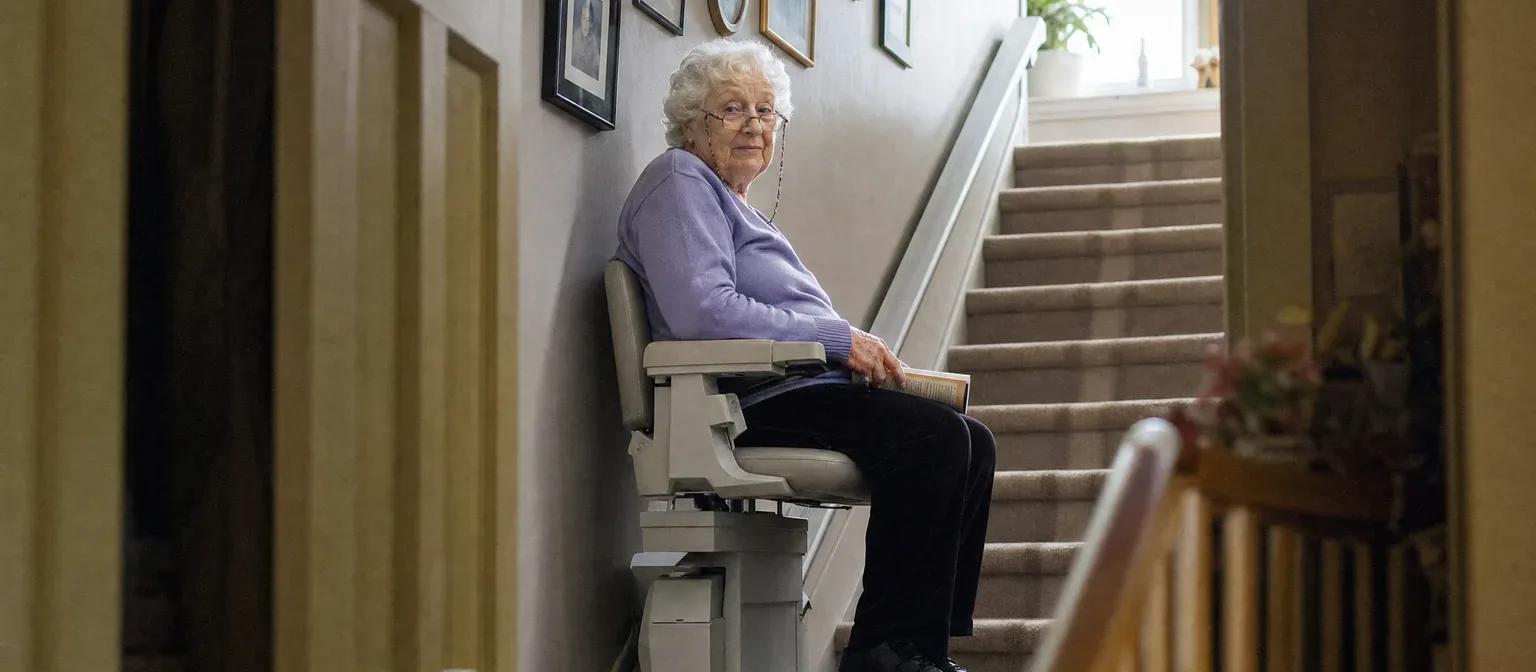
For a lot of Canadian families, the staircase is where the aging-in-place conversation gets real. The bedrooms are upstairs, the laundry is downstairs, and the stairs in between have started to feel like a daily gamble. A stair lift can solve that. It can also cost as much as a used car, and it is not always the right answer.
This is the vendor-neutral guide we wished existed: what stair lifts actually cost in Canada, the tax credits and grant programs that help pay, what to check before signing anything, and what to do instead when a lift does not fit your house, your health, or your budget.
What does a stair lift cost in Canada?
A new straight stair lift in Canada typically costs $3,000 to $6,000 installed. A curved stair lift, which needs a custom-built rail, runs $9,000 to $18,000 or more. Renting a straight lift costs roughly $170 to $300 per month plus installation and removal fees, and refurbished straight lifts start around $2,200 installed.
Those ranges line up across several Canadian vendors as of 2026: Davies Home Healthcare quotes $3,500 to $6,000 for straight lifts, Stannah Canada $3,050 to $5,500, and Toronto's Mobility Specialties $2,500 to $5,000.
| Option | Typical Canadian price (2026) |
|---|---|
| New straight stair lift, installed | $3,000 to $6,000 |
| New curved stair lift, installed | $9,000 to $18,000+ |
| Refurbished straight lift, installed | $2,200 to $3,000+ |
| Straight lift rental | $170 to $300 per month, plus install/removal fees |
Two pricing traps to avoid. First, "starting at" prices are not installed totals: ask for an itemized, tax-inclusive quote covering the rail, chair, any electrical work, installation, warranty labour, and eventual removal. Second, curved staircases change everything. Because the rail is custom-fabricated, curved lifts cost two to three times more and generally cannot be rented.
Are stair lifts tax deductible in Canada?
Yes, in two ways, but a rule change in 2026 means you now have to choose between them for the same expense.
The Medical Expense Tax Credit (METC). The CRA's medical expense list specifically includes a "power-operated guided chair to be used in a stairway, including installation." You need a prescription. Keep it with your receipts.
The Home Accessibility Tax Credit (HATC). If you are 65 or older at year-end (or eligible for the Disability Tax Credit), the HATC covers up to $20,000 of eligible home accessibility expenses per year, worth up to $2,800 at 2026 rates. A supporting family member who pays can often claim it too. Our Home Accessibility Tax Credit guide walks through the details.
The 2026 catch: for expenses on or after January 1, 2026, the same dollar can no longer be claimed under both credits. Older articles will tell you to double-claim; that rule ended with the Budget 2025 Implementation Act. For most seniors with taxable income, running the numbers both ways (or asking whoever prepares your taxes to) is worth ten minutes before you file.
If mobility is limited enough that walking is a struggle, it is also worth checking whether you qualify for the Disability Tax Credit, which opens further doors.
Who can help pay? Grants and programs by province
Canada has a patchwork of programs that can fund some or all of a stair lift. One rule applies to nearly all of them: get written approval before you order the lift. Most programs will not reimburse work that has already started.
| Program | Where | Up to | Who it's for |
|---|---|---|---|
| Home & Vehicle Modification Program (March of Dimes Canada) | Ontario | $15,000 lifetime | Household income under $60,000, mobility-limiting disability; stair lifts explicitly eligible |
| Veterans Independence Program, home adaptations | Canada-wide (veterans) | $7,729 (2025 rate) | Qualifying veterans; policy expressly covers stair glide installation |
| Rebate for Accessible Home Adaptations | BC | $20,000 | Low-income seniors and people with disabilities |
| Residential Access Modification Program | Alberta | $12,000 per year | Includes seniors 65+ who use a four-wheel walker; grant, income-tested |
| Seniors Home Adaptation and Repair Program (loan) | Alberta | $40,000 | Senior homeowners, income up to $75,000; expressly covers stair lifts |
| Residential Adaptation Assistance Program, Option 2 | Quebec | $12,000 interior | Straight stair chairs only (curved not eligible under Option 2) |
| Home Repair and Accessibility Program | Nova Scotia | $16,000 | Income-tested owner-occupiers; accessibility upgrades |
Most other provinces and territories run similar programs, from PEI's Seniors Safe @ Home ($10,000) to Yukon's accessibility grant ($30,000). If yours is not listed, search your province's name plus "home adaptation program."
Veterans and their families should start with our Veterans Independence Program guide, which walks through the program and how to apply.
Renting versus buying
Renting makes sense when the need is temporary or uncertain: recovering from a hip replacement, trialling whether a lift actually gets used, or bridging the wait before a move. At $170 to $300 a month, a year of renting costs $2,000 to $3,600, so if the need is clearly long-term, buying a straight lift usually wins within two years. Remember that rentals apply almost exclusively to straight staircases.
Before you sign: six practical checks
- Get an occupational therapist's assessment first. An OT looks at the person, not just the staircase: transfers, balance, vision, and how abilities may change. Some funding programs require an assessment anyway.
- Test the actual transfer. Can the person sit down, buckle the belt, keep feet on the footrest, hold the control, and stand up safely at both landings? The chair only helps if every one of those steps works.
- Check the measurements. Folded width, remaining walking space on the stairs, headroom, and clear space to get on and off at top and bottom.
- Ask about power. Modern lifts run on rechargeable batteries that top up from a regular outlet, and a charged lift keeps working through a power outage, typically for 15 to 20 rides.
- Compare weight capacity. Common models handle 300 to 400 pounds; confirm the spec sheet, not the brochure.
- Read the warranty like a contract. Coverage differs sharply between brands on parts versus labour. Ask who services the lift locally, how fast, and at what call-out cost.
Installation itself is quick: usually two to four hours for a straight lift, four to eight for a curved one.
When a stair lift is the wrong answer
Occupational therapists sometimes advise against a stair lift, and their reasons are worth taking seriously:
- The transfer is the hazard. If getting on and off the chair is unsafe, a lift just moves the risk to the top landing, arguably the worst place in the house for it.
- Sitting balance is not reliable. A belt cannot do the work of trunk stability.
- The controls demand more attention than is realistic, for example with advancing dementia.
- The person cannot leave their wheelchair. A seated lift requires transfers at both ends; a platform lift or elevator may be safer.
- A progressive condition means independent use may only last months. Renting or restructuring the home may serve better than paying twice.
When a lift is out, the alternatives have their own price tags:
| Alternative | Typical Canadian cost |
|---|---|
| Second wall-mounted handrail | $500 to $1,800 for a typical run |
| Converting a main-floor room into a bedroom | $3,000 to $8,000 (simple conversion) |
| Home elevator | $30,000 to $75,000 installed |
Moving the bedroom downstairs is the quiet hero of that table. For many bungalow-adjacent homes with a main-floor bathroom, it removes most daily stair trips for a fraction of a curved lift's price. Our guide to essential home modifications for aging in place covers the wider toolkit.
Whatever you choose, don't leave the stairs unguarded in the meantime
Here's a number that should shape the plan: in the Public Health Agency of Canada's falls surveillance report, 12% of seniors who suffered a serious fall injury said it happened on stairs or steps. Stairs are among the most consequential places in the house to fall, and decisions about lifts, grants, and renovations take weeks or months.
While you decide, layer the quick protections: both handrails installed and tight, lighting at the top and bottom, no loose carpet edges, and nothing stored on the steps.
And add a layer for the moment protection matters most: what happens if a fall happens anyway, and nobody is home to see it. That is exactly what a medical alert with fall detection is for. Holo Alert devices include fall detection at no extra cost: if the device detects a fall, it can automatically connect you to a 24/7 Canadian monitoring team, even if you can't reach a phone or press the button. It works anywhere in Canada with cellular coverage, no smartphone or Wi-Fi needed, upstairs, downstairs, and everywhere in between.
A stair lift and a medical alert solve different halves of the same worry. One reduces the daily strain of the climb; the other is there so a bad moment on the stairs, or anywhere else, doesn't have to go unnoticed.
Stair lift questions, answered quickly
What is the average price of a stair lift in Canada? Most straight lifts land between $3,000 and $6,000 installed. Curved lifts run $9,000 to $18,000 or more because the rail is custom-made.
Are stair lifts covered by government programs? Sometimes. Ontario's Home & Vehicle Modification Program, Alberta's RAMP and SHARP, BC's adaptation rebate, Quebec's PAD, and veterans' programs can all contribute, with income tests and pre-approval requirements.
Who is eligible for a free stair lift? Nobody is handed one automatically, but a senior with a modest income in the right province can have much of the cost covered by a grant program, with the tax credits above applying to whatever is paid out of pocket.
Do stair lifts work in a power outage? Yes. They run on rechargeable batteries and typically manage 15 to 20 rides on a charge.
What can seniors use instead of a stair lift? Second handrails, moving the bedroom to the main floor, platform lifts or home elevators for wheelchair users, and for some homes, a move to single-level living.
If you are weighing the options for yourself or a parent and want to talk through where a medical alert fits in the plan, call us at 1-888-445-0192, or compare Holo Alert devices here. Every plan is backed by the 10-day risk-free guarantee.
Prices and program amounts come from the Canadian vendors and government sources named above, published between 2024 and 2026 and checked in August 2026. Programs change and quotes vary by home; confirm details with the program or dealer before committing.