To prepare for a power outage when you live alone, plan to look after yourself for at least 72 hours, the standard the Government of Canada's Get Prepared guide sets. That means a written plan for heat, light, food, medication and staying in touch, plus a small kit to carry it out.
The plan matters more than the kit. A flashlight is easy to buy. Knowing who will check on you, and where you could go if the house gets too cold, takes a conversation.
The timing is not an accident. National Senior Safety Week runs November 6 to 12, 2026. For 2026, the Canada Safety Council is asking one question: if the power went out tonight and stayed out tomorrow, what would change for you? In British Columbia, storms that started on November 6, 2026 caused more than 380,000 outages in three days, Global News reported.
This post turns that question into a one-page plan you can fill in today. Then it covers the kit, heat and cold, food and medication, and practical questions like whether you can still flush the toilet. If you live on your own, our safety guide for seniors living alone covers the everyday side of the same plan.
What to do when the power goes out
When the power goes out, first check whether it is only your home by looking at your breaker panel. Then report it to your hydro company, switch to a flashlight, unplug your electronics, and keep the fridge and freezer closed. Tune into local radio for updates. Most of these steps come from Get Prepared.
Here is the order, in short:
- Check if it is just you. Look at your breaker panel. If the street is dark too, it is a wider outage.
- Report it. Call your hydro company, or use its outage map if your phone has a charge.
- Light the room safely. Use a flashlight, not candles. Get Prepared says flashlights lower the risk of fire.
- Unplug appliances and electronics.
- Turn the thermostat down. Get Prepared says this prevents damage from a power surge when the power is restored.
- Leave one light switched on inside and one outside, so you know when the power is back.
- Keep the fridge and freezer closed. Every opening lets the cold out.
- Save your phone battery. Turn on power saving mode and keep calls short if you cannot charge it.
Write this list on the inside of a cupboard door near your flashlight. In the dark, a list beats memory.
Your outage plan: five things to write down
The Canada Safety Council suggests answering five prompts on paper: what you rely on, your alternatives, where you could go, who you could contact, and where you would get updates. Writing them down matters, because your phone may not be charged or connected when you need them.
Print this table or copy it onto a sheet of paper, and write your own answer under each line. The examples are there to get you started.
| Write down | Examples for someone who lives alone |
|---|---|
| What I rely on | Electric heat, the elevator, a CPAP machine (a breathing machine used during sleep), insulin in the fridge, a phone that needs charging, a ride to appointments |
| My alternatives | A gas fireplace, a fully charged power bank, a cooler and ice packs, a ground-floor friend's place |
| Where I could go | A relative across town, a friend with a generator, a warming centre if my city opens one |
| Who I could contact | A neighbour two doors down, my son or daughter, a friend from church or the curling club |
| Where I would get updates | Local radio station, my hydro company's outage line, my city's emergency page |
Write your outage plan on paper. If the power is out long enough, your phone may be too.
Then do the step most people skip: talk it through with the people on the list. The Canada Safety Council suggests an easy opener: "If the power stayed out, here's what I would need to think about. Could we talk about how we would stay in touch?" Agree on who checks on whom, and how.
If you are an adult child helping a parent, the council's advice is to start by asking what an outage would change for them, and to listen before suggesting fixes.
The 72-hour kit, sized for one person
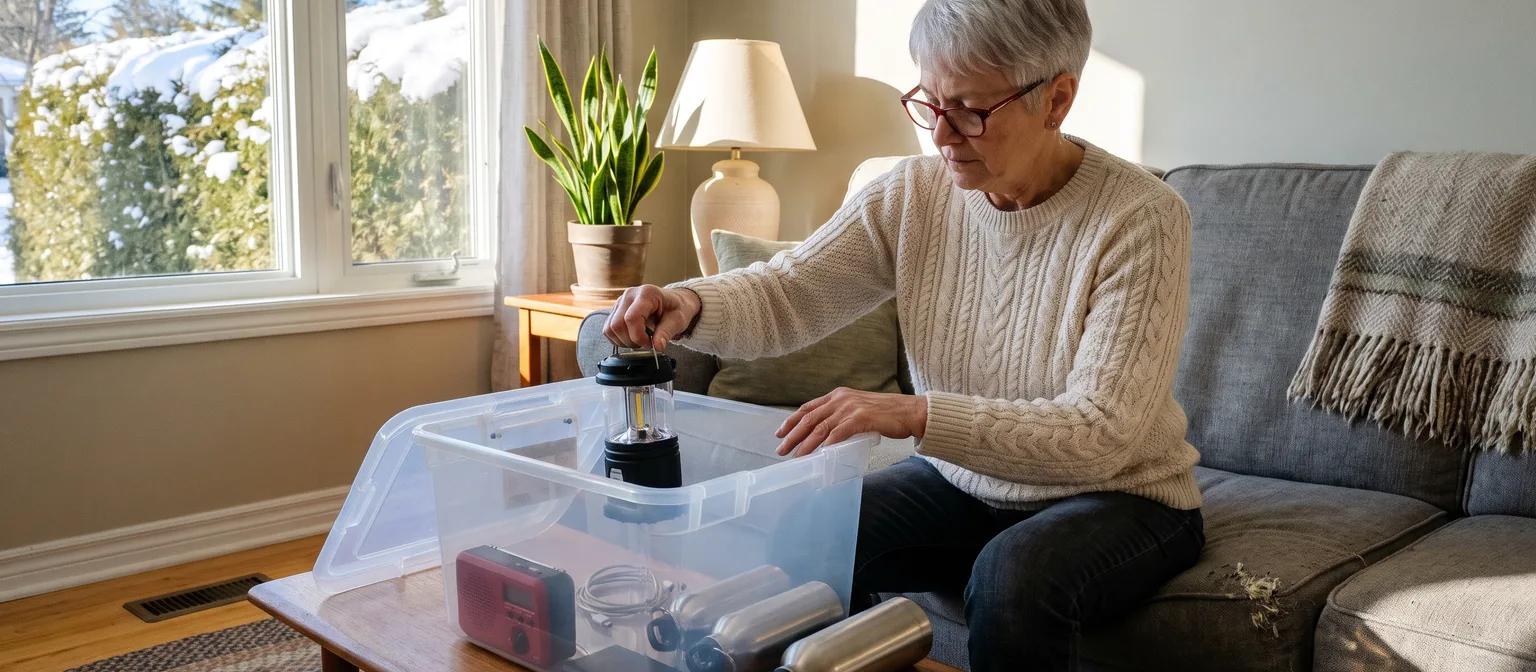
Get Prepared says to be ready to look after yourself for at least 72 hours. For one person, that means at least 6 litres of water and three days of food that needs no cooking or fridge. Add a flashlight, a radio, spare batteries, a power bank, a first aid kit, cash and your medication.
Get Prepared's emergency kit checklist sets at least two litres of water per person per day, for drinking, cooking and washing, and its emergency kits page suggests about four. So three days for one person is at least 6 litres, and 12 is better. The rest of the basic list:
- Non-perishable food, like canned food, energy bars and dried food, plus a manual can opener
- A wind-up or battery-powered flashlight and radio, with extra batteries
- A phone charger and a power bank
- A first aid kit
- Extra house and car keys
- Cash in small bills and coins
- Toilet paper and tissues
- A written list of your medications, the dose and what each is for, with your doctor's number and your health card number
For a Canadian winter, the checklist adds warm clothing, gloves, socks, heat packs and ice grippers for your boots. Keep it all in one bin or bag in an easy spot, like the front hall closet.
A useful habit from the same guide: check the kit when the clocks change in spring and fall, and swap out anything that has expired. For a fuller list that covers floods, wildfire smoke and evacuation, see our emergency preparedness guide for Canadian seniors.
How to prepare for a power outage in winter: heat, cold and carbon monoxide
In winter, a long outage means cold, and some ways of staying warm are dangerous. Never bring a barbecue, camp stove or fuel-burning generator inside, not even into the garage with the door open. Get Prepared says portable fuel generators belong at least 6 metres (20 feet) from the house.
You cannot see or smell carbon monoxide. That is why Get Prepared asks every home to have working carbon monoxide alarms and smoke alarms with battery backups. Check those batteries now, before a storm.
Some safer ways to stay warm, from the same guidance:
- A natural gas fireplace can keep you warm until the power is back.
- A natural gas stove can be used to cook, but not to heat the room.
- Battery-powered or solar portable generators do not produce carbon monoxide.
- Do not idle your car in the garage to warm up or charge your phone, even with the door open.
- After snow, check that the outdoor exhaust vents for your furnace and other fuel-burning appliances are clear of snow and ice.
If the carbon monoxide alarm goes off, leave the house right away, without looking for the cause. Call 9-1-1 once you are outside, and do not go back in until a qualified professional says it is safe.
If the house gets too cold to stay, that is what the "where I could go" line in your plan is for. Our guide to winter safety for seniors in Canada covers dressing for the cold, ice and getting around in winter.
Food, medication and powered medical devices
Health Canada says an unopened fridge keeps food cold for about 4 hours. A full freezer keeps food frozen for about 48 hours, and a half-full one for about 24. Keep both doors closed, and throw out food that has been at room temperature for 2 hours or more.
Two more rules from Health Canada surprise people. Do not put frozen food outside, even in winter: animals can get into it, and the sun can thaw it on a cold day. And when food has been sitting out, "when in doubt, throw it out."
Medication. If you take insulin or another medicine kept in the fridge, plan ahead with your pharmacist. Diabetes Canada says the insulin you are using can stay at room temperature for up to 30 days, but storage differs from one product to the next, so check yours. HealthLink BC adds that insulin should not get colder than 2°C, which is another reason not to leave it outside.
Diabetes Canada suggests keeping at least one to two weeks of diabetes supplies on hand. Get Prepared suggests a couple of weeks of medication in general, if you can. If you live with diabetes, our post on how diabetes management changes for Canadian seniors covers the day-to-day side.
Powered medical devices. If you use an oxygen concentrator, a CPAP machine, a home dialysis unit or another device that runs on electricity, talk to your health-care provider about a backup plan now. Then tell your hydro company:
- Ontario (Hydro One): customers who rely on electrically powered devices can apply for life support notification with a medical form. Hydro One says it will do its best to contact people on the list during outages.
- Quebec (Hydro-Québec): if you use a life-sustaining device such as a ventilator, an oxygenator or a pump, call 1 888 385-7252 to register, and fill out a form with your doctor. You will get a call at least 72 hours before a planned interruption.
- British Columbia: BC Hydro asks people who rely on life-support devices to contact their regional health authority, and to have a backup power source and a place to go.
Being on Hydro-Québec's list does not move you to the front of the line: it says plainly that restoring power to your home will not be prioritized. Hydro One also recommends a backup power supply. Plan for the backup, and the list is a bonus. If your utility is not one of these three, call it and ask what it offers.
Who could you contact, and who could check on you?
Pick at least one person nearby and one further away, and agree on a check-in before the storm, not during it. The Canada Safety Council says to keep their phone numbers somewhere other than your cellphone, because a dead phone takes your contact list with it.
A neighbour is often the best first name. They are close enough to knock on the door, and they may be dealing with the same outage. A relative across town or in another city can call you, check the news and arrange a place to stay. If you are able, the council suggests offering to check on someone else, too.
Get Prepared is honest about phones. In an outage, it says, "you may also lose internet and phone service." Its kit guide adds that a cordless home phone or a cellphone may not work if the power or the cell network is down. So keep a power bank charged, and a battery or wind-up radio for news.
Get Prepared also suggests enrolling in a medical alert program and making sure it will work during a power outage. That is a fair question to ask any provider, so here is the plain answer for ours. Holo Alert devices place alert calls over their own cellular connection, so they do not need a landline, home internet or a smartphone. They do run on a rechargeable battery and need cellular service to be available, like any cellphone.
In the standard Always On mode, Holo Pro typically lasts about 2 to 3 days and Holo Mini about 1 to 2 days; Holo Active lasts up to 48 hours. Battery life varies, so charge daily, and charge fully when a storm is in the forecast. If an outage could last longer than one charge, plan how you would recharge it. Our guide to medical alert systems without a landline explains how cellular devices work.
Can you flush the toilet during a power outage?
If your home is on city water, the toilet usually still flushes during a power outage. On a private well, it is different. Health Canada says not to flush, shower or run the taps while the power is out. The electric pump keeps the water pressure up, and using the water can let contamination in.
BC Hydro says water keeps running in most homes during an outage, but there are exceptions, so be ready to go without it either way. One simple tip from BC Hydro: fill the bathtub before a storm, and use that water to flush the toilet and wash dishes.
If you are on a well, Health Canada says to have your water tested before you use it if the system loses all its pressure. When the power comes back, let the water run for a few minutes first. In winter, Get Prepared also warns that pipes can freeze during a long outage, so learn where your main water shut-off is now.
Frequently asked questions
Do elevators work in a power outage?
Plan as if they will not. Get Prepared advises planning a way out of your building without the elevator, and telling your property management ahead of time if you would need help leaving. The Canada Safety Council names the elevator as one of the things an outage can interrupt, so put it on your plan.
How long does a power outage last?
Health Canada says that depending on the cause, a power outage can last hours, days or even weeks. That is why Get Prepared asks every household to be ready to look after itself for at least 72 hours. Your hydro company's outage map or line gives the estimate for your area.
Will my gas fireplace work in a power outage?
According to Get Prepared, a natural gas fireplace can provide warmth until the power is back on. A natural gas stove can be used for cooking, but not as a heater. Never use a barbecue, camp stove or fuel-burning generator indoors, because of carbon monoxide.
What to do during a power outage at night?
Keep a flashlight within reach of your bed, so you are not walking in the dark looking for one. Use flashlights rather than candles, which Get Prepared says lowers the fire risk. Leave one light switched on, so you will know when the power returns, and go back to sleep warm if you can.
Start with one conversation
You do not have to build all of this today. Fill in the five lines of your outage plan and put the paper on the fridge. Then call the first person on your "who I could contact" line and agree on a check-in.
After that, add one kit item each time you shop. By the next storm, you will have both a plan and the people to carry it out with you.
Get our emails, starting with three free guides
Benefits and programs, a home safety checklist and choosing a medical alert, one at a time.