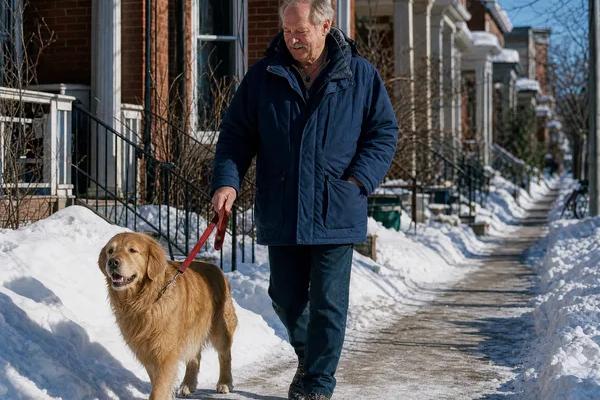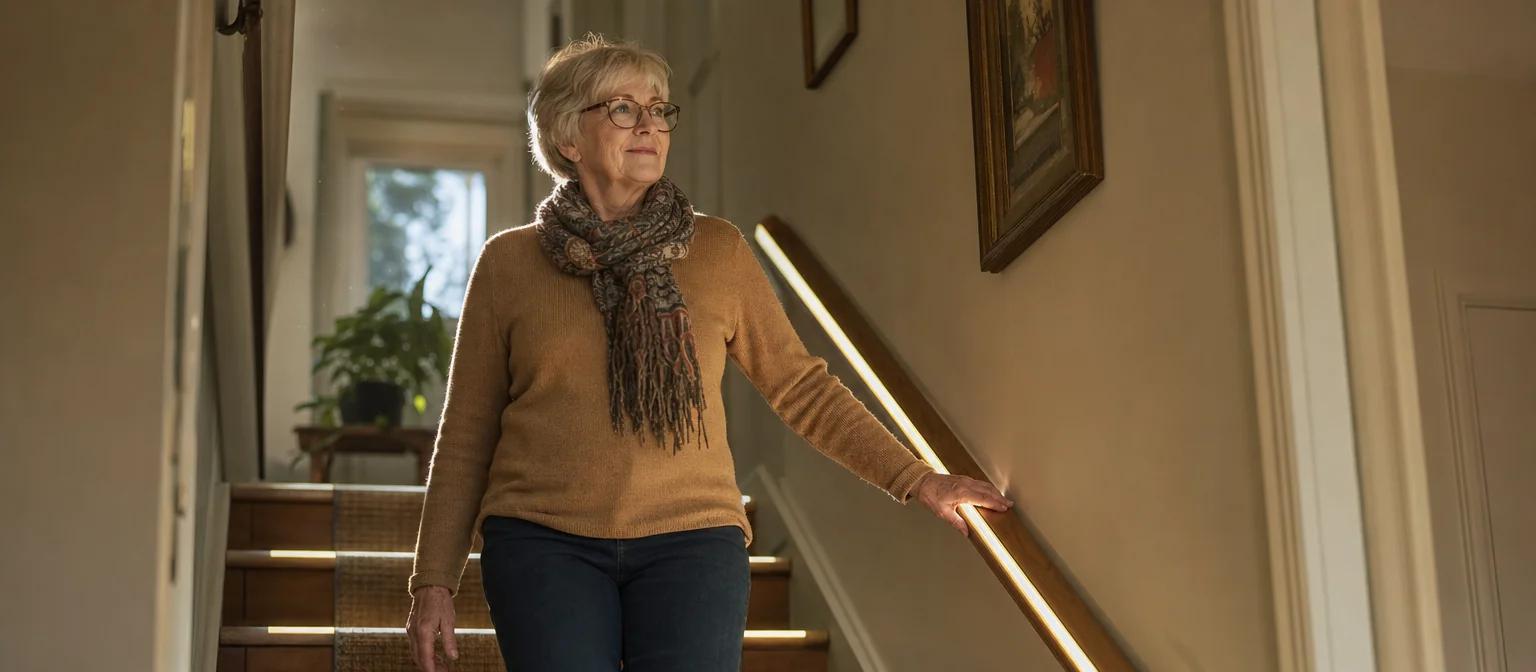
Your mother has always been steady on her feet. Then you notice small things. She reaches for the railing she never used to need. She hesitates at the top of the basement stairs. She trips on the edge of a rug that has been in the same spot for twenty years.
It is easy to chalk this up to "slowing down." But there may be a quieter explanation, and it has nothing to do with her legs. It is her eyes.
Vision changes happen so gradually that most people, and most families, never connect them to safety. Yet the science is clear: as eyesight fades, the risk of a serious fall climbs sharply. The good news is that this is one of the most modifiable fall risks there is. Once you understand the connection, you can act on it.
This guide explains how aging vision drives falls, the specific changes to watch for, and a practical plan to protect both your sight and your footing.
The hidden link between eyesight and falling
Falls are the leading cause of injury-related hospitalization and death for Canadians aged 65 and older. About one in three Canadian seniors falls each year, according to the Public Health Agency of Canada. In 2022, falls sent more than 78,000 older Canadians to hospital and were linked to 7,621 deaths, a 51% jump since 2017. Roughly a third of those hospital stays involved a hip fracture.
Here is the part most people miss. Your eyes are not just for seeing. They are a core part of how you stay upright.
Balance depends on three systems working together: your vision, your inner ear (the vestibular system), and your sense of body position (proprioception). Vision is the system that scans ahead, spots the curb, reads the surface, and tells your body where it is in space. When one of the other two systems weakens with age, the brain leans even harder on the eyes to compensate. Researchers call this "sensory reweighting." In plain terms: the older we get, the more our balance depends on clear vision, not less.
That is why even mild vision loss matters so much later in life. Peer-reviewed research consistently finds that visual impairment roughly doubles an older adult's risk of falling. A widely cited 2018 review in the Journal of Physiological Anthropology found that poor depth perception alone was linked to a 2.5 times higher risk of repeated falls.
The takeaway: Failing vision does not just make the world blurrier. It removes the early-warning system your body relies on to catch a stumble before it becomes a fall.
4 age-related vision changes that raise fall risk
Not all vision loss looks the same, and each type creates its own kind of danger. Understanding the difference helps you know what to watch for. (None of the below is a substitute for a professional eye exam, which we cover later.)
1. Cataracts: blur, glare, and fading contrast
Cataracts are the most common cause of vision loss in Canada, and nearly everyone develops some lens clouding with age. The Canadian Ophthalmological Society reports that 75% of Canadians who have cataracts are over 60.
Cataracts blur vision, increase sensitivity to glare, and wash out contrast. Glare from sunlight or a bright bulb can briefly "white out" someone's sight at the worst possible moment, like stepping off a curb. Lost contrast means steps, curbs, and floor transitions blend together and are hard to see until they are already underfoot.
The encouraging news: cataract surgery may help. A 2021 meta-analysis found that first-eye cataract surgery was associated with about a 32% reduction in falls. It is increasingly recommended as part of a complete fall-prevention plan.
2. Glaucoma: losing the edges of your world
Glaucoma slowly damages the optic nerve and erodes peripheral (side) vision, sometimes described as "tunnel vision." It is especially dangerous because the lower field of vision, the part you use to spot obstacles near your feet, is often affected. Worse, glaucoma rarely causes symptoms early on. Nearly 40% of Canadians with glaucoma do not know they have it.
Because there are no early warning signs, regular eye exams are the only reliable way to catch it before damage is done.
3. Age-related macular degeneration: the center goes dark
AMD is the leading cause of significant vision loss in Canadians over 50. Roughly 2.5 million Canadians live with some form of it. AMD attacks central vision, the sharp detail in the middle of your view, while side vision is often preserved early on.
For balance, the biggest problem is depth perception. People with AMD struggle to judge distance, which makes stairs, curbs, and uneven ground genuinely treacherous. Telling where one step ends and the next begins becomes a daily hazard.
4. Everyday aging changes (even without a diagnosis)
You do not need an eye disease to be at risk. Normal aging brings:
- Reduced contrast sensitivity so edges and steps fade into their surroundings
- Slower dark adaptation so moving into a dim hallway or stairwell is briefly blinding
- Declining depth perception so step height and reaching distance are harder to judge
- Increased glare sensitivity so ordinary light scatters and dazzles
Here is a detail almost no one knows: contrast sensitivity, not the standard eye-chart score, is one of the most consistent predictors of falls. A senior can pass the classic "read the letters" test and still have dangerously poor contrast vision. It is worth asking an optometrist to check it directly.
One more surprising culprit: multifocal and progressive lenses. Research going back to 2002, and confirmed by a 2025 clinical trial, found that people who wear them are more than twice as likely to fall, because the lower part of the lens blurs contrast and depth exactly when you look down at stairs or obstacles.
Warning signs a loved one's vision is putting them at risk
Vision decline is gradual, and the people experiencing it often adapt without realizing how much they have lost. As a family member, you are often the first to notice. Watch for these signs:
Moving and navigating:
- Misjudging steps, curbs, or floor transitions, or reaching for a step that isn't there
- Bumping into furniture, doorframes, or people approaching from the side
- Slowing down noticeably on stairs or in unfamiliar rooms
- Reaching for walls and railings more than before
Light and dark:
- Squinting or complaining that ordinary lights are too bright
- Needing extra time to adjust when coming indoors from outside
- Avoiding driving at night, or giving it up entirely
Daily life:
- Pulling back from evening activities or events they used to enjoy
- New clumsiness with small tasks like buttons, needles, or picking up objects
- Missing turns on a familiar route
Direct red flags (book an exam promptly):
- A blurry or dark spot in the center of vision
- Halos around lights at night
- Straight lines that appear wavy or distorted
- Any sudden flashes, new floaters, or curtain-like loss of vision (treat these as emergencies)
If vision changes are showing up in one part of life, they are almost certainly affecting others. Difficulty on the road, for example, often signals trouble at home too. Our guide to the 7 signs your aging parent should stop driving covers the overlap in more detail.
How to protect your sight and your footing
This is the part that matters most, because nearly every vision-related fall risk can be reduced. Here is the plan.
Book a comprehensive eye exam (and know your provincial coverage)
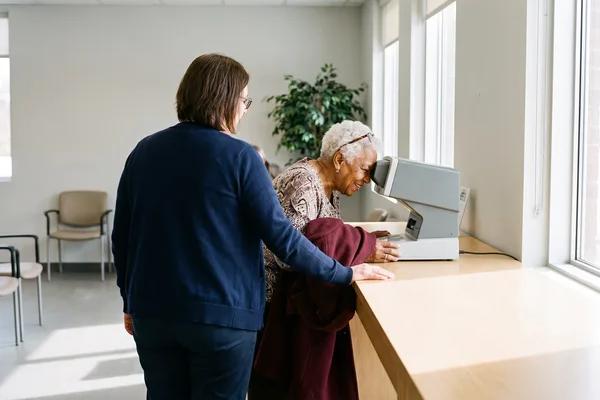
The single most important step is a thorough eye exam. The Canadian Association of Optometrists recommends seniors 65 and older have a comprehensive eye exam every year. Regular exams catch silent conditions like glaucoma before they steal vision, and they keep prescriptions current.
What it costs depends on where you live. Public coverage for routine senior eye exams varies widely across Canada:
| Province | Routine exam coverage for seniors 65+ | Frequency |
|---|---|---|
| Ontario (OHIP) | Covered | Every 18 months, or annually with a diagnosed eye condition |
| Alberta (AHCIP) | Covered | One full exam per benefit year |
| Quebec (RAMQ) | Covered | Annually |
| Manitoba | Covered | Every 2 years |
| Nova Scotia | Covered | Every 2 years |
| British Columbia (MSP) | Only when medically required | Varies by condition |
| Saskatchewan | Supplementary (low-income) only | Annually |
| New Brunswick / PEI / N.L. | Limited; social assistance only | Varies |
Coverage details change. Confirm current rules with your provincial plan or optometrist before booking. Source: Canadian Association of Optometrists, Overview of Provincial Coverage for Optometric Care, December 2024.
The takeaway for families: in British Columbia and Saskatchewan especially, a routine exam may not be covered unless a medical condition is documented. Do not let cost uncertainty become a reason to skip a visit that could prevent a hip fracture.
Light your home for aging eyes
Lighting may be the highest-impact change you can make. One study found that for people with glaucoma, each tenfold increase in room lighting was linked to 35% fewer falls, rising to nearly half among those with mild field loss.
Focus on the darkest, most dangerous zones: hallways, stairs, and the path from the bedroom to the bathroom. Add motion-sensor night lights at floor level so there is never a dark gap while eyes adjust. Our full guide to how better home lighting reduces fall risk walks through it room by room.
Add contrast and remove hazards
When eyes cannot see edges, make the edges obvious:
- Put bright contrasting tape on stair edges so each step stands out
- Use high-contrast switches, handles, and doorframes
- Remove or secure loose rugs, the single most common trip hazard
- Install handrails on both sides of every staircase and grab bars in the bathroom
Quick tip: If your parent wears progressive or bifocal lenses, ask their optometrist about a dedicated pair of single-distance glasses for stairs and outdoor walking. It is a small change that addresses a proven risk.
Keep moving
Strong muscles and good balance are your backup when vision falters. Exercise remains one of the most effective fall-prevention tools we have. A landmark Stanford study found Tai Chi cut falls by 58% compared with standard stretching. Gentle, vision-friendly options work too: our balance exercises to prevent falls are a safe place to start.
When prevention isn't enough: a safety net for falls
Here is the honest reality. Even with annual exams, bright lighting, and daily exercise, vision loss raises the odds that a fall will eventually happen. And when someone with reduced vision does fall, they may struggle to find a phone or even see clearly enough to call for help.
That is the gap a medical alert system is built to close. With one press of an SOS button, a person is connected by two-way voice to a real, trained responder, no need to find a phone or read a screen. For falls where pressing a button isn't possible, automatic fall detection can recognize a hard fall and call for help on its own.
Fall detection does not detect all falls. Gradual slides, slow collapses, or certain movements may not trigger an alert. Customers should press the SOS button manually if able.
For a family, this is peace of mind: knowing that if Mom's eyes let her down on the stairs, she is never facing it alone. You can learn more in our guide to how fall detection works for seniors in Canada.
A medical alert does not replace good prevention, and it does not replace 911 or emergency medical services. It is the safety net underneath everything else you have put in place.
Frequently asked questions
Can poor eyesight really cause falls?
Yes. Vision is one of the three systems that keep you balanced, and it becomes more important with age, not less. Peer-reviewed research consistently finds that visual impairment roughly doubles an older adult's risk of falling, with poor depth perception and contrast sensitivity being especially strong predictors.
Does cataract surgery reduce fall risk?
In most studies, yes, particularly first-eye surgery. A 2021 meta-analysis found first-eye cataract surgery was associated with about a 32% reduction in falls. It is increasingly recommended as part of a complete fall-prevention plan. Talk to an ophthalmologist about timing.
How often should a senior get an eye exam in Canada?
The Canadian Association of Optometrists recommends a comprehensive eye exam every year for adults 65 and older. Public coverage varies by province, so check your provincial plan before booking.
What is the most dangerous time of day for vision-related falls?
Transitions between bright and dim light are highest risk, because aging eyes adapt slowly. Coming indoors from outside, or walking from a lit room into a dark hallway, leaves a window of near-blindness. Good lighting and floor-level night lights directly target this risk.
Protect what matters most
Your eyes are part of how you stay on your feet. Treating vision care as fall prevention, not just "seeing better," can keep a loved one steady, confident, and independent for years longer.
Start with an eye exam. Brighten the home. Keep moving. And put a safety net in place for the moments prevention can't catch. To talk through which Holo Alert device fits your family, call us at 1-888-445-0192. Every plan is backed by our 10-day risk-free guarantee, so you can make sure it's the right fit with complete peace of mind.