The Invisible Hazard: How Poor Lighting Causes Falls in Canadian Homes
It is a frightening reality: 60% of falls among older adults happen right inside their own homes. We often blame these accidents on slippery rugs or poor balance, but there is a silent predator lurking in the hallways of many Canadian seniors: inadequate lighting.
As we age, our eyes undergo physiological changes that drastically reduce the light reaching the retina. A dim hallway that was navigable in your 40s becomes a treacherous obstacle course in your 70s. For seniors and caregivers, "mood lighting" is a luxury you cannot afford. You need safety-grade illumination.
With our long Canadian winters and short daylight hours, relying on natural light is a recipe for disaster. Implementing a strategic lighting plan is not just home improvement; it is fall prevention. However, even the brightest home cannot prevent every accident. That is why lighting must be paired with a reliable safety net.
Key Takeaways
- Lighting is a primary risk factor: Poor visibility is an independent predictor of falls, directly leading to fractures and hospitalizations.
- Transition zones are traps: The shift from carpet to hardwood, or bedroom to bathroom, requires specific lighting strategies to prevent missteps.
- Biology works against you: Aging eyes need significantly more light and contrast to detect hazards than younger eyes.
- Technology fills the gap: Motion sensors and fall detection technology are essential layers of protection when physical vigilance fails.
- Maintenance is mandatory: A burnt-out bulb or a dead battery in a sensor is an immediate threat to your safety.
Why Lighting Matters for Fall Prevention
Falls are not accidents; they are often the result of an environment that fails to support the person living in it. Studies indicate that lighting is an independent predictor of fall risk. For older adults, adequate lighting is the only thing compensating for age-related impairments in vision, cognition, and physical balance.
If you cannot see the edge of the stair tread or the threshold of a doorway, you are gambling with your mobility every time you take a step. Visibility and contrast are your primary defenses. You need to detect hazards—a crumpled rug, a wet patch, a stray slipper—with enough time to react.
Age-related vision changes, including reduced contrast sensitivity and slower adaptation to light changes, make standard residential lighting insufficient. A 60-watt bulb that was sufficient years ago may now leave you navigating in what your eyes perceive as semi-darkness.
The Holo Alert Difference
While proper lighting helps you see the risk, it cannot physically catch you if you slip. A sudden drop in blood pressure or a dizzy spell can cause a fall in a fully lit room. This is why thousands of Canadians rely on medical alert systems. Holo Alert provides the necessary backup, ensuring that if a fall occurs despite your best efforts, help is on the way immediately.
How to Assess Your Home Lighting Safety
Before you rush to the hardware store, you must conduct a ruthless assessment of the current living environment. You are looking for "danger zones"—dark routes, transitions between flooring types, thresholds, and stairs. Lighting deficiencies are dangerously common; if care facilities often fail to meet recommended lighting levels, your private home is likely falling short as well.
Your Assessment Checklist
- Measure light levels: Use a smartphone light meter app to identify areas that are objectively too dim in the evenings.
- Identify visibility gaps: Note areas that become dangerously dark during Canadian winter afternoons when the sun sets early.
- Check hardware: Burnt-out bulbs and flickering switches are immediate hazards. Replace them now.
- Assess glare and contrast: Look for unshielded bulbs reflecting off shiny floors. Glare can be just as blinding as darkness.
- Document critical pathways: The route between the bedroom and the bathroom is the "Red Zone." This is where nighttime urgency meets drowsiness, creating a high fall risk.
Looking for peace of mind? Shop the Holo Alert Pro.
Low-Cost Interventions That Work Immediately
You do not need a renovation contractor to save yourself from a hip fracture. Simple, low-cost interventions can have an immediate impact. Start by increasing bulb wattage (within the fixture's safety rating) to brighten rooms. Replace dim, yellow bulbs with high-CRI (Colour Rendering Index) LED bulbs to improve your ability to see edges and contrast.
Nightlights are non-negotiable. Install them in hallways, specifically models with automatic motion sensors or dusk-to-dawn activation. Fumbling for a switch in the dark is a common cause of loss of balance. These lights ensure the floor is illuminated the moment your feet hit the ground.
However, hardware has limits. Storms and ice can knock out power in your neighbourhood for hours. Standard plug-in nightlights become useless in a blackout. This is where Holo Alert stands apart. Our systems are equipped with long-lasting battery backups, ensuring you are connected to emergency help even when the rest of your house goes dark.
Motion Sensor Lights and Smart Options
Fumbling for a light switch requires dexterity and balance that may be compromised at night. Motion-activated lighting solves this by removing the physical act of turning on a light. These systems activate illumination the moment movement is detected, ensuring you never step into a blind spot.
Advanced tunable lighting systems can also mimic natural circadian rhythms—brighter, cooler light during the day to keep you alert, and warmer, dimmer light at night to prepare you for sleep. This biological regulation helps prevent the daytime drowsiness and confusion that often lead to falls.
| Feature | ✅ Holo Alert Safety Standard | ❌ Generic Home Lighting |
|---|---|---|
| Activation | ✅ Automatic / Always On Monitoring | ⚠️ Manual Switches (Requires Balance) |
| Power Outage | ✅ Battery Backup Built-In | ❌ Lights Out / Total Darkness |
| Fall Event | ✅ Detects Fall & Calls Help | ❌ Illuminates the Fall, No Help Sent |
| Coverage | ✅ Everywhere (GPS Mobile Options) | ⚠️ Fixed to One Room |
Room-by-Room Priorities
Different areas of your home present unique risks. Research highlights the bedroom and bathroom as the highest-priority areas. The bathroom is particularly dangerous due to hard surfaces and water hazards. In fact, many seniors remove their medical alerts while bathing—a critical mistake. Waterproof medical alert systems are designed specifically for this environment.
| Area | Intervention | Rationale |
|---|---|---|
| Bedrooms | Install bedside lamps and low-profile nightlights. | Most falls occur here; residents navigate this space while groggy. |
| Bathrooms | Use glare-reduced overhead lighting and motion-sensor nightlights. | High-risk zone for slips; often inadequately lit for nighttime visits. |
| Hallways | Add motion-sensor lights or dusk-to-dawn units. | The main artery of the home; automatic activation prevents reaching. |
| Stairs | Ensure overhead lighting at top/bottom; mark step edges. | Shadows on stairs can hide the edge, leading to catastrophic falls. |
Selecting Bulbs: LEDs and Glare Reduction
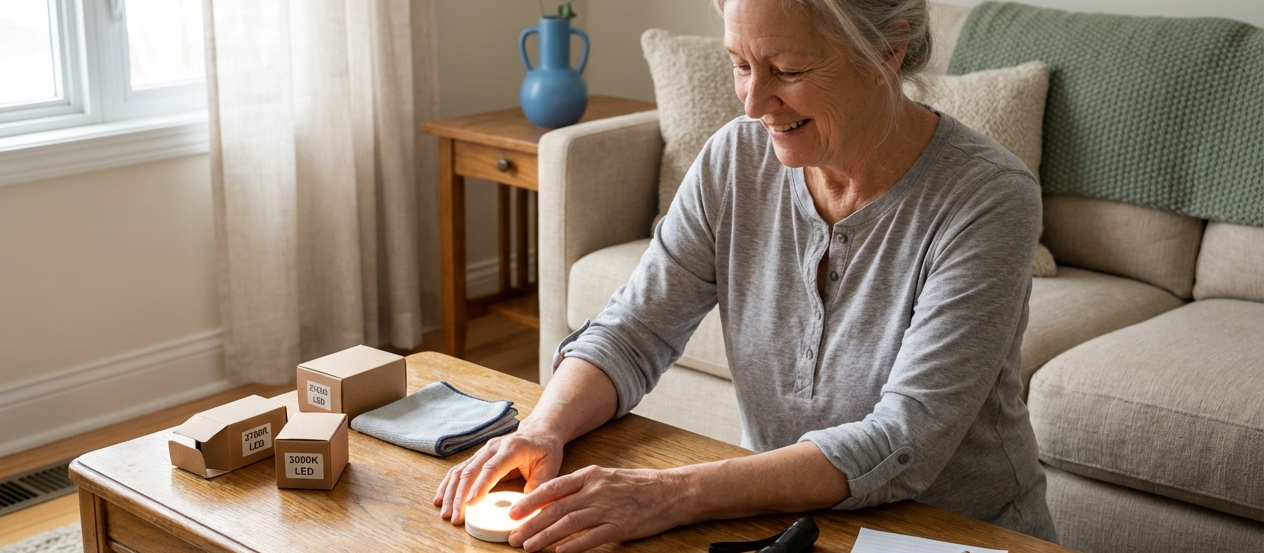
Choosing the right light bulb is about science, not just wattage. LED bulbs are the standard because they offer energy efficiency and specific colour temperatures. For seniors, we recommend:
- Daytime: Cool light (4000K–5000K) to mimic sunlight and support alertness.
- Evening: Warm light (2700K–3000K) to help the brain prepare for sleep.
- CRI: Look for a Color Rendering Index of 80 or higher. This improves your ability to distinguish the contrast between a floor and a rug.
Don't leave safety to chance. Shop the Holo Alert Pro.
Maintenance: The Safety Step You Can't Skip
Installing new lights is only the first step. Dust accumulation on bulbs can reduce brightness significantly over time, and a dead battery in a motion sensor creates a false sense of security. Establish a strict maintenance routine:
- Replace bulbs immediately: Never wait for a second bulb to burn out.
- Check batteries quarterly: Inspect batteries in motion sensors and portable lights.
- Clean fixtures: Wipe down shades and covers to remove dust and improve brightness.
Frequently Asked Questions
How does lighting affect sleep and fall risk?
Lighting directly influences your circadian rhythm. Proper lighting—bright during the day and warm at night—ensures better sleep quality. Poor sleep leads to daytime drowsiness and reduced cognitive function, which drastically increases the likelihood of stumbling or falling.
What is the best colour temperature for senior housing?
There is no single "best" temperature. Use cool light (4000K–5000K) during the day to boost alertness and visibility. Switch to warm light (2700K–3000K) in the evenings to reduce glare and support natural sleep cycles.
Where is the most critical place to install nightlights?
The "Red Zone" path from the bedroom to the bathroom is critical. This is where urgency meets disorientation. Install motion-sensor nightlights along this entire route to ensure continuous visibility without fumbling for switches.
Can higher wattage bulbs prevent falls?
Yes, increasing brightness helps make obstacles visible. However, you must manage glare. A bright bulb without a diffuser can temporarily blind a senior. Use frosted shades and ensure the fixture is rated for the higher wattage.
Secure Your Peace of Mind Today
Adequate lighting is a cornerstone of fall prevention, but it is not a guarantee. You can install every motion sensor and LED bulb on the market, but you cannot predict a sudden dizzy spell or a medical emergency. Do not wait for a "near miss" to realize you need more protection. By combining a well-lit home with the 24/7 protection of Holo Alert, you ensure that you remain independent, safe, and secure in the home you love.