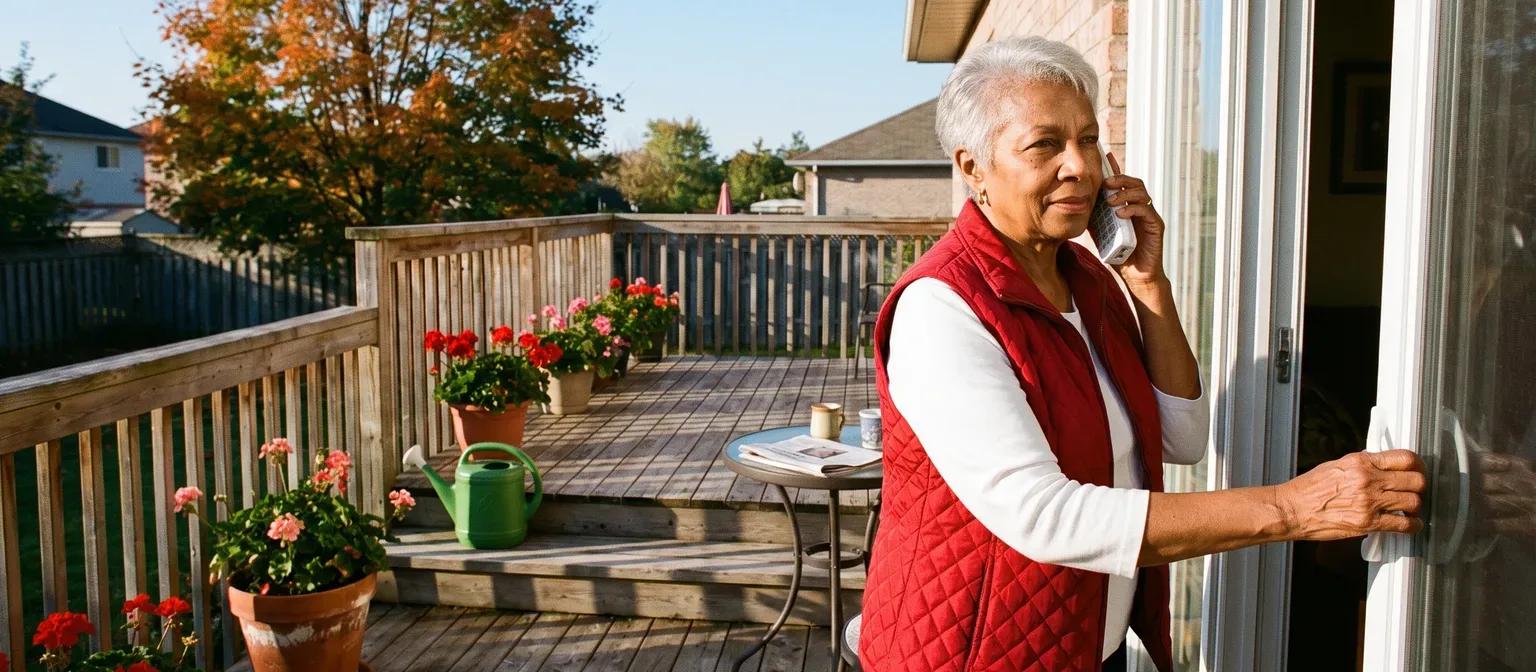
The grandparent scam is a phone call. Someone claims to be your grandchild, or to be calling on their behalf, and says they are in trouble and need money today for bail, a lawyer, a hospital bill or an ambulance. The Canadian Anti-Fraud Centre (CAFC), Canada's national fraud reporting centre, calls it the emergency scam.
It works because it is not really a story about money. It is a story about someone you love being hurt and frightened, told by a stranger who has ten minutes to keep you from thinking clearly.
This post covers what the call sounds like, the phrases that give it away, exactly what to do while the phone is still in your hand, and how to set up a family code word so the next call ends in about four seconds.
What is the grandparent scam?
A caller claims to be your grandchild, or to be calling for them, and asks for money right away. The CAFC describes it plainly: the call usually arrives on a home phone, and the caller says they need money as soon as possible for bail, lawyer's fees, hospital fees or ambulance fees. The payment, they say, is needed immediately to avoid jail or to get out of it.
The scale is not small. The CAFC reported in April 2024 that, by its own data, the emergency scam had taken more than 23 million dollars across Canada. The release did not say over what period.
Fraud overall is bigger still. Canadians reported losing over 704 million dollars to fraud in 2025, and about 351 million dollars in the first six months of 2026 alone, according to the CAFC. Those totals only count people who told someone. The CAFC estimates that just 5 to 10 per cent of fraud is ever reported.
What does a grandparent scam call sound like?
It sounds like a crying grandchild, then a calm professional. The caller opens upset and hard to place, which explains away a voice that does not quite match. They say there has been a car accident, or an arrest at a checkpoint. Then they hand the phone to someone who sounds official.
The CAFC says fraudsters impersonate all three roles: the grandchild, the lawyer and the police officer. The second voice does the real work. It supplies a file number, a courthouse, a deadline, and a reason you cannot call anyone to check.
That reason is usually a made-up gag order. The CAFC lists it as a standard feature of the script: the caller claims a court has barred you from discussing the case, including with your own family. RCMP British Columbia puts the counter-move just as plainly, telling people to verify with other family members "even if they say don't tell mom and dad."
Most of these calls land on a home phone, often in a quiet house in the middle of the day. If you are the family member who worries about a parent managing alone, our safety guide for seniors living alone in Canada covers the wider picture this call is one part of.
Six phrases that give it away
Every row below is drawn from how the Canadian Anti-Fraud Centre and RCMP British Columbia describe these calls. If you hear two of these six in one phone call, you are being worked.
| What you hear | What it is actually doing |
|---|---|
| "Grandma, it's me. I'm in trouble." | Letting you supply the name. A shaky voice covers the mismatch, and you fill in the grandchild yourself. |
| "I need bail money today or I stay in jail." | Attaching a deadline to the fear. Urgency is the whole mechanism. |
| "I'm passing you to my lawyer now." | Handing off to a second, calmer voice that sounds official and supplies fake details. |
| "There's a gag order. Don't tell Mom and Dad." | Cutting you off from the one phone call that would end this in seconds. |
| "A courier will come to the house for the cash." | Moving money in a form nobody can reverse or trace. Cash, cryptocurrency and gift cards all work the same way for them. |
| "Stay on the line with me until it's done." | Keeping you from hanging up, because hanging up is what stops it. |
No Canadian court lets anyone post bail with cash handed to a courier, with gift cards, or with cryptocurrency. The Canadian Anti-Fraud Centre says so plainly.
Why do scammers target grandparents?
Because the script only needs one thing to be true: that you love someone enough to act fast. Nothing about falling for this call says anything about a person's judgment. It says the caller found the one subject nobody is calm about.
Two other things make the call land. Grandparents often do not know exactly where a grandchild is on a given Tuesday, so "I'm in Montreal" cannot be immediately checked. And the gag order is designed to isolate, because one sentence to a spouse or a neighbour would end it. Being in regular contact with people is a genuine defence here, which is one more reason staying socially active as you age matters beyond the health benefits.
The technology has caught up too. Lethbridge Police Service warned in August 2024 that scammers were using artificial intelligence to copy grandchildren's voices in exactly these calls, asking for nine to ten thousand dollars in bail. A voice that sounds right is no longer proof of anything.
None of this is a fringe crime committed by amateurs. In April 2024 the Ontario Provincial Police charged 14 people with 56 offences in an investigation called Project Sharp, with arrests in Montreal and Laval. Police said the group had taken about 2.2 million dollars since February 2022. In under three months alone, officers identified 126 victims across Canada who lost roughly 739,000 dollars, and police said they were working with banks to recover at least 559,000 dollars of it, CBC News reported. One of the accused, Erin Rud, was found guilty of fraud over 5,000 dollars and sentenced in February 2026 to 18 months in the community.
Canadians aged 60 and over made up 23.4 per cent of everyone who reported being defrauded in 2024, up from 15.5 per cent in 2021, and lost at least 179.9 million dollars that year, according to federal figures drawn from CAFC data.
What to do if you get the call
Hang up, then call the person back on the number you already have. That one move ends almost every version of this call. Here is the full sequence, straight from the CAFC and RCMP British Columbia.
- Say you will call back, and hang up. You do not owe a stranger an explanation. The CAFC's own advice is to hang up the phone.
- Call your grandchild yourself. Use a number already in your phone or on the fridge, never a number the caller gave you.
- If nobody answers, call somebody else in the family. Ring their parent, a sibling, anyone who would know where they are. Ignore the gag order. It is not real.
- If the caller claimed to be police, call the police yourself. Look the detachment number up or use one you already have, and never a number from the call.
- Send nothing. No cash, no cryptocurrency, no gift cards, no envelope, no courier at the door. The CAFC's line is to never send funds to unknown people, unverified addresses or bank accounts.
- Report the call even if you sent nothing. The CAFC number is 1-888-495-8501, open weekdays from 10:00 a.m. to 4:45 p.m. Eastern time. You can also report online at reportcyberandfraud.canada.ca, anonymously if you prefer.
You do not need to be polite about step one. Every extra minute on the line is a minute the script is designed to use.
How to set up a family code word
Agree on one word now, and the whole script collapses the next time it runs. Two Canadian organisations recommend it. Desjardins tells families to "come up with a codeword" and to ask for it when a caller asks for money. Edmonton Police Service says to set a safe word or phrase "that includes details only you would know."
It takes one conversation. Pick a word nobody could guess and nobody has posted online, so not a pet's name, not a street you lived on, not a grandchild's middle name. A specific object from a shared memory works well. Tell every adult in the family in person or by phone, never by email or social media. Write it somewhere private at home if that helps you remember it.
Then agree on the rule that gives it teeth: anyone who calls asking for money gets asked for the word, with no exceptions and no hurt feelings. A real grandchild in real trouble will not mind. A caller who cannot produce it will hang up on you, which saves you the trouble.
This is a good conversation to have alongside the other family paperwork nobody enjoys. If you are already planning one of those visits, our list of the legal documents Canadian caregivers should sort out before a crisis fits naturally into the same afternoon.
If money already went out
Move fast, and do not spend one minute on shame. The people who built this script do it for a living, to thousands of people. Here is the order the CAFC and the Canadian Bankers Association give.
- Call the financial institution that sent the money. Use the number on your card, in the official app, or on the official website. The Canadian Bankers Association says a bank can help stop transactions and secure accounts, and speed matters here.
- Gather everything. The CAFC asks for documents, receipts and copies of any emails or texts. Write down what was said and when while it is fresh.
- Report it to your local police and get a file number. Keep that number for every conversation afterward.
- Report it to the Canadian Anti-Fraud Centre at 1-888-495-8501 or at reportcyberandfraud.canada.ca.
- If any personal details were shared, protect the accounts. The CAFC advises flagging accounts, changing passwords and reporting to both credit bureaus, Equifax and TransUnion. The Financial Consumer Agency of Canada describes this as placing a fraud alert on your credit report.
- Expect a second call. The CAFC warns that fraudsters often come back with an offer to recover the money for a fee. It also notes that the CAFC and police will never ask you to transfer funds or make a payment of any kind.
If this is a parent rather than you, and the worry is that it could happen again, it is worth understanding how money oversight actually works in Canada before anyone reaches for it. Our guide to power of attorney for Canadian caregivers explains what it does and what it does not.
Other scams aimed at seniors right now
The grandparent call is one branch of a bigger pattern: a stranger with authority, a manufactured emergency, and a demand for money in a form you cannot get back. Four recent Canadian examples show the same shape.
The fake Canada Post and police call. Summerside Police Services reported three calls on 10 September 2026 in which callers said the person's name was tied to fraudulent Canada Post packages, then posed as Canada Post staff and as police. Victims were told to withdraw between five and ten thousand dollars and feed it into a bitcoin machine. Nobody ultimately lost money, CBC Prince Edward Island reported on 16 September 2026.
The fake RCMP officer. A Sidney, British Columbia resident told police on 2 September 2026 that a caller posing as an RCMP officer talked him into handing over cryptocurrency account details. Almost 19,000 dollars was withdrawn. Sidney and North Saanich RCMP warned that police never ask for passwords or cryptocurrency credentials over the phone, CTV News Vancouver Island reported on 15 September 2026.
The fake officer and judge. On 11 September 2026 the Ottawa Police Service and the Ontario Provincial Police warned about two incidents in Kanata where suspects posed as an OPP officer and a judge in connection with roofing work. Seniors handed over tens of thousands of dollars for work that was misrepresented or never done.
The bank investigator. Guelph Police reported on 8 January 2026 that a woman in her seventies lost roughly 800,000 dollars, including her savings and cashed-in life insurance. She was told she was helping a bank investigation. She deposited cash into cryptocurrency machines and, three times, handed over gold bars bought on the caller's instruction.
There is a sales version of the same trick, and it is worth naming because we sell in this category. A top-ten scam list compiled by the Canadian Association of Chiefs of Police and released by Summerside Police in 2016 described a caller claiming a worried family member had ordered you a medical alert device, who then took credit card or banking details and never delivered anything. The rule holds across all of it: nobody legitimate needs your card number on an incoming call. If you are shopping in this category, our honest look at medical alert systems advertised with no monthly fee is a useful primer on reading an offer properly.
Frequently asked questions
How do I report a scam phone call in Canada?
Report it to the Canadian Anti-Fraud Centre by phone at 1-888-495-8501, weekdays from 10:00 a.m. to 4:45 p.m. Eastern time, or online at reportcyberandfraud.canada.ca. You may report anonymously. If you lost money or shared personal details, also call your bank right away and report the incident to your local police.
Should I report a call if I did not lose any money?
Yes. The CAFC says to report fraud "whether you are a victim or not." It explains that reports build national intelligence, identify new tactics, support public warnings and help law enforcement. A report costs you a few minutes and makes the next person's call less likely to succeed. Attempted fraud counts.
Can scammers really copy my grandchild's voice?
Yes. Lethbridge Police Service warned in August 2024 that artificial intelligence was being used in local grandparent scam calls to mimic grandchildren's voices, with demands of nine to ten thousand dollars in bail. Treat a familiar voice as no proof at all. This is exactly what the code word is for, since the caller cannot guess it.
Why do these calls come to the home phone?
The CAFC says the grandparent scam typically arrives on a home phone or landline. A listed home number is easy to find and suggests a household that still answers unknown calls. It does not mean anything is wrong with having one. It simply means the call is more likely to reach a landline than a mobile.
What happens if I already sent cash by courier?
Call the financial institution that sent the money immediately, then your local police for a file number, then the Canadian Anti-Fraud Centre. Gather receipts and messages. If you shared personal details, ask Equifax and TransUnion to place a fraud alert on your credit file. Be ready for a follow-up call offering to recover your money for a fee.
One thing to do this week
Pick the word. Call whoever in your family has not heard this yet, agree on something only the family would know, and agree that anyone asking for money gets asked for it. That is a ten minute phone call, and it is the single thing in this article that stops the scam before it starts.
If it is a parent living alone you are thinking about, the same visit is a good time to walk through everything else that comes up when nobody else is in the house. Our safety guide for seniors living alone in Canada is a practical place to start.