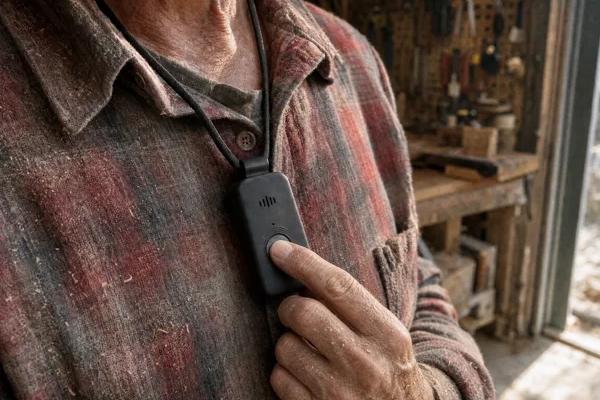
A medical alert watch is a wrist-worn device with a help button and automatic fall detection that connects to a monitoring centre staffed around the clock. A smartwatch with fall detection, like an Apple Watch or a Galaxy Watch, calls emergency services or texts your contacts instead. Both can work; they do different jobs, and the difference matters most in the minutes after a fall.
The reason wrist devices exist at all is a stubborn fact about pendants. In a long-running UK study of people 91 to 105, an alarm was on hand for 141 of 143 falls where someone was stuck on the floor alone, but it went unused 80 percent of the time overall, and in the worst cases, where the person was down for over an hour, it went unused 37 out of 38 times (Fleming and Brayne, BMJ, 2008). A device that is not worn, or not pressed, protects nobody.
This guide compares the watch-style options Canadian families can actually buy in 2026: the monitored medical alert watches, and the consumer smartwatches with a fall feature. It covers what each does after a fall, what it costs, what it needs to work, and who each one suits.
Why a watch instead of a pendant
A watch gets worn because it looks like a watch, and a fall-detection watch calls for help without anyone pressing a button. Those two facts answer the two ways protection usually fails.
The stakes are not small. In fiscal 2023 to 2024, falls sent 81,599 Canadians age 65 and older to hospital, a count that does not include Quebec (Public Health Agency of Canada, 2024). Falls killed 7,621 Canadians age 65 and older in 2022, the most recent year published (Public Health Agency of Canada, 2025), and they are behind 89 percent of all injury-related hospital stays in that age group. About half of the falls that land seniors in hospital happen at home.
The catch is that a pendant on a nightstand does nothing, and, as the UK study above shows, a pendant on the person often goes unpressed after a fall. Pride, confusion after a knock to the head, or a hand that cannot reach the button all play a part. A watch that detects the fall and opens the call itself removes the second problem; a watch that a person is happy to wear removes the first. If a fall has already happened in your family, our guide to what to do after a senior falls covers the first hours and the weeks after.
What makes a good medical alert watch for seniors?
Six things: automatic fall detection, two-way voice through the watch, a monitoring centre rather than an app, no phone required, one-press help, and a battery that lasts more than a day.
- Automatic fall detection, not just a help button. The watch should sense a hard fall and start the call even if the wearer cannot press anything. Our explainer on how automatic fall detection works covers the sensors and the countdown.
- Two-way voice through the device. When the alert triggers, the wearer should be able to talk to a real person through the watch, not through a phone in another room.
- A monitoring centre, not only notifications. An app that texts family is not the same as trained operators who follow a protocol, know the address, and can call 911 or a neighbour depending on what they hear.
- Works without a smartphone or Wi-Fi. A watch that needs a paired phone nearby fails when the phone is charging in the bedroom and the fall happens in the kitchen.
- One-press help. Touchscreens are fine; three swipes to reach the SOS screen are not. Test the help sequence before you buy.
- Battery life beyond a day. A watch that needs charging every 18 hours spends a lot of mornings on the charger instead of on the wrist.
Wrist-worn medical alert bands without a screen meet most of these too; our guide to medical alert bracelets in Canada covers those options.
Is a smartwatch as good as a medical alert system?
For most seniors living alone, no, because a smartwatch calls 911 or texts a contact, while a medical alert watch connects to a person who can decide what kind of help to send. For a tech-comfortable senior with an iPhone in their pocket all day, an Apple Watch can be a reasonable choice, with trade-offs worth knowing.
What Apple Watch does. Every Apple Watch sold in Canada today, the Series 12, the Ultra 4, and the SE 3, comes with Fall Detection built in, and Apple turns it on automatically once the owner's age is set to 55 or older (Apple Canada and Apple Support Canada, 2026). When the watch senses a hard fall, it taps the wrist, sounds an alarm, and shows an alert the wearer can answer. If the person keeps moving, it waits. If the person does not move for about a minute, it starts a 30-second countdown, and if nobody cancels it, the watch calls emergency services itself, plays a recorded message with the location, and then texts the emergency contacts to say help is on the way.
That is a real safety feature, and three things about it deserve a plain statement. First, there is no operator: the call goes to emergency services or nowhere. Second, a watch without cellular can only make the call if the paired iPhone is nearby or the watch has Wi-Fi, so a monthly cellular plan is needed if the watch has to work on its own away from the phone. Third, the current Apple Watch SE starts at CAD $399 with a battery Apple rates at up to 18 hours, and the Series 12 starts at CAD $549 with up to 24 hours (Apple Canada, 2026), which means nightly charging. Our deeper comparison of a medical alert versus an Apple Watch goes through those trade-offs one by one.
What Samsung Galaxy Watch does. On the Galaxy Watch7, Watch8, and Watch Ultra, fall detection is off out of the box and has to be turned on in the Galaxy Wearable app. Once on, a detected fall triggers a 60-second alert; if the wearer does not cancel it, the watch sends a message with the location to the contacts chosen in the app and can call one of them if set up that way (Samsung Canada, 2025 to 2026). It does not call 911 on its own; a separate five-press gesture does that. The watch works with most Android phones running Android 11 or later, not only Samsung phones, and it does not pair with an iPhone. An LTE model needs an active LTE plan to send the alert without the phone nearby.
What a monitored medical alert watch does. It opens a two-way call with a monitoring centre, where an operator talks to the wearer, checks what happened, and sends the right help, whether that is a neighbour, a family member, or an ambulance, using the address and details already on file. It works without a phone, and it does not depend on the wearer choosing the right contacts in an app.
Medical alert watches and fall detection watches sold in Canada
Three Canadian providers sell a monitored watch-style device, one of them also sells a wrist-worn band, and the two big consumer smartwatches add a fall feature without monitoring. The table below is drawn from each company's own site or support pages, as dated.
| Watch | Monitoring centre | Fall detection | Needs a phone? | Published price | Source and date |
|---|---|---|---|---|---|
| Holo Active (Holo Alert) | Yes, 24/7 Canadian operators | Included at no extra cost | No: own wireless connection, no Wi-Fi or smartphone | See the device page for current plans | holoalert.ca, September 2026 |
| Holo Mini (Holo Alert), wrist-worn band | Yes, 24/7 Canadian operators | Included at no extra cost, wrist-optimized | No | See the device page for current plans | holoalert.ca, September 2026 |
| Lifeline On the Go Smartwatch | Yes | Yes | No | From CAD $36.75 a month plus a one-time activation fee (amount not listed online) | lifeline.ca, January 2026 |
| Galaxy Medical Alert Mobile Watch and Slimline Watch | Yes | Yes, with GPS | Not stated on the retrieved pages | From CAD $49.95 a month, in Canadian funds | galaxymedicalalert.com, 2026 |
| Apple Watch SE 3 and Series 12 | No: calls emergency services directly | On by default at age 55 and older | Needs a paired iPhone nearby, Wi-Fi, or a cellular plan | CAD $399 (SE 3) and CAD $549 (Series 12), plus CAD $10 to $15 a month for a cellular plan | apple.com/ca; Bell, Rogers, TELUS plan pages, 2026 |
| Samsung Galaxy Watch7, Watch8, Ultra | No: messages chosen contacts | Off by default; must be enabled | Needs an Android phone; LTE plan to work alone | Not covered here; varies by model | samsung.com/ca support pages, 2025 to 2026 |
Two Canadian providers you might expect in this table are not in it. Life Assure does not currently sell a watch-style device in Canada; its lineup is a pendant and a wristband, with mobile pendant plans starting at CAD $54.95 a month (Life Assure Canada, 2026). TELUS Health's current lineup is also a pendant and home systems rather than a dedicated watch, with plans starting at CAD $35 a month (TELUS Health, 2026).
The two Holo Alert options
The Holo Active is a 2-in-1: a watch with a 1.83-inch touchscreen that can also be worn as a pendant on a lanyard for gardening or sleep. It carries the SOS button, two-way voice with an anti-noise microphone for loud rooms, automatic fall detection, heart rate and body temperature monitoring, IP67 water resistance so it stays on in the shower, and a battery rated at 48 hours or more. It connects on its own wireless connection, so no smartphone, Wi-Fi, or landline is needed.
The Holo Mini is the smallest and lightest option, a wrist-worn band for people who want the help button on the wrist and nothing else to learn. Fall detection is included and tuned for the wrist, with a 12-second window to cancel a false alarm. It locates the wearer through Wi-Fi and cellular signals rather than GPS, so the Holo Pro pendant, which has GPS, is the better choice for someone who is out and about a lot.
How much does a medical alert watch cost in Canada?
Monitored watches in Canada start at about CAD $37 to $50 a month, while a consumer smartwatch costs CAD $399 to $549 up front plus CAD $10 to $15 a month for a cellular plan, and needs a phone on top.
Lifeline Canada's On the Go Smartwatch, which works without a phone, starts at CAD $36.75 a month for monitoring and equipment, plus a one-time activation fee that Lifeline does not list a dollar amount for online (Lifeline Canada, 2026). Galaxy Medical Alert Systems sells two watch-style monitored devices with GPS and fall detection starting at CAD $49.95 a month (Galaxy Medical Alert Systems, 2026).
On the smartwatch side, the watch is only the first cost. On Bell, adding cellular service to a watch runs about CAD $10 a month if it shares the phone's number, or CAD $15 a month as a standalone plan; Rogers charges about CAD $10 a month to pair a watch to a phone plan; TELUS charges CAD $15 a month per connected watch on an eligible unlimited plan (Bell, Rogers, and TELUS, 2026). Add an iPhone if the person does not already own one.
Holo Alert's own prices live on the device pages rather than in this post, because they change with promotions. Monthly plans include the device at a one-time cost; annual plans include the device at no charge.
How fall detection on a watch actually works, and where it falls short
A fall-detection watch reads a sudden drop, a hard impact, and then stillness, and starts a countdown before it calls. Wrist placement is the trade-off: it is the spot people will wear, and it is also the spot that misses the most falls.
In controlled lab testing across thousands of simulated falls, a sensor worn at the waist caught 99.96 percent of falls, compared with 97.37 percent for the best wrist result, though this was staged testing, not real life (Özdemir, Sensors, 2016). Looking across many studies, researchers found that wrist-worn sensors tend to miss more falls than sensors worn at the waist, even though wrist devices are easier and less noticeable to wear day to day (systematic review, 2022).
Real life is harder than the lab for every device. When researchers tracked a wearable fall sensor on real seniors for over 15,000 hours of everyday use, it caught 80 percent of actual falls and produced roughly one false alarm every 40 hours (Kangas et al., Gerontology, 2015). In one US study, an automatic fall detector set off 84 alarms and 83 of them turned out to be false alarms (Chaudhuri et al., Journal of the American Geriatrics Society, 2015). No watch on the market catches every fall, which is why every good one keeps a help button the wearer can press, and why a monitoring centre that can ask "are you all right?" matters more than a sensor score.
The practical rule: choose the device the person will wear every day, and make sure it has both automatic detection and a button. A more accurate pendant left in a drawer protects nobody. Many families combine a watch for daytime with a pendant on the bedside table at night; our guide to GPS versus home medical alert systems covers the formats in more depth.
Does a medical alert watch work everywhere in Canada?
Anywhere there is LTE cellular coverage, which reached 99.2 percent of Canadian households at the end of 2021, and 96.3 percent of rural and remote households (Office of the Auditor General of Canada, citing CRTC data, 2023). Gaps remain along some rural highways and in remote areas, so confirm signal strength at the home address before subscribing.
The older 3G networks are on their way out. Rogers began a region-by-region shutdown on August 7, 2025, and Bell and TELUS have set March 1, 2027 as their national dates (carrier announcements, 2025 to 2026). Any current medical alert wearable should be running on LTE, and any older 3G device in a drawer will stop working; ask the provider before relying on an older unit.
Frequently asked questions
Which watch is best for medical alerts?
A watch that connects to a monitoring centre, includes automatic fall detection, and works without a phone. In Canada that shortlist is the monitored watches from Holo Alert, Lifeline, and Galaxy Medical Alert. A consumer smartwatch can add a fall feature, but it calls emergency services or texts a contact rather than reaching an operator who can judge the situation.
Does Apple Watch fall detection call 911 in Canada?
Yes, when it decides the wearer is not responding. After a hard fall, if the person does not move for about a minute, the watch runs a 30-second countdown and then calls emergency services itself with a recorded message and the location, then texts the emergency contacts (Apple Support Canada, 2026). A watch without cellular needs the paired iPhone nearby or Wi-Fi to place that call.
Can a Samsung Galaxy Watch call for help after a fall?
It can message and, if set up, call the contacts chosen in the Galaxy Wearable app after a 60-second alert, but fall detection is off by default and must be turned on first (Samsung Canada, 2025 to 2026). It does not call 911 on its own after a fall; a separate five-press gesture is what reaches emergency services. It needs an Android phone, and an LTE plan to work away from it.
What is the best fall detection watch for seniors in Canada?
For a senior living alone, the best fall detection watch is one that opens a call to a trained operator, includes fall detection at no extra cost, works without a smartphone, and lasts more than a day on a charge. The Holo Active meets all four, and the Lifeline and Galaxy Medical Alert watches are the other monitored options. The best watch is still the one the person will keep on their wrist.
The right watch is the one they will actually wear
Every fall detection watch shares one limit: it cannot help from a dresser. Sensor accuracy and battery life matter, but the deciding question is whether your parent will look at the watch, like it, and put it on every morning.
The Holo Active is built for that test: a watch that looks like a watch, Canadian monitoring that knows the address, and fall detection working in the background. To talk through whether the Active or the Mini fits, call 1-888-445-0192, or compare the devices online. Every plan is backed by the 10-day risk-free guarantee. For the wider picture, including pendants and home systems, read our comparison of the best medical alert systems in Canada.