The Crisis of Distance: Protecting Aging Parents in Another Province
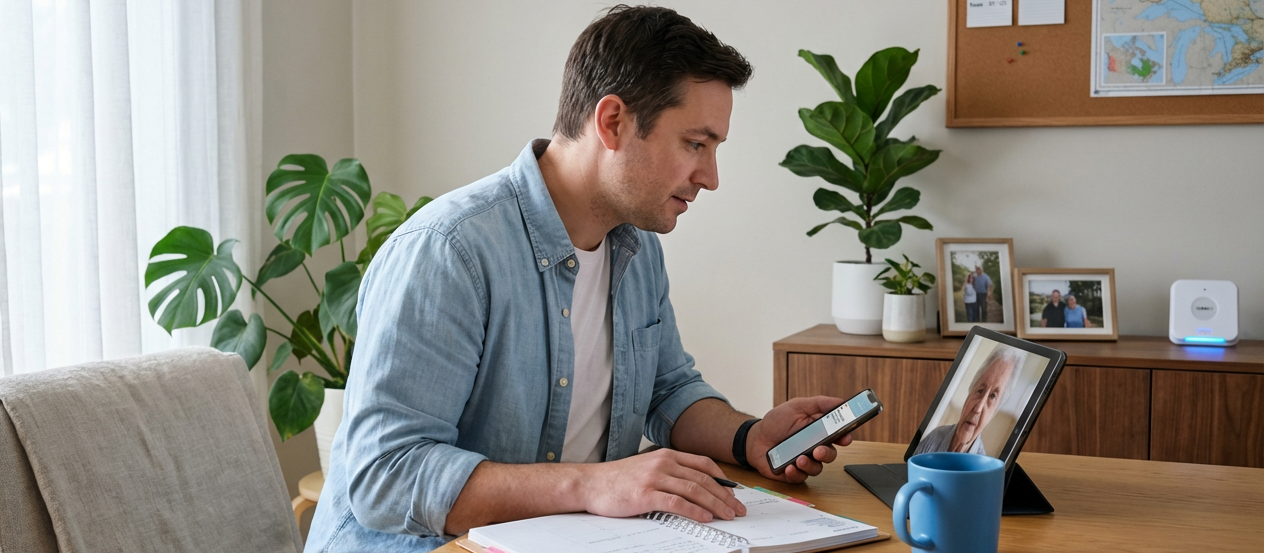
Living in Ontario while your aging parent resides in British Columbia isn't just a logistical inconvenience; it is a safety gap that widens every single day. When you can't see your parents daily, you miss the subtle signs of decline—the unwashed dishes, the slight stumble on the stairs, or the confusion during a phone call.
By the time a crisis is visible from across the country, it is often too late to prevent it. The geography of Canada creates unique dangers for seniors. Provincial borders act as barriers to healthcare access, and time zones complicate communication.
You are not just a child checking in; you are a remote care manager trying to navigate a fragmented system. To keep them safe, you must stop relying on luck and start building a fail-safe infrastructure that bridges the gap between your home and theirs.
Key Takeaways for Remote Caregivers
- Healthcare is Provincial: What is free in your province may cost thousands in theirs. You must navigate the specific rules of their local health authority.
- Video Calls Lie: Parents often "perform" wellness on calls. You need objective data and trusted local eyes to see the reality of their health.
- The 911 Disconnect: Calling 911 from another province can route you to the wrong dispatch centre. A dedicated medical alert service bypasses this fatal flaw.
- Legal Authority: A Power of Attorney in one province may not be immediately accepted in another. Ensure your paperwork matches their jurisdiction.
The Provincial Healthcare Maze
The Canadian healthcare system is not a monolith; it is a collection of independent provincial silos. If you are managing care from Alberta for a parent in the Maritimes, you are dealing with entirely different funding models, wait times, and coverage rules.
A service covered by OHIP in Ontario might be an out-of-pocket expense under MSP in British Columbia. Distance also creates a terrifying blind spot regarding immediate intervention. Statistics show that 1 in 3 Canadian admissions to long-term care could be avoided with better home support.
When you are thousands of kilometres away, you cannot physically catch them when they fall. Relying solely on neighbours or scheduled phone calls leaves your parent vulnerable for hours—or days—following an accident.
The Holo Alert Difference: We erase provincial borders
Whether your parent is in a condo in Vancouver or a cottage in rural Nova Scotia, Holo Alert provides consistent, 24/7 monitoring. Our Canada-wide network ensures that jurisdictional healthcare differences never delay an emergency response.
Stop Guessing: Assessing Needs Remotely
You cannot manage what you cannot measure. A friendly chat on Sunday does not reveal if your parent is taking their medication or if they are afraid to walk down the hallway at night. Remote assessments must be rigorous.
While video calls help, they have limitations; a camera cannot capture balance issues or the smell of burnt food from a stove left on. You need to supplement your observations with hard data. This is where smart fall detection technology becomes non-negotiable.
Subjective reports from parents who don't want to worry you are unreliable. Objective alerts tell you exactly when a safety breach has occurred.
The Holo Alert Difference: Automatic detection
We don't rely on your parent admitting they need help. Our advanced fall detection sensors automatically identify a fall and trigger an alarm, even if your parent is unconscious or unable to speak. This provides you with the truth about their stability, not just the version they tell you over the phone.
Looking for peace of mind across the miles? Shop the Holo Alert Pro.
Active Protection vs. Passive Monitoring
There is a dangerous misconception that passive monitoring alone is enough to keep seniors safe. While smart home data such as a fridge door opening can provide insight into daily routines, it does nothing to help when a stroke or sudden medical emergency occurs in the living room.
In those moments, seconds matter and an active response system is essential. Specialized medical alert systems like Holo Alert provide immediate two-way voice access to a live operator, ensuring help is summoned right away rather than relying on an app notification that could be missed.
Automatic fall detection can trigger an emergency response immediately instead of revealing a lack of movement hours later. GPS capabilities extend protection beyond the home, allowing seniors to be located anywhere in Canada, while long-lasting, purpose-built batteries reduce the risk of system failure compared to passive setups that vary widely in reliability and often require complex configuration.
The Emergency Dispatch Protocol
This is the most critical logistical failure in long-distance caregiving: You cannot be the first responder. If your mom collapses in Winnipeg and you call 911 from your cell phone in Toronto, you will likely connect to a Toronto dispatcher. Valuable minutes are wasted transferring calls across provinces.
Furthermore, paramedics cannot enter a locked home without police presence unless they have verified access protocols, causing further delays.
The Holo Alert Difference: We act as the local proxy
When an alarm is triggered, our operators instantly access your parent's profile, including lockbox codes and medical history. We contact the local EMS dispatch directly—bypassing the 911 provincial routing issues—and provide paramedics with the entry code to get inside immediately. This seamless coordination saves lives.
Don't let distance delay emergency care. Secure your parent with Holo Alert today.
Legal Authority and Financial Strategy
If a medical crisis strikes, you will need immediate legal authority to make decisions. However, a Power of Attorney (POA) drafted in Ontario may be scrutinized or rejected by a hospital in Quebec or British Columbia during a time-sensitive emergency. It is safer to have documents drafted according to the laws of the province where your parent resides.
Financially, ensure you are utilizing federal options like the Canada Caregiver Credit, but don't ignore the cost of safety. Many families hesitate to spend money on mobile vs in-home medical alert systems, only to face massive costs later when a preventable fall results in long-term hospitalization.
Managing the "Absent Caregiver" Guilt
Caregiver guilt is the silent killer of your own well-being. You feel you aren't doing enough because you aren't physically there. But recognize this: Institutionalization often happens not because family didn't care, but because the home lacked the right infrastructure.
The Holo Alert Difference: Convert guilt into action
We allow you to convert your guilt into action. By equipping your parent with a Holo Alert device, you are effectively placing a safety guardian in their home 24/7. You are not "absent"—you are providing the highest standard of safety available.
Frequently Asked Questions
Will my local 911 work for my parent in another province?
Likely not efficiently. Cell tower routing usually connects you to the nearest dispatch centre, not your parent's. Holo Alert bypasses this risk by contacting the dispatch centre closest to the subscriber's location immediately.
Can Holo Alert detect falls if my parent is outside?
Yes. Unlike traditional landline systems, our mobile units use GPS technology to protect seniors whether they are gardening, walking to the mailbox, or shopping, providing safety beyond the front door.
What if my parent refuses to wear a button?
Resistance is common. Frame it as a tool for your peace of mind rather than their frailty. Many seniors agree to wear it simply to stop their children from worrying. Remind them that knowing what to do after a fall is useless if they can't call for help.
Distance Doesn't Have to Mean Danger
You cannot be in two places at once, but you can ensure your parent is never truly alone. Waiting for the "right time" to install a medical alert system usually means waiting until after an accident has already happened. In the context of cross-province caregiving, that delay can be catastrophic.
Close the distance gap. Equip your parents with the protection they need and give yourself the ability to sleep at night, knowing that if the worst happens, help is already on the way.