Losing your spouse changes everything, including the household income you counted on. If you are trying to sort out what support exists, you are not alone, and the answer is more encouraging than most people expect. This guide walks through Canada's survivor benefits in plain language: what they pay in 2026, who qualifies, and exactly how to apply.
Is there a widow's pension in Canada?
Yes. Canada does not have one single program called a "widow's pension." Instead, a surviving spouse or common-law partner may qualify for three federal benefits: the monthly CPP survivor's pension, a one-time CPP death benefit, and, for lower-income survivors aged 60 to 64, the monthly Allowance for the Survivor under Old Age Security.
Each program has its own rules, so it is worth checking all three. Some people qualify for more than one at the same time.
How much is a widow's pension in Canada in 2026?
Here are the current maximum amounts, using Service Canada's January 2026 CPP rates and the July to September 2026 Old Age Security quarter:
| Benefit | Who it's for | Maximum in 2026 |
|---|---|---|
| CPP survivor's pension (under 65) | Surviving spouse or common-law partner | Up to $803.54/month |
| CPP survivor's pension (65 and older) | Surviving spouse or common-law partner | Up to $904.59/month |
| Allowance for the Survivor | Widowed, aged 60 to 64, income under $30,696/year | Up to $1,702.34/month |
| CPP death benefit | The estate of the person who died | $2,500 one time, or $5,000 in some cases |
A few important notes on how those numbers actually work:
If you are under 65, the CPP survivor's pension is a flat-rate portion of $238.17 plus 37.5 percent of your spouse's calculated retirement pension, to a maximum of $803.54 per month in 2026 (Service Canada, January 2026 rates).
If you are 65 or older, you receive 60 percent of your spouse's calculated CPP retirement pension, to a maximum of $904.59 per month in 2026 (Service Canada, January 2026 rates).
These are maximums, not typical amounts. Your actual payment depends on how much and how long your spouse contributed to CPP. Service Canada calculates it as though your spouse's retirement pension had been worked out at age 65 on the date they passed away.
The death benefit is bigger than it used to be. The CPP death benefit is a one-time payment of $2,500 to the estate. For deaths on or after January 1, 2025, the amount rises to $5,000 when the person never received a CPP or QPP retirement or disability pension and no surviving spouse qualifies for the survivor's pension (Service Canada; Canada Pension Plan, s. 57).
Quick takeaway: a widow or widower aged 65 or older can receive up to $904.59 per month from CPP in 2026, and a lower-income survivor aged 60 to 64 can receive up to $1,702.34 per month through the Allowance for the Survivor.
Who is entitled to CPP survivor benefits?
The CPP survivor's pension goes to the person who, at the time of death, was the legal spouse or common-law partner of a contributor who paid into the Canada Pension Plan. Common-law partners qualify on the same footing as married spouses. The formula that applies depends on your age: the flat-rate-plus-37.5-percent calculation before 65, and the 60 percent calculation from 65 on.
If your spouse worked in Quebec, their contributions may fall under the Québec Pension Plan instead. The QPP pays its own surviving spouse's pension with similar rules, through Retraite Québec rather than Service Canada.
If your income is modest, the survivor's pension also stacks with other supports. Our Guaranteed Income Supplement guide explains the biggest one for Canadians 65 and over.
How long will you receive CPP survivor benefits?
The survivor's pension is paid for the rest of your life. It does not expire after a set number of years, and it does not end if you remarry (Canada Pension Plan, s. 73).
The remarriage question deserves its own line, because the old rule still causes confusion. Since 1987, remarrying does not affect your CPP survivor's pension. If you lost a survivor benefit because you remarried before 1987, Service Canada says you can ask to have it restored.
Is there a survivor benefit for OAS? The Allowance for the Survivor
Old Age Security itself starts at 65, but there is a bridge for widowed Canadians who have not yet reached that age. If you are 60 to 64, widowed, and have not remarried or entered a new common-law relationship, the Allowance for the Survivor pays up to $1,702.34 per month for the July to September 2026 quarter, provided your annual net income is under $30,696 (Service Canada).
You also need to live in Canada and have lived here for at least 10 years since turning 18. The payment amount slides with your income: the less income you have, the closer you get to the maximum.
The Allowance for the Survivor ends the month you turn 65. At that point you move to Old Age Security, and if your income is low, the Guaranteed Income Supplement on top of it (Service Canada). If your retirement income is higher, it is worth understanding how the OAS clawback works before then.
Is the CPP survivor benefit taxable?
Yes, the survivor's pension counts as taxable income. It arrives on a T4A(P) slip and goes on line 11400 of your tax return (Canada Revenue Agency). Tax is not taken off automatically, so if you would rather not face a bill at tax time, you can ask Service Canada to withhold a portion from each payment.
How to apply for a widow's pension in Canada
The survivor's pension is not automatic. You apply online through My Service Canada Account or by mailing form ISP1300. Service Canada can back-pay at most 12 months, so applying promptly protects money you are already entitled to.
Here is the process, step by step:
- Gather the basics. You will need your Social Insurance Number, your spouse's SIN, the death certificate, and your banking details for direct deposit.
- Apply for the CPP survivor's pension. Sign in to My Service Canada Account and complete the online survivor's pension application, or mail paper form ISP1300 to Service Canada. The same form also covers children's benefits.
- Apply for the Allowance for the Survivor if you are 60 to 64. You apply online through My Service Canada Account or with paper forms ISP3008 and ISP3026 (a statement of income). There is no automatic enrolment for the Allowance for the Survivor.
- Watch for the decision letter. Service Canada says the first payment typically arrives 6 to 12 weeks after it receives a completed application.
Payments cannot start earlier than the month after the death, and back payments cover at most 12 months, which is why it pays to apply sooner rather than later, even while other paperwork is still in motion.
If you already receive your own CPP
Many survivors are already collecting their own CPP retirement pension. You keep it, and the survivor's pension is added, but with a cap. If you already collect your own CPP retirement pension, the two are combined into one monthly payment, and you will not receive both amounts in full. The maximum combined payment is $1,531.56 per month in 2026 for someone whose retirement pension started at 65 (Service Canada, January 2026 rates).
If you have not started your own CPP yet, the timing decision matters more than ever. Our guide on when to start taking CPP walks through how the math changes.
Settling into life on your own
The paperwork is only one part of this season. Many widowed Canadians are also living alone for the first time in decades, and the practical side of that deserves the same calm, one-step-at-a-time approach as the finances.
A few things that help:
- Set up direct deposit for every benefit so nothing depends on getting to the bank.
- Review the household budget once the new income is known. Programs like the GIS, provincial supplements, and senior discounts can stretch a single income further than most people realize.
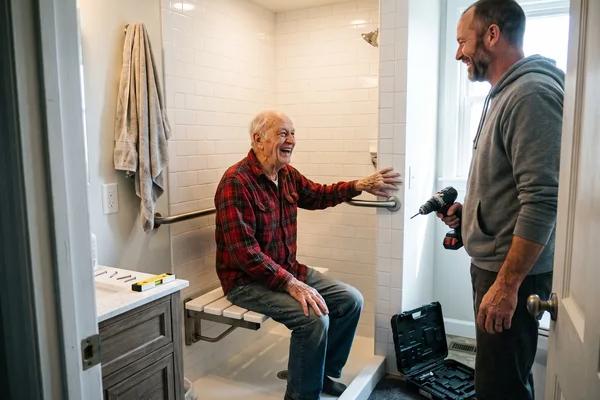
- Think through home safety early, on your own terms. Simple changes make living alone easier, and some people also like knowing help is a button-press away. A medical alert system such as Holo Alert is one option worth knowing about, with 24/7 professional monitoring anywhere in Canada with cellular service.
- Tell Service Canada about changes. Moving, income changes, or a new relationship can affect the Allowance for the Survivor, so a quick call keeps payments accurate.
For a fuller room-by-room look at living alone with confidence, our complete safety guide for seniors living alone in Canada is a good next read.
Frequently asked questions
How is the CPP survivor's pension calculated? Service Canada first works out what your spouse's retirement pension would have been at age 65, then applies your rate: the flat-rate portion of $238.17 plus 37.5 percent of that pension if you are under 65, or 60 percent of it if you are 65 or older (Service Canada, January 2026 rates).
What percentage of CPP does a surviving spouse get? At 65 or older, 60 percent of the deceased's calculated retirement pension. Under 65, 37.5 percent plus the flat-rate portion. If you also draw your own CPP, the combined payment is capped.
How long does it take to get survivor benefits? Service Canada says the first payment typically arrives 6 to 12 weeks after it receives a completed application.
Does the survivor's pension end if I remarry? No. Since 1987, remarrying does not affect your CPP survivor's pension.
Is the widow's pension different in Ontario or other provinces? No. CPP survivor benefits are federal and identical across every province and territory except Quebec, where the Québec Pension Plan runs a parallel surviving spouse's pension through Retraite Québec.
Sources: Service Canada's Survivor's pension, Death benefit, and Allowance for the Survivor pages (January 2026 CPP rates; July to September 2026 OAS quarter), the ESDC 2026 CPP benefit-amount tables, the Canada Pension Plan (R.S.C. 1985, c. C-8), and the Canada Revenue Agency's line 11400 guidance, all reviewed August 2026.