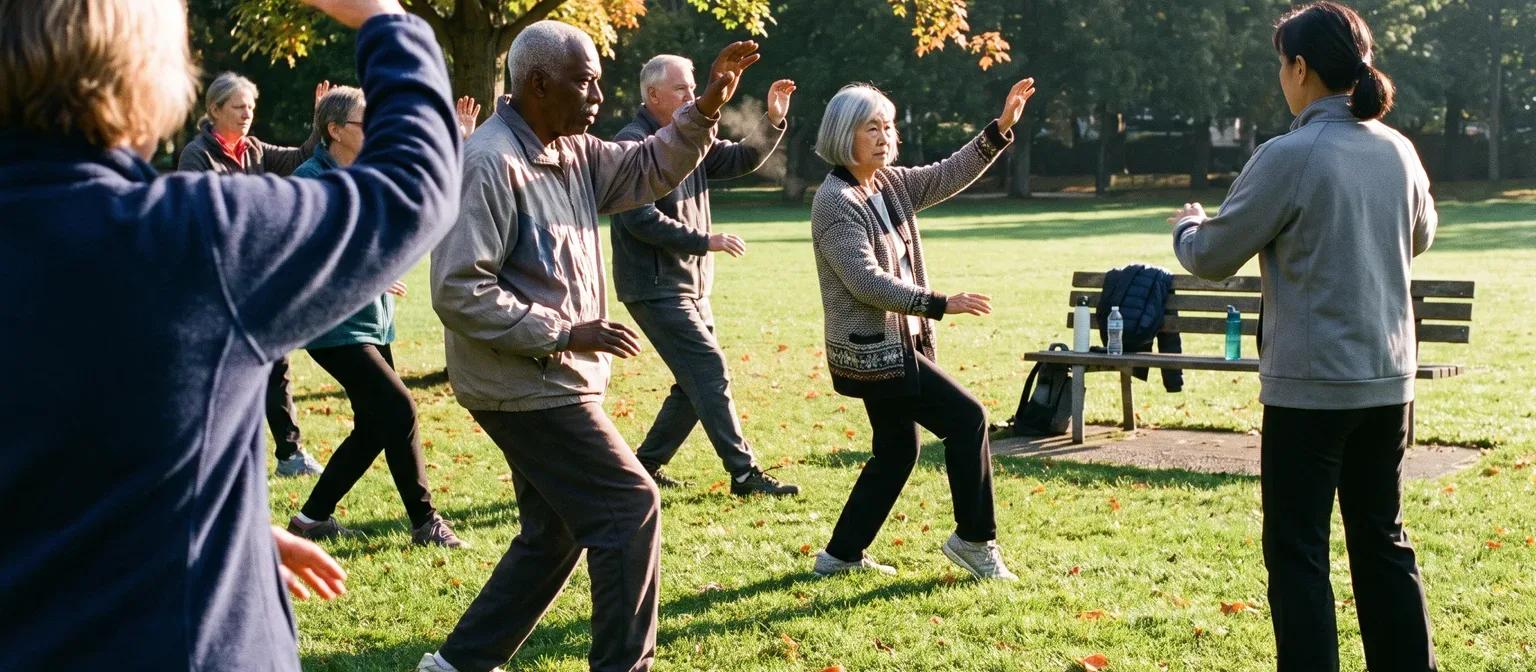
Tai chi lowered the rate of falls by about 19 percent in a 2019 Cochrane review of exercise trials from around the world, though the reviewers rated that evidence low certainty. A 2023 meta-analysis of 24 randomized trials put the reduction in the risk of falling at 24 percent. Few fall-prevention exercises have that kind of track record.
About one in five Canadian seniors, 19.8 percent, reported falling in the previous year in the 2017 to 2018 national health survey, and more than a third of those who fell did so more than once. Most fall injuries happen while walking, which is exactly the everyday balance that tai chi trains.
This guide covers what the research actually shows, how much practice it takes, which style suits which person, what chair tai chi can and cannot do, and where to find a class in Canada, including the free and low-cost ones.
Does tai chi really work for seniors?
Yes, for falls and balance, with a caution about how strong the evidence is. A major 2019 Cochrane review looked at falls-prevention exercise trials from around the world and found that tai chi lowered the rate of falls by about 19 percent, though the researchers called this low-certainty evidence because results varied a lot from trial to trial. The same review found an even bigger effect for balance and functional exercise generally: a 24 percent drop in the fall rate, and this time the evidence was rated high certainty, the strongest grade Cochrane gives.
Newer work points the same way. A 2023 meta-analysis of 24 randomized trials, published in Frontiers in Public Health, found tai chi reduced the risk of falling by 24 percent, close to the Cochrane figure for general balance exercise. We could not find a Canadian trial among them, so the numbers describe older adults in general rather than Canadians specifically, but there is no reason to think balance works differently here.
Why tai chi in particular? It is slow, it shifts weight from one leg to the other constantly, and it asks you to move your arms while your feet are doing something else. That is a description of walking across a kitchen while carrying a mug, which is the movement most falls interrupt. Roughly six in ten fall injuries among Canadian seniors happen while walking, and about 12 percent on stairs or steps, according to the Public Health Agency of Canada's surveillance report (2022, using 2009 to 2013 survey data). Our guide to why Canadian seniors fall covers the other causes, from medications to vision.
How much tai chi do you need?
About 45 to 60 minutes, at least twice a week, for at least 12 weeks. Across several reviews of the research, that is where the benefits showed up. Some programs run longer, up to 24 weeks, for the strongest fall-prevention results.
Some balance gains can show up in as little as 8 weeks of twice-weekly practice, but the programs with the strongest track record for actually cutting falls ran for 16 to 24 weeks. Treat the first two months as the point where you start to feel steadier, and the first six months as the point where the fall numbers in the trials began to move.
That fits Canada's own movement guidelines. The Canadian Society for Exercise Physiology's guidelines for adults 65 and older call for at least 150 minutes a week of moderate to vigorous activity, muscle-strengthening activity at least twice a week, and activities that challenge your balance, like tai chi. The guidelines do not specify an exact number of balance sessions per week, just that balance work should be part of the mix. Most Canadians in this age group are not there yet: only about 30 percent of Canadians aged 65 to 79 get the recommended 150 minutes, according to directly measured Statistics Canada data from 2022 to 2024, well below the 50 percent rate for adults under 65.
Two classes a week is a realistic anchor. On the days in between, a short home routine keeps the gains; our balance exercises to prevent falls post has one you can do beside a kitchen counter.
What is the best tai chi style for seniors?
For a generally mobile beginner, simplified 24-form tai chi, which is based mostly on Yang style, has the best supporting evidence and is a reasonable starting point. For sore joints, Sun style. For anyone who has already fallen, a program built specifically for balance.
| Style or program | Best for | What the research found |
|---|---|---|
| Simplified 24-form (mostly Yang style) | Mobile beginners | Ranked first for reducing falls and improving balance scores in a 2024 comparison of tai chi styles |
| Sun style, including Tai Chi for Arthritis and Fall Prevention | Arthritis and sore joints | About a one-third drop in fall rates after 24 weeks in a trial of over 700 older adults (Australia, 2007) |
| Tai Ji Quan: Moving for Better Balance | People who have fallen or have a known balance problem | 58 percent fewer falls than stretching, and 31 percent fewer than other exercise, over 24 weeks in a 670-person trial (United States, 2018) |
A 2024 comparison of different tai chi styles found that the simplified 24-form version, which is based mostly on Yang style, came out on top for reducing falls and improving balance test scores. People with sore or arthritic joints often do better with Sun style, which uses more upright postures. Dr. Paul Lam's Tai Chi for Arthritis and Fall Prevention program, based on Sun style, was one of several Sun-style programs used in a large Australian trial of over 700 older adults that showed about a one-third drop in fall rates after 24 weeks. Because instructors in that trial used more than one program, it supports the community-class approach rather than proving that one branded curriculum alone.
For people who have already fallen or who have a known balance problem, the program with the strongest single-trial evidence is Tai Ji Quan: Moving for Better Balance. In a study of 670 older adults with a history of falls or balance trouble, it cut falls by 58 percent compared with stretching, and by 31 percent compared with other exercise programs, over 24 weeks.
The honest footnote: the style comparisons are indirect, drawn from different trials rather than head-to-head tests. In practice, an instructor willing to use higher stances, smaller steps, a chair for support, and gradual progression matters more than the style name on the poster.
What is tai chi walking for seniors?
"Tai chi walking" is a term you will mostly meet on video sites. It generally describes gentle routines that pair walking or stepping in place with tai chi arm movements, and for someone who has not exercised in a while it can be a comfortable way to start moving.
It is not what the trials above studied. The fall-reduction figures in this post come from structured, instructor-led programs, most of them 45 to 60 minutes and at least twice a week, that deliberately challenge balance by shifting weight and holding positions. A walking-in-place video keeps you active, and that has value on its own, but treat it as a warm-up to a real class rather than a substitute for one.
Chair tai chi for seniors
Chair, or seated, tai chi is a reasonable option for people who cannot stand for long periods. Small studies show it can improve seated balance and coordination, but the evidence is thin, and seated tai chi has not been shown to prevent standing falls the way standing, balance-challenging tai chi has.
That is worth saying plainly because the two get sold as equals. Seated practice keeps the trunk, arms, and breath working, and for someone recovering from surgery, living with a condition that limits standing, or building confidence after a fall, that is a good use of half an hour. What it cannot do is train the weight shift from foot to foot that standing tai chi is built on.
In Canada, seated tai chi classes do exist. For example, Lifemark Seniors Wellness in Ontario offers a free 30 to 45 minute seated tai chi class, in person in the Mississauga-Halton area and online, and the Canadian Tai Chi Academy has offered a seated form class in the Cowichan Valley, B.C. If a class is not available nearby, a chair placed beside you in a standing class does much of the same job on the days your legs are tired, and the safe at-home exercises in our fall-prevention guide fill the gaps between classes.
Where to take tai chi in Canada
Most Canadian cities offer tai chi for seniors through a community centre, a seniors' centre, or the Taoist Tai Chi Society, and many classes cost a few dollars a session or nothing at all. Here is what we found, with dates, because fees change every season.
| Where | What it offers | Cost (as published) | How to find it |
|---|---|---|---|
| Taoist Tai Chi Society of Canada (Fung Loy Kok Institute of Taoism) | Beginner and continuing classes; programs reported at around 183 Canadian locations in 2025 | Participant contributions that vary by location; no national fee schedule published | Find a Location page on taoist.org |
| Canadian Tai Chi Academy | Classes in Alberta, B.C., Manitoba, New Brunswick, the Northwest Territories, Nova Scotia, Ontario, P.E.I., and Quebec | Set locally per class; no national price list | Class list on canadiantaichiacademy.org |
| City of Toronto, Parks, Forestry and Recreation | Registered "Tai Chi, Older Adult" programs | $5.05 per program hour before tax in 2026; residents 60 and older get 50 percent off adult programs | City recreation registration |
| City of Vancouver community centres | Seniors tai chi and drop-in classes | Strathcona Community Centre: free with registration (2025 to 2026); Kensington: about $83 for 15 seniors' sessions; Kitsilano: $4 drop-in | Each centre's recreation guide |
| City of Ottawa senior centres | Tai chi through the Active Living Club 50+ | $29.18 a year plus $2.20 drop-in; residents 65 and older get 10 percent off registered programs | City of Ottawa senior centre pages |
| City of Calgary Recreation | Tai chi and qigong classes; free outdoor tai chi downtown in summer 2026 | Varies by session | City of Calgary program pages |
| Ville de Montréal | Free introductory traditional tai chi in Parc Toussaint-Louverture (September 2026); free registration for low-income residents through Accès-Loisirs | Free for the park sessions | montreal.ca events and Accès-Loisirs |
| Ontario Seniors Active Living Centres | 416 provincially funded programs in 2026; several offer tai chi | Each centre sets its own fees | Ontario's "find a program near you" page |
| YMCA Canada | Tai chi at some of its 37 regional associations, including YMCA of Northern Alberta and YMCA of Regina | Varies by association | Your local Y |
| Lifemark Seniors Wellness (Ontario) | Free seated tai chi, 30 to 45 minutes, in person and online | Free | lifemarkseniorswellness.ca |
Sources: Charity Intelligence Canada (2025); Taoist Tai Chi Society of Canada, Canadian Tai Chi Academy, City of Toronto, City of Vancouver, City of Ottawa, City of Calgary, Ville de Montréal, Government of Ontario, YMCA Canada, and Lifemark Seniors Wellness program pages, 2025 to 2026.
The Taoist Tai Chi Society deserves a special mention because it is one of the country's largest tai chi networks and is often the only option in a smaller town. Its current pages describe participant contributions rather than a fixed national price, so check with your local branch directly.
Alberta's Finding Balance program and B.C.'s Finding Balance and Strength and Balance for Life resources both recommend tai chi as a good balance-challenging activity for older adults. They are information hubs rather than class providers, so you will still need to find the class itself through your city or one of the groups above.
Your first class
Wear loose clothing and closed shoes with a grippy, non-slip sole; our guide to the safest footwear for seniors explains what to look for. Tell the instructor about any joint replacement, dizziness, or recent fall before the class starts, and ask for a chair beside you for the first few sessions. A good instructor will offer higher stances and smaller steps without being asked.
If you have a heart condition, have had recent surgery, or get dizzy when you stand, check with your doctor before starting a new exercise program. Tai chi is gentle, but it is still exercise.
Expect to feel awkward for the first month. The forms have names, the sequence takes time to learn, and everyone in the room was once the person at the back copying the person in front. Two classes a week for twelve weeks is the trial-tested dose, and it is also about how long it takes to stop thinking about your feet.
What tai chi cannot do
Tai chi lowers the rate of falls; it does not bring it to zero. Falls sent 81,599 Canadians aged 65 and older to hospital in fiscal 2023 to 2024, and that number does not include Quebec. Exercise is the best-evidenced way to make falls less likely, and a plan for what happens if one occurs anyway is the other half of staying independent at home. Our guide to fall detection for seniors in Canada explains how automatic fall detection on a wearable device works and what to look for.
Frequently asked questions
Which is better for seniors, yoga or tai chi?
We did not review the yoga research for this post, so we cannot rank the two. What the fall-prevention evidence does say is that exercise that deliberately challenges balance works, and tai chi does that by design: constant weight shifts, slow steps, and arm movements at the same time. The 2019 Cochrane review rated balance and functional exercise as high-certainty evidence for reducing falls. Our chair yoga guide covers the seated yoga side.
How often should seniors do tai chi?
The research points to sessions of 45 to 60 minutes, at least twice a week, for at least 12 weeks. Some balance gains show up by 8 weeks, and the programs with the strongest fall-reduction results ran 16 to 24 weeks. Canada's movement guidelines for adults 65 and older add that balance activities should be a regular part of each week, without setting an exact count.
Can I learn tai chi for free?
Often, yes. Strathcona Community Centre in Vancouver offered a free seniors tai chi class for the 2025 to 2026 season, Montreal ran free introductory sessions in a city park in September 2026, Calgary offered free outdoor tai chi downtown in summer 2026, and Lifemark Seniors Wellness in Ontario runs a free seated class in person and online. Many other city programs cost a few dollars a session.
Is tai chi safe for people with arthritis?
Sun-style tai chi, with its more upright postures, is the base for several programs built for sore joints. Dr. Paul Lam's Tai Chi for Arthritis and Fall Prevention program, based on Sun style, was one of the programs used in an Australian trial of over 700 adults over 60 that showed about a one-third drop in fall rates after 24 weeks. Tell the instructor which joints hurt, and ask for higher stances.
Getting started this week
Pick one class from the table above, call to confirm the fee and start date, and put two sessions a week in the calendar for the next twelve weeks. In between, the balance exercises in our fall-prevention post take ten minutes beside a counter. The trials did not find a shortcut; they found that people who kept showing up fell less.