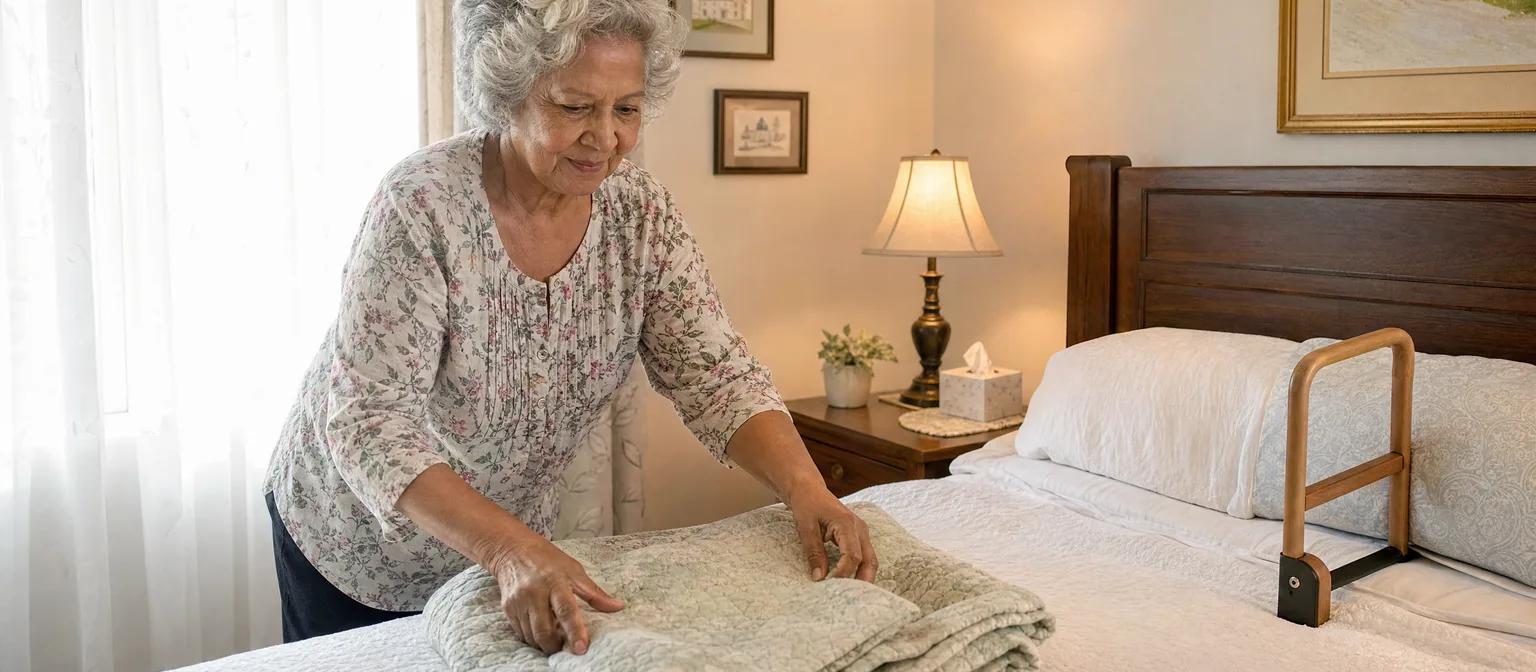
Do bed rails make seniors safer? Sometimes, for the right person and the right rail. A short bed assist handle can give someone a steady grip getting in and out of bed. A full-length rail is a different product with a different record: it can trap a head, neck, or chest, and Health Canada has recalled several models sold here over exactly that hazard.
If you are setting up a bedroom for a parent, or thinking about your own, the real question is rarely "should I buy a bed rail." It is "what is making this bed unsafe."
Do bed rails make seniors safer?
It depends on the job you are asking the rail to do. A short rail used as a handhold can make getting into and out of bed safer for someone who is steady but needs something to grip. A full-length rail used as a barrier to stop someone rolling out has not been shown to reduce falls, and it adds an entrapment risk.
Canada's guidance reflects that. The Public Health Agency of Canada's Safe Living Guide, revised in 2015, recommends short bed rails or assist handles as a steadying handhold, not a wall to keep someone in.
About one in five Canadian seniors living in the community reported falling in the previous year, according to PHAC's Seniors' Falls in Canada: Second Report, published in 2014 using 2008-2009 survey data. More current figures from PHAC's Health Infobase, updated in November 2025 using 2022 hospital data that excludes Quebec, show falls accounted for 89 percent of injury-related hospitalizations among Canadians 65 and over.
A rail someone holds onto is a mobility aid. A rail meant to hold someone in is a restraint. Those are two different decisions with two different sets of rules.
Why are bed rails dangerous?
The main hazard is entrapment. A person's head, neck, or chest slips into a gap in or around the rail, and they cannot get free. Health Canada has recalled several adult portable bed rail models sold here over entrapment and asphyxiation hazards.
Rather than one blanket advisory, Health Canada issues product-specific recalls. The clearest Canadian figure comes from the Home Bed Assist Handles recall, first announced on December 6, 2021 and re-announced on December 28, 2023 after a second Canadian death was reported, bringing that product line to two Canadian deaths.
There is no published national count: the Canadian Institute for Health Information does not publish a bed-rail entrapment figure. The closest measure of scale is American: in its July 2023 final rule, the US Consumer Product Safety Commission reported 310 deaths linked to adult portable bed rails between January 2003 and December 2021, 284 of them from entrapment. Those are US numbers, not Canadian ones.
The second hazard is quieter. A rail turns a low bed into an obstacle, and someone who wakes up disoriented may climb over rather than call out, turning a mattress-height fall into a higher one. If that happens, knowing what to do in the first few minutes matters more than families expect.
What the rules say in Canada
The United States has a mandatory federal standard for these products, 16 CFR Part 1270, published July 21, 2023 and effective August 21, 2023. It builds on the ASTM F3186-17 industry standard and requires probe-based testing of gaps across four defined entrapment zones.
Canada has no equivalent product-specific standard as of 2026. These rails are still covered by the Canada Consumer Product Safety Act's general prohibition on selling a product that is a danger to health or safety, which is the basis for Health Canada's recalls. So the safety net here is the recall system, not pre-market approval: look the model up in Health Canada's Recalls and Safety Alerts database before you buy.
Who should avoid bed rails?
A bed rail is the wrong tool for anyone who cannot release it themselves. That includes people living with dementia or delirium, anyone who becomes disoriented at night, and anyone who might try to climb over. Canadian care guidance treats a full-length rail in those situations as a last resort.
A rail is likely the wrong choice when:
- The person cannot lower, unlatch, or move past it without help.
- Confusion, dementia, or night-time disorientation is part of the picture.
- They shift a lot in their sleep, or slide down in the bed.
- The bed is adjustable or hospital-style and the rail was not designed for it.
- Nobody nearby could free them quickly.
A short assist handle suits someone who is alert, can reposition themselves, and needs something solid to grip while sitting up and standing. If you are unsure which group someone is in, an occupational therapist or their healthcare provider can settle it quickly.
What can help seniors not fall out of bed?
Falling out of bed and falling on the way out of bed are two different problems, and the second is what most families are really solving. The changes that help are about bed height, lighting, and the night-time routine, not a barrier along the mattress.
| Change | What it does | Worth knowing |
|---|---|---|
| Lower the bed | Shortens the drop, lets feet sit flat | Lock the wheels if it has them |
| Fall mat beside the bed | Cushions a landing | Softens an injury, does not prevent the fall |
| Lighting on the bathroom path | Makes the route visible | Motion sensors remove the fumbling step |
| Regular toileting routine | Reduces urgent night trips | Best when individualized and scheduled |
| Short bed assist handle | A handhold to sit up and stand | The rail type PHAC recommends |
| Bed exit alarm | May alert someone else | Evidence is mixed, so treat it as an aid |
Those come from PHAC's Safe Living Guide (revised 2015), the Winnipeg Regional Health Authority's Bed System Safety resource guide (revised October 2025), and Southern Health-Santé Sud's Bed Rail Alternative Strategies Chart (November 2024). The alarm caveat comes from the Registered Nurses' Association of Ontario's Preventing Falls and Reducing Injury from Falls guideline (September 2017) and a 2014 CADTH review, which both found limited evidence that alarms reduce falls in long-term care.
Lighting is the piece families underestimate most, and better home lighting is one of the cheapest fall-risk reductions available.
What can I use instead of side rails?
The most common swap is a short bed assist handle in place of a full-length rail. It gives a handhold where the hands naturally go, without a long barrier a body can be trapped against.
Beyond that, the alternatives are the bed, the floor, the light, and the routine: lower the bed, put a mat beside it, light the path, and schedule the night-time trips. None of them can become an entrapment hazard while someone sleeps, which is the argument for trying them first. Our guide to essential home modifications for aging in place covers the rest of the house.
What is the best bed rail for seniors?
There is no single best model, but there is a best type for the job. The safest choice is usually the shortest rail that does the work: an assist handle that fits your exact bed and leaves no gap a head, neck, or chest could slip into.
| Type | What it is | Best for | Watch for |
|---|---|---|---|
| Bed assist handle | A short grab handle at the bedside | Getting in and out with a grip | Must fit the mattress and frame, no gaps |
| Half-length rail | Covers about half the mattress | A handhold plus a partial edge | The gap where the rail ends |
| Full-length rail | Runs most of the mattress length | Rarely right in a home bedroom | Entrapment, and climbing over |
| Strap-mounted rail | Held by straps under the mattress | Beds with no attachment points | Straps loosen, need re-checking |
Before you buy: check the model against Health Canada's recalls database, match the rail to your bed (mattress thickness, frame type, whether it adjusts), and ask whether it was tested against a recognized entrapment standard such as ASTM F3186.
How to install a bed rail with straps safely
Strap-mounted rails are held by webbing that runs under the mattress and tightens on the far side. The most important step is closing gaps: beside the rail, at each end, and underneath. The second is re-checking, since straps loosen.
- Start with the manufacturer's instructions for your exact model and bed. Different frames need different setups.
- Run the straps flat and untwisted under the mattress, then tighten on the opposite side as instructed.
- Close every gap. Check beside, above, below, and at both ends of the rail. Nothing should be able to slip into those spaces.
- Push and pull the rail hard in every direction. If it shifts, lifts, or wobbles, it is not set up correctly.
- Look at the whole bed system: mattress, frame, headboard, and any space the mattress leaves at the edges.
- Watch the person use it, then re-check weekly and whenever the mattress, bedding, or frame changes.
Is there a minimum safe height or gap in Canada?
No Canadian rule sets a minimum height or maximum gap for these rails, because Canada has no product-specific mandatory standard. The American standard tests gaps across four defined entrapment zones, and that principle is the one to borrow at home: any opening a head, neck, or chest could slip into is the thing to eliminate. Follow the manufacturer's gap instructions rather than judging by eye. In Ontario long-term care, by contrast, a full bed-system entrapment assessment is required every time a rail is used, under section 18 of Ontario Regulation 246/22.
Why are bed rails not allowed in nursing homes?
They are allowed, but tightly controlled. Under Ontario's Fixing Long-Term Care Act, 2021 and Ontario Regulation 246/22, in force since April 11, 2022, a bed rail becomes a physical restraint when used to restrain a resident who cannot release it themselves. Restraints require consent, a documented care plan, and regular reassessment.
The same rail is classified by what it does. Used to help a resident get into or out of bed, it can count as a personal assistance services device under section 36 of the Act. Used to keep someone in who cannot get past it, it falls under section 35 as a restraint, and the home must then show a significant risk of serious bodily harm, document it in the care plan, show that alternatives were tried, use the least restrictive method, obtain clinician approval and consent, release and reposition roughly every two hours, and reassess at least every eight hours.
Those rules are a free checklist for your own home. Is this rail helping someone move, or stopping them? Have we tried the alternatives? Who reassesses this, and when?
Where bed rails fit in a bigger bedroom safety plan
A rail is one item on a longer list, and rarely the first worth buying. A safer bedroom has:
- A clear, lit path from the bed to the bathroom door.
- Nothing underfoot on the way: cords, curled mat edges, low furniture.
- A steady handhold exactly where the person needs one, and nowhere they do not.
- A way to call for help from the floor, not only from the nightstand.
That last point is the one most checklists skip. Our complete safety guide for seniors living alone in Canada covers the rest of the home.
Frequently asked questions
Where can I buy adult bed rails in Canada? Home medical supply stores, pharmacies with a home health section, and the large online retailers all carry them. Before you order, look the model up in Health Canada's recalls database and confirm it is rated for your bed and mattress.
What is the minimum safe setup for a bed rail? Correct fit for that bed, no gaps at either end or underneath, straps tightened per the instructions, a firm push-and-pull test, and a re-check whenever the bedding or frame changes. If you cannot close a gap, it is the wrong rail for that bed.
What should I do if our bed rail was recalled? Stop using it and follow the recall notice, which usually explains how to get a repair kit, refund, or replacement. Health Canada's database lists each affected model.
Where a medical alert fits into bedroom safety
Everything above works on the bed and the room. None of it can call for help if a fall happens anyway and the person cannot reach a phone.
That is the gap a medical alert fills. Holo Alert includes fall detection at no extra cost and works anywhere in Canada with cellular service, so the bedroom at 3 a.m. is covered the same way the hallway is. If a fall happens, help can be called without anyone getting to a phone. New to the feature? Read how fall detection works for Canadian seniors.
To see the devices, visit holoalert.ca or call 1-888-445-0192. Every plan is backed by the 10-day risk-free guarantee.
This article is general information about home safety, not medical advice. Recalls and regulations change, so confirm current notices with Health Canada and talk to a healthcare provider or occupational therapist about the person's situation.