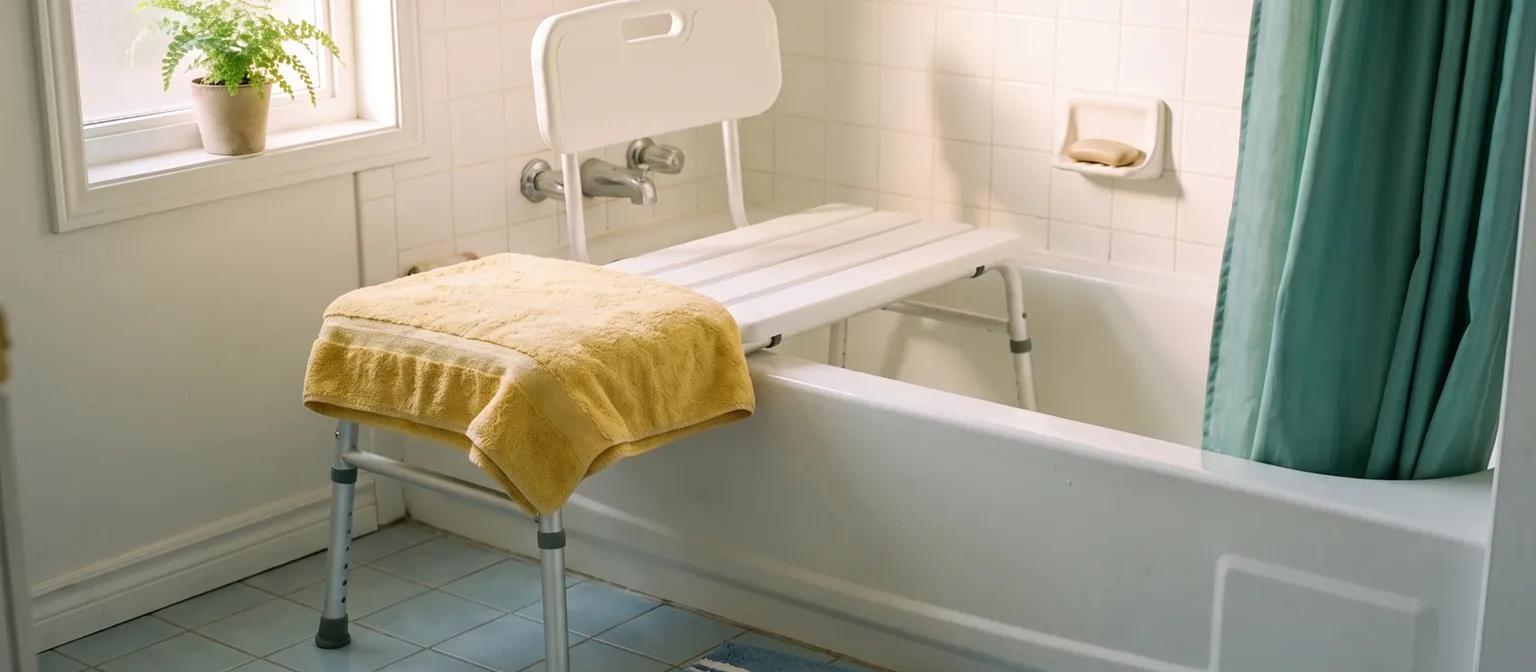
The right shower chair depends on one thing: whether the person can still step over the bathtub wall safely. If they can, a plain four-legged shower chair with a back is usually enough. If they cannot, they need a tub transfer bench, which straddles the tub wall so they sit down first and lift their legs over second.
Getting that one choice wrong is the most common reason a chair goes back in the box. A shower chair does not help anyone get into a bathtub. It only helps once they are already standing in it.
This guide covers the seven kinds of seat sold in Canada, what height to set one at, what to check before you buy, how to use a transfer bench safely, current Canadian prices, and the short list of programs that actually pay. It is one fixture in a room with several; our guide to bathroom safety for Canadian seniors covers the rest of it.
Which shower chair is best for seniors?
For most people, the best shower chair is a height-adjustable four-legged chair with a back, non-slip rubber feet, and a weight rating above the user's weight. It suits a walk-in shower or a bathtub the person can still step into. The moment stepping over the tub wall stops feeling safe, the answer changes to a transfer bench.
Canadian clinical sources are consistent on the split. Shared Health Manitoba's bathing equipment guidance describes a bath seat as something you use once you are inside the tub or shower. It does not assist entry or exit over a bathtub wall (Shared Health Manitoba, 2026). The transfer bench exists for exactly that job.
Three questions settle it in about a minute. Does the bathroom have a tub, a walk-in shower, or a level-entry shower with no lip? Can the person lift one leg over a tub wall while holding something? And can they get up from a low seat without help? The table below turns those answers into a product.
The seven kinds of shower chair, and which bathroom each fits
Canadian home-care and benefit sources describe seven distinct bathing seats. They are not interchangeable. Each one is built for a different bathroom and a different amount of help. Prices are typical Canadian ranges, checked on 21 September 2026, before tax and delivery.
| Type | What it is | Bathroom it fits | Height and weight notes | Typical price (CAD) | Watch out for |
|---|---|---|---|---|---|
| Shower chair with a back, arms optional | Four-legged seat with a backrest, arms to push up from if needed | Walk-in shower, or a tub the person can still step into | Most adjust 14 to 22 in.; standard rating 300 lb | $70 to $110 | Does nothing to help you over a tub wall, and arms add width |
| Shower stool | Backless seat, same four legs | Walk-in shower, steady sitting balance | Cheapest and least supportive | $63 to $91 | No back, so leaning back has nothing behind it |
| Tub transfer bench | Wide seat straddling the tub wall, two legs in, two out | Bathtub only, never a curbless shower | Inside and outside legs adjust separately | $200 to $256 | Needs floor space outside the tub; the curtain must tuck in |
| Bath board | Flat board resting across both tub rims | Bathtub with two sound rims | Fixed at rim height; no legs, no back | Varies by retailer | Rim height can be too low to stand up from; tips if you lean back |
| Wall-mounted fold-down seat | Seat bolted to the shower wall, folds up | Accessible or level-entry shower | Canada's draft standard: 460 to 480 mm high, holds 227 kg | $339 to $665 plus installation | Needs a structural wall behind the tile |
| Bath lift | Powered seat that lowers you toward the tub floor | Bathtub only | Battery powered; heavier to move and store | $1,800 to $2,800 | The step past basic gear, priced accordingly |
| Shower commode chair | Wheeled chair with a cut-out seat | Level-entry or wheel-in shower | Transfer happens outside the bathroom | $994 to $1,200 | Will not fit a standard shower stall or tub |
Sources: Shared Health Manitoba, Bathing Equipment Definitions (2026) and Guidelines for Safe Bathing (2026); Canadian Red Cross health equipment instruction sheets; Indigenous Services Canada self-care equipment benefits list (2026); Alberta Aids to Daily Living; University Health Network, Toronto Rehab (2022); Accessibility Standards Canada draft CAN-ASC-2.3. Prices from named Canadian retailer listings observed 21 September 2026.
Two rows deserve a note. The bath board is the cheapest way to sit down in a tub, and Shared Health Manitoba warns it is also the least forgiving: it has no back, it sits at tub-rim height, which can be too low to stand up from, and it can tip if the person leans back or bends forward. The shower commode chair is the only one on the list that is not really bathroom furniture. The person transfers onto it somewhere else and is wheeled straight into the shower, so it only works in a level-entry stall (University Health Network, Toronto Rehab, 2022).
What height should a shower seat be?
There is no single Canadian rule for shower seat height. The closest clinical figure comes from hip surgery recovery: Vancouver Coastal Health tells patients to set a bench or chair about 2 inches above standing knee height, so the hips stay above the knees (Vancouver Coastal Health, 2018). That is written for a specific recovery, not as a universal fitting rule.
For everyone else, a practical test works better than a number. Set the seat so the person's feet rest flat on the floor with their knees at roughly a right angle, and so they can stand up without pulling hard on anything. If they have to rock forward twice to get up, the seat is too low.
Most adjustable models sold in Canada cover roughly 14 to 22 inches. Canadian Tire's AquaSense seat, for example, adjusts from 15 to 22 inches. Fixed seats are different: for a fold-down seat bolted to the wall, Canada's draft accessibility standard for the built environment sets it 460 to 480 mm above the floor, at least 500 mm wide, within reach of the controls, and rated to hold at least 227 kg (Accessibility Standards Canada, draft CAN-ASC-2.3).
Height matters most after surgery, when hip and knee rules are strict for a while. If that is your situation, our guide to getting a home ready for hip replacement recovery covers the seat alongside the rest of the setup.
What to check before you buy a shower chair
Five things decide whether the chair gets used or put in the basement.
The weight rating. In the Canadian market, a standard shower chair or transfer bench is rated to 300 lb (136 kg), and a heavy-duty or bariatric model to 500 lb (227 kg), based on 2025 to 2026 listings from Compass Health Brands Canada, Durham Medical, and ERP Group. The label on the box is what counts, not the category.
The feet. The federal benefit specification for a bath chair requires non-skid rubber tips or suction feet on every adjustable leg, and requires the whole leg footprint to fit inside the tub (Indigenous Services Canada, 2026). The Canadian Red Cross adds that all four legs must reach the floor evenly, and the chair should be tested for stability before anyone sits on it. Rubber tips wear down. Turn a used chair over and look.
The back and the arms. Both are optional. The federal specification allows a chair with or without a backrest and says it may include arms. Shared Health Manitoba's reason for the back is simple: extra support while sitting. Arms help someone who pushes up to stand, but they also add width, so measure the stall and the tub opening first.
Drainage. No Canadian rule requires holes in a portable seat. They are a comfort feature that stops water pooling under you. The draft built-environment standard does require a fixed wall-mounted seat to be self-draining, with any holes or slots between 4 and 6 mm.
Something to hold. A seat handles the sitting. It does nothing for the standing up, the turning, or the step in. That is a grab bar's job, and the two are usually bought together; our guide to where grab bars go and what they cost in Canada has the mounting heights.
How to use a transfer bench safely
The Canadian Red Cross publishes step-by-step instructions for a bath transfer bench. Here they are in short.
- Put two legs inside the tub and two outside, with the inside legs as close to the far tub wall as you can get them.
- Put the handle on the wall side.
- Adjust the inside pair of legs equally and the outside pair equally, so the bench sits roughly level, every leg reaches its own floor, and the seat does not rest on the tub rim.
- Test the bench for stability, and put a slip-resistant mat in the tub.
- To get in, sit down on the part of the bench that is outside the tub.
- Use the side arm if there is one, slide toward the centre, then lift one leg over the rim, then the other.
- To get out, slide back toward the outside end, bring your legs out, turn slowly without twisting, press down on the seat, and stand.
The order is the whole point. Sitting comes before the legs, every time, in both directions.
What do shower chairs cost in Canada?
A basic shower stool starts around $63, a chair with a back runs $70 to $95, and a tub transfer bench runs $200 to $256. Those are typical Canadian listing prices observed on 21 September 2026, before tax and delivery, at named retailers.
| Item | Typical price (CAD, September 2026) |
|---|---|
| Shower stool, no back | $63 to $91 |
| Shower chair with a back | $70 to $95 |
| Shower chair with a back and arms | $107 to $110 |
| Bariatric or heavy-duty chair | $131 to $160 |
| Tub transfer bench | $200 to $256 |
| Wall-mounted fold-down seat | $339 to $665 |
| Shower commode chair | $994 to $1,200 |
| Powered bath lift | $1,800 to $2,800 |
Sources: listings at Wellwise by Shoppers, Canadian Tire, Home Depot Canada, Amazon.ca, and Healthcare Solutions, checked 21 September 2026. There is no national price survey for this equipment, so treat these as typical ranges rather than fixed prices, and expect sales.
The jump from $95 to $256 is the one that surprises people. A transfer bench is nearly three times the price of a chair because it is nearly twice the furniture. It is still cheaper than almost any other way of solving the same problem.
Who helps pay for a shower chair in Canada?
Fewer programs than families expect, and the most famous one does not apply. The federal Home Accessibility Tax Credit does not cover a chair you carry into the bathroom. The Canada Revenue Agency limits that credit to work that is "of an enduring nature and is integral to the eligible dwelling," and says an item that will not become a permanent part of your home is generally not eligible (Canada Revenue Agency, 2026).
That rule turns on portability, not on price. A fold-down seat bolted to the shower wall becomes part of the house, so it is a different conversation. A chair you can carry out is not. Our guide to the Home Accessibility Tax Credit explains what does qualify and what to keep for receipts.
The line that does work is the medical expense claim. The Canada Revenue Agency lists bathroom aids that help a person get in or out of a bathtub or shower as an eligible medical expense, with one condition: a prescription is needed. Disability Tax Credit approval is not required, and no T2201 form is involved (Canada Revenue Agency, 2026). Ask for the prescription before you buy, not after.
Here is the rest, province by province, as the program pages read in September 2026.
| Program | Covers a shower chair or bench? | Amount |
|---|---|---|
| Federal Home Accessibility Tax Credit | No, portable items are not eligible | $20,000 in expenses, $2,800 max credit, for permanent work |
| Federal medical expense claim (lines 33099 and 33199) | Yes, as a prescribed bathroom aid | Non-refundable credit on eligible expenses |
| Veterans Affairs Canada, Aids for Daily Living (program of choice 1) | Yes, bath chairs are named | Prescribed by an approved health professional |
| Alberta Aids to Daily Living | Yes, chairs, benches and transfer tub benches | Client pays 25%, capped at $500 per family per year |
| BC Rebate for Accessible Home Adaptations | Yes, free-standing shower seat or transfer bench | Up to $165 per item, up to 2 items |
| Quebec, Daily Living and Domestic Assistance Program | Yes, seats, benches, boards and bathtub lifts | Supplied with no fee for eligible people |
| Manitoba Employment and Income Assistance | Yes, a bath seat, for eligible participants | Amount not published |
| Ontario Assistive Devices Program | No, expressly excluded | None |
| Ontario, March of Dimes Canada home modification program | Not for an ordinary chair; it funds bathroom modifications, mainly a roll-in shower | Up to $15,000 lifetime for modifications, adaptations and devices |
| Nova Scotia Seniors Care Grant | No, the grant pays for services | $750 a household, none of it for devices |
| Saskatchewan, New Brunswick | Not published for this item | Not published |
Sources: Canada Revenue Agency (2026), Veterans Affairs Canada (2025), Government of Alberta (2025), BC Housing (2026), Gouvernement du Québec (2026), Government of Manitoba (2024), Government of Ontario (2026), March of Dimes Canada (2026), Government of Nova Scotia (2026). Program terms change; check the current page before you apply.
Three of those rows are worth reading twice. Ontario's Assistive Devices Program says it plainly: it does not cover bath and shower aids, including benches, chairs and bath lifts. Nova Scotia's Seniors Care Grant is $750 a household for 2026 to 2027, and its own fact sheet says the costs of devices and equipment are not covered. And veterans are often pointed to the Veterans Independence Program, which is the right program for home adaptations but not for a bath seat: Veterans Affairs Canada covers bath chairs under Aids for Daily Living instead.
Alberta and Quebec are the two places where the system genuinely pays. Alberta Aids to Daily Living funds chairs and benches against a benchmark price, with most clients paying 25 percent and their share capped at $500 per family each benefit year. Quebec supplies the equipment outright, with no fee, for people with a significant and persistent disability who already receive help through a CISSS or CIUSSS, Quebec's regional health and social services centres.
Do you need an occupational therapist first?
Not for a basic chair in a walk-in shower. You do for anything that involves getting over a tub wall, and you do for most of the funding programs above, which want a health professional's recommendation on file.
The assessment can be free. In Ontario, anyone can call Ontario Health atHome at 1-833-515-1234 and ask for an assessment. A care coordinator decides eligibility and can arrange occupational therapy, including a home-safety and equipment visit. In Alberta, the Continuing Care Access Line is 1-855-371-4122, and Alberta Health Services says there are no fees for professional care services in Home Care. Every province has an equivalent intake line.
If the wait is long or the person does not qualify, private is an option with a price. The Canadian Association of Occupational Therapists' 2026 fee schedule puts typical hourly rates between $120 and $230 depending on the province, with Ontario around $140 an hour and Alberta $150 to $170.
Where to buy a shower chair in Canada
You have four realistic options, and they are not equally good for the same job.
Pharmacy chains. Wellwise by Shoppers sells bath seats, transfer benches and bath lifts online and in store, and staff can point you at the right category. Stock varies by location, so call first.
Big-box retail. Canadian Tire, Home Depot Canada and Walmart Canada all carry bathroom safety seating. This is the cheapest route and the one with the least advice attached.
Online. Amazon.ca has the widest range and the widest quality range with it. Read the weight rating on the listing, not the title.
Home-health suppliers. Stores like Healthcare Solutions and Durham Medical carry the equipment the funding programs approve, including commode chairs and bath lifts. If a program is paying, start here, because these suppliers usually know the paperwork.
One rule across all four: if a funding program is involved, get the approval before you pay. British Columbia's rebate, for one, expects approval before purchase.
What a shower chair cannot do
A shower chair takes the standing out of a shower. That is a real reduction in how much balance the person has to spend on a slippery floor, and it is the reason occupational therapists recommend them so often.
It cannot call anyone. In one Canadian government study of brain-injury cases among adults 65 and older who fell at home, about 14 percent of the falls with a recorded room happened in the bathroom (Public Health Agency of Canada, 2020). Falls sent 81,599 older Canadians to hospital in the 2023 to 2024 fiscal year, not counting Quebec (Public Health Agency of Canada, 2024). A seat changes the odds of one of those moments. It does nothing about the minutes after.
That gap is why a lot of families pair the bathroom work with a wearable help button that can be pressed from the shower floor. Our explainer on how fall detection works for seniors in Canada covers what those devices do and where they fall short.
Frequently asked questions
What can you use instead of a shower chair?
A tub transfer bench, a bath board across the tub rims, or a wall-mounted fold-down seat, depending on the bathroom. Each is a real alternative, not a substitute: a bench and a board help you get in, a fold-down seat saves floor space. A kitchen chair is not on the list. Household chairs are not rated for wet floors.
Does Walmart Canada sell shower chairs for seniors?
Yes. Walmart Canada carries shower chairs in its bathroom aids and safety category, including adjustable-height models with a back and padded arms rated to 300 lb, checked 21 September 2026. Prices there are at the low end of the market. Check the weight rating and the foot design on the listing, because both vary widely at that price.
What is the difference between a shower chair and a transfer bench?
A shower chair sits entirely inside the tub or shower, and you step in before you use it. A transfer bench straddles the bathtub wall, with two legs outside and two inside, so you sit down on the outside end first and lift your legs over afterward. If stepping over the tub wall is the hard part, the bench is the answer.
Can you claim a shower chair on your taxes in Canada?
Yes, as a medical expense, if a health professional prescribes it. The Canada Revenue Agency lists bathroom aids that help a person get in or out of a bathtub or shower among eligible medical expenses, with a prescription required. It does not qualify for the Home Accessibility Tax Credit, which is limited to permanent work integral to the home.
How much weight can a shower chair hold?
A standard chair or bench sold in Canada is usually rated to 300 lb (136 kg). Heavy-duty and bariatric models are typically rated to 500 lb (227 kg), and those run about $131 to $160. Ratings are set by the manufacturer, not by a Canadian standard, so read the label on the box rather than assuming the category.
Your next step
Measure three things before you shop: the width of the tub or shower floor, the height from the floor to the top of the tub wall, and the clear floor space outside the tub. Those three numbers rule out half the options before you leave the house.
Then get the grab bar sorted in the same trip, because the seat and the bar solve different halves of the same problem. Our guide to grab bar placement and Canadian costs has the heights, and the bathroom safety guide covers the flooring, the lighting and the small fixes worth doing while you are in there.