As we age, maintaining mobility and balance becomes essential for preserving independence and quality of life. Stiffness in the joints, minor aches, or concerns about steadiness can sometimes make traditional exercise feel daunting or inaccessible.
However, movement remains one of the most effective ways to manage these changes. Chair yoga offers a practical, gentle solution that bridges the gap between inactivity and strenuous exercise. This accessible form of yoga adapts traditional poses to be performed while seated or using a chair for support.
It allows you to experience the physical and mental benefits of yoga—such as improved flexibility, better sleep, and stress reduction—without the need to get up and down from the floor. Whether you are managing a chronic condition like arthritis or simply want to stay active, chair yoga provides a safe foundation for healthy aging.
Incorporating a medical alert system, such as Holo Alert, into your home environment can provide additional peace of mind while you practice. Knowing that help is available if you feel unwell allows you to focus fully on your breathing and movement.
By committing to a regular, low-impact practice, you can build strength and confidence in your daily activities.
Key Takeaways
- Chair yoga is a low-impact practice designed to improve mobility, balance, and functional fitness for seniors.
- Clinical studies from 2023 confirm that regular chair yoga can reduce pain interference and improve daily life activity scores.
- Safety is paramount; always use a sturdy, non-rolling chair and consult a healthcare provider before starting.
- Simple seated exercises and breathing techniques can be done at home to manage stress and build strength.
- Modifications allow the practice to be adapted for various ability levels, including those with chronic conditions.
Why chair yoga matters for seniors
For many older adults, the fear of falling or exacerbating joint pain can lead to a reduction in physical activity. This creates a cycle where inactivity leads to further stiffness and muscle weakness. Chair yoga poses for beginners break this cycle by providing a secure environment to move.
The practice focuses on improving mobility and balance, specifically targeting the needs of those with limited flexibility or balance concerns.
The clinical evidence supporting chair yoga is compelling. A 2023 study published in Healthcare (Basel) involving 85 older women with knee osteoarthritis found that a 12-week chair yoga program significantly improved functional fitness and daily life activity scores. By engaging in these adapted movements, participants were able to handle daily tasks with greater ease.
Furthermore, randomized controlled trials highlighted in U.S. data from 2023 indicate that chair yoga reduces pain interference and improves walking ability, with benefits that are sustained even months after the initial training.
Beyond physical health, chair yoga supports mental well-being. It is known to reduce symptoms of anxiety and depression, which can accompany aging or chronic illness. The Government of Canada's Active Aging Strategy specifically promotes low-impact activities like seated exercises for the elderly as part of a comprehensive approach to healthy aging.
Provincial bodies, such as the Ontario Seniors' Secretariat, also recognize the value of adaptive yoga in maintaining community participation and independence.
Safety, precautions, and preparing for practice
While chair yoga is widely considered a safe, low-risk activity, preparation is key to preventing injury. Clinical trials consistently report high adherence rates and no serious adverse events among seniors participating in chair yoga programs. However, treating the practice with respect and caution ensures you get the most out of it without setbacks.
Before beginning any new exercise routine, Health Canada recommends consulting a healthcare provider. This is particularly important if you have chronic conditions, a history of falls, or recent injuries. Your doctor can provide specific guidance on movements to avoid.
Once you are cleared to exercise, your environment plays a major role in your safety. The most critical tool for this practice is your chair. You must use a sturdy, armless chair with a backrest. Avoid chairs with wheels, soft cushions that cause you to sink, or unstable folding chairs. The chair should sit on a non-slip surface, such as a yoga mat, to prevent it from sliding.
Wear comfortable clothing that allows for a full range of motion and choose non-slip footwear. Practicing barefoot is often recommended to improve tactile feedback from the floor, which aids in balance.
If you experience pain—sharp or shooting sensations—dizziness, or shortness of breath, stop immediately. While a gentle stretch is desirable, pain is a signal from your body to back off. For added security, many seniors keep a medical alert system, like Holo Alert, nearby during their sessions.
8 chair yoga poses for beginners (step-by-step)
These eight poses are designed to gently wake up the body, improve circulation, and enhance flexibility. Move slowly and prioritize smooth, even breathing over the depth of the stretch.
1. Mountain Pose (Seated Tadasana)
This pose establishes good posture and core engagement. Sit comfortably toward the edge of your chair with your feet flat on the floor, hip-width apart. Press your sit bones down while lengthening your spine upward through the crown of your head.
Roll your shoulders back and down, letting your arms hang by your sides with palms facing forward. Engage your abdominal muscles slightly and breathe deeply for 5 to 10 breaths.
2. Seated Cat-Cow
This sequence warms up the spine and relieves tension in the back and neck. Place your hands on your knees or thighs.
Cow: Inhale as you arch your back, lifting your chest and chin slightly toward the ceiling. Squeeze your shoulder blades together.
Cat: Exhale as you round your spine, tucking your chin to your chest and curling your tailbone under. Repeat this flow for 5 to 8 rounds, moving with the rhythm of your breath.
3. Seated Forward Fold
This pose stretches the lower back and helps calm the nervous system. Sit tall with feet planted firmly on the ground, slightly wider than hip-width. Inhale to lengthen your spine.
Exhale and hinge from your hips, slowly folding your upper body between your legs. Rest your hands on your thighs, shins, or the floor, depending on your flexibility. Let your head hang heavy to release neck tension. Hold for 3 to 5 breaths, then slowly roll up on an inhale.
4. Seated Spinal Twist
Twists aid digestion and spinal mobility. Sit sideways on the chair so your right side is against the backrest. Inhale to lengthen your spine.
Exhale and gently twist your torso toward the right, holding onto the back of the chair with both hands. Keep your hips facing forward; the twist should come from the upper back. Hold for 3 to 5 breaths, return to centre, and switch sides.
5. Seated Warrior I
This pose builds strength in the arms and shoulders while opening the chest. Sit tall with feet flat on the floor. Inhale and sweep your arms out to the sides and up toward the ceiling.
Keep your shoulders relaxed away from your ears. Interlace your fingers if comfortable, or keep hands shoulder-width apart. Lift your chest and gaze forward or slightly up. Hold for 5 breaths, feeling the expansion in your ribs.
6. Seated Pigeon (Ankle-to-Knee)
This is excellent for opening tight hips and relieving sciatic discomfort. Sit tall and cross your right ankle over your left knee. Flex your right foot to protect the knee joint.
If you feel a stretch in your right hip, stay here. For a deeper stretch, gently hinge forward from the hips. Hold for 5 to 8 breaths. Repeat on the left side. Note that one hip may feel tighter than the other; this is normal.
7. Seated Side Stretch
This lateral stretch opens the rib cage and improves breathing capacity. Sit tall with feet flat. Place your left hand on your left thigh or hold the side of the chair for stability.
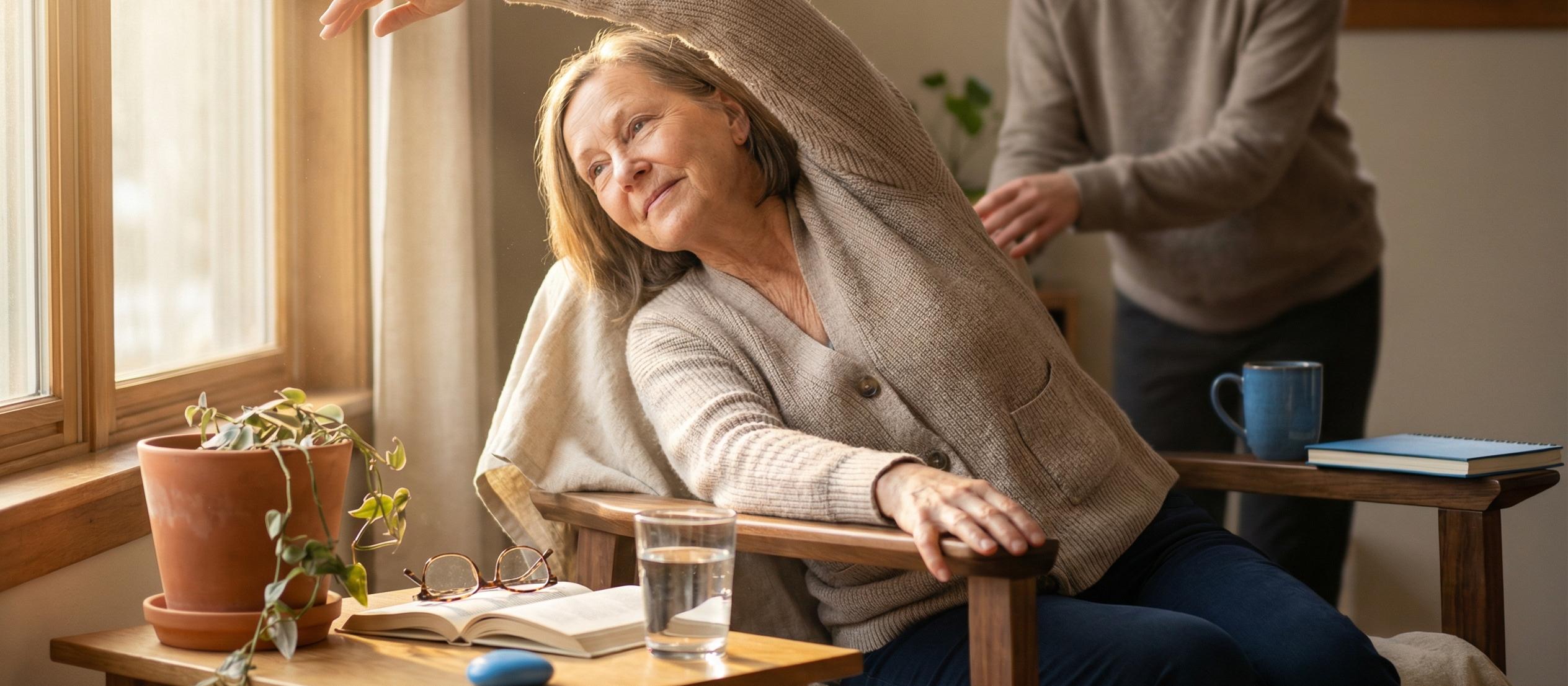
Inhale and reach your right arm up toward the ceiling. Exhale and lean gently over to the left, keeping your right sit bone grounded in the chair. Hold for 3 to 5 breaths, imagining breathing into your right side ribs. Return to centre and switch sides.
8. Single Leg Stretch
This pose targets the hamstrings gently. Sit toward the edge of the chair. Extend your right leg out straight, resting the heel on the floor with toes pointing up.
Keep a slight bend in the knee to avoid hyperextension. Inhale to lengthen the spine, then exhale and hinge forward slightly from the hips until you feel a gentle stretch in the back of the right leg. Hold for 5 breaths, then switch legs.
Seated exercises for elderly to build strength and balance
While yoga focuses on flexibility and mindfulness, seated exercises specifically target muscular strength and endurance. These exercises complement chair yoga by building the core and leg strength necessary for standing balance and fall prevention. U.S. data from 2023 indicates that incorporating seated strength work improves functional fitness and reduces fall risk in seniors.
Seated Marching is a fundamental exercise for hip strength. Sit tall and lift your right knee as high as comfortable, then lower it and lift the left. Continue alternating in a marching rhythm for 30 to 60 seconds. This mimics the motion of walking without the risk of tripping, helping to maintain the neural pathways for gait.
Leg Extensions target the quadriceps, the large muscles in the front of the thigh that are crucial for standing up from a chair. From a seated position, slowly straighten one leg out in front of you, hold for a count of two, and lower it back down. Perform 10 to 12 repetitions on each leg.
Seated Torso Twists (dynamic) can also build core stability. Unlike the static yoga hold, this involves moving continuously from side to side with control, engaging the abdominal muscles. Canadian physical activity guidelines emphasize that strength and balance exercises are vital components of a weekly routine for older adults.
Using light resistance bands or small weights can further enhance the benefits of these movements.
Gentle yoga for aging: breathing and relaxation techniques
The breath is the bridge between the mind and body. As we age, respiratory muscles can weaken, and stress can lead to shallow, chest-based breathing. Breathing exercises, or pranayama, are a central part of gentle yoga for aging. They help reduce cortisol levels, improve sleep quality, and enhance mental well-being.
Diaphragmatic Breathing (Belly Breathing) is the most effective technique for relaxation. Place one hand on your belly and one on your chest. Inhale deeply through your nose, focusing on expanding the belly so the lower hand rises while the upper hand remains still.
Exhale slowly through pursed lips or the nose, letting the belly fall. This signals the parasympathetic nervous system to rest and digest.
Alternate Nostril Breathing is another technique often used to balance the mind. Using your thumb and ring finger, you gently close one nostril to inhale through the other, then switch to exhale. This requires focus, which can help clear the mind of anxiety.
Research highlighted in News-Medical (2023) suggests that mindfulness and breathing exercises significantly improve functional capacity and overall well-being. Many seniors find that using meditation apps or guided audio recordings helps them stay consistent with these practices.
Modifications and progressions for different ability levels
One of the greatest strengths of chair yoga is its adaptability. It meets you exactly where you are. If you have limited range of motion, props can be incredibly helpful. Yoga straps can extend your reach, allowing you to stretch your legs without rounding your back. Yoga blocks can bring the floor closer to you if you are performing forward folds or side stretches.