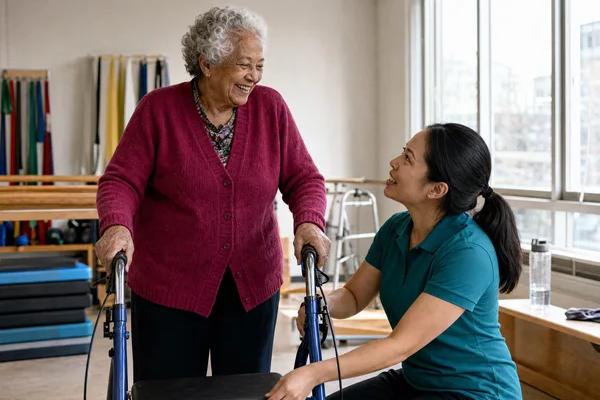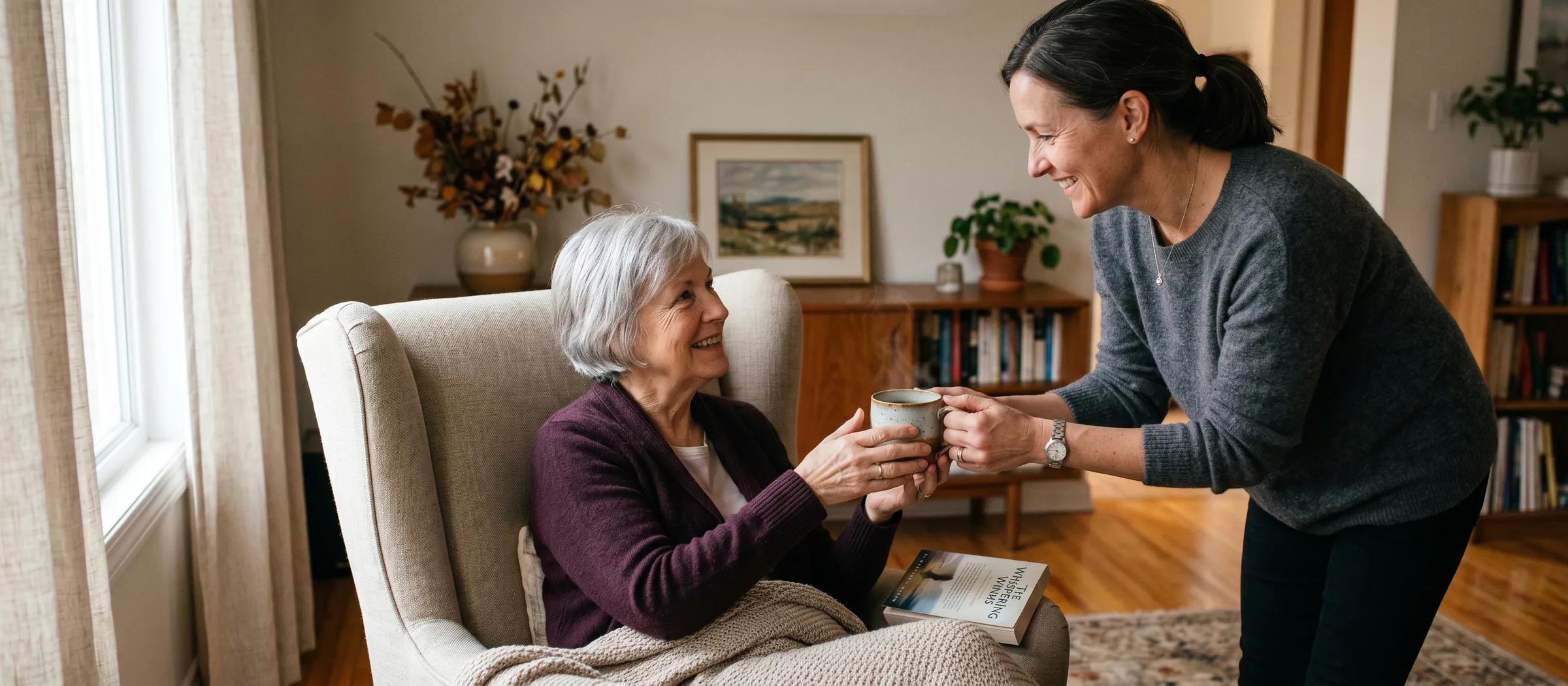
Convalescent care in Canada is short-term recovery support for a senior who is medically stable but not yet ready to return home safely after a hospital stay. It can happen in a publicly funded convalescent bed, in a private retirement-home suite, or at home with provincial home-care visits, family caregiving, and safety modifications. The right path depends on your province, the medical event, and how independent your parent was before it.
If you've ever stood in a hospital hallway being told a parent is being discharged in 48 hours, you already know the feeling. Most Canadian families have one to three days to figure out where their parent will sleep, who will help them get to the bathroom, what new medications they're on, and whether the home they left two weeks ago is safe enough to come back to.
What makes this moment so difficult is that the highest-risk window for an older adult isn't the hospital stay. It's the weeks immediately after it. Researchers call this post-hospital syndrome, a 30-day period of elevated vulnerability driven by disrupted sleep, deconditioning, medication changes, and the stress of being hospitalized at all. (Canadian research suggests elevated health care use can extend to 90 days and beyond for older adults with complex conditions.) A senior can be discharged "medically stable" and still be days away from a fall or a return trip to emergency.
This guide is for the adult child standing in that hallway. By the end you'll know what convalescent care actually is in Canada, the differences between it and respite or rehab, who pays in each province, how to apply through the hospital discharge planner, and how to set up safe recovery at home if a facility isn't the right fit. The recovery-at-home window is also the highest fall-risk window of the year for most seniors. Planning a fall-detection backstop is part of a thorough discharge handoff, not an afterthought.
Table of contents
- What is convalescent care?
- Convalescent care vs respite, rehab, and long-term care
- Who pays for convalescent care in Canada?
- Province-by-province snapshot
- How to apply through your hospital discharge planner
- When recovery at home is the better choice
- The hidden risk during recovery: post-hospital syndrome and falls
- What caregivers should do in the first week after discharge
- When to escalate from convalescent care to long-term care
- Frequently asked questions
What is convalescent care?
Convalescent care is the period of recovery support that bridges a hospital stay and full independent living. The phrase discharge planners use is medically stable but not yet ready to go home safely. That gap is what convalescent care fills.
In Canada it most often follows one of four events:
- Post-fall. Falls account for about 89% of injury-related hospitalizations among older Canadians, and roughly a third of seniors hospitalized for a fall do not return to independent living. The convalescent window is where that outcome is either avoided or accepted. See what to do after a senior falls for the first 24 hours.
- Post-surgery. Hip and knee replacements, abdominal surgery, and cardiac procedures all require structured recovery time.
- Post-stroke. Stroke recovery follows the Heart and Stroke Foundation's Canadian Stroke Best Practice Recommendations. The convalescent stage continues early intensive rehab outside acute care.
- Post-illness. Severe pneumonia, sepsis, dehydration, or COVID complications. The hospital fixes the immediate problem; convalescent care helps the body recover from being broken.
A typical Canadian convalescent stay lasts between 30 and 90 days. Ontario's Convalescent Care Program targets 45 to 55 days. Fraser Health in BC averages about seven weeks. The exact duration depends on the province, the program, and how recovery progresses.
What's included: 24-hour nursing, medication management, physiotherapy, occupational therapy, nutrition support, and monitoring for the complications most likely to send a senior back to hospital. What's not included: acute medical treatment (still hospital), permanent placement (long-term care), or social companionship as the primary service (adult day programs).
Convalescent care vs respite, rehab, and long-term care
Families often confuse these four services and end up applying for the wrong one, which delays care during a window when delays compound quickly.
| Service | Purpose | Typical duration | Who decides | Where it happens |
|---|---|---|---|---|
| Convalescent care | Recovery after a specific medical event | 30-90 days | Hospital discharge planner | Designated convalescent beds in long-term care homes, retirement-home suites, or at home with home-care support |
| Respite care | Temporary relief for the primary family caregiver | Hours to weeks (up to 60-90 days/year in some provinces) | Family | Home or facility |
| Inpatient rehab | Active intensive therapy after a major event (stroke, complex orthopedic surgery) | Weeks to months | Referring physician | Designated rehab hospital or unit |
| Long-term care | Permanent placement when independent living is no longer possible | Indefinite | Family with provincial assessment | Long-term care home |
Convalescent vs rehab. If your parent needs daily intensive physiotherapy, occupational therapy, and speech therapy, they're a candidate for inpatient rehab. Rehab is therapy-dense and the entry route is a referring physician. Convalescent care is gentler, appropriate when the goal is to keep recovering safely rather than to undergo daily intensive therapy.
Convalescent at home. Many families don't realize convalescent care doesn't have to happen in a facility. Provincial home-care, a primary caregiver, and the right home modifications can replicate most of what a convalescent facility provides for patients who don't need 24/7 nursing. If you're looking for a caregiver break rather than recovery support, our guide to finding respite care in Canada covers that path.
Who pays for convalescent care in Canada?
It depends on the province and on whether the patient is in a publicly funded program or a private-pay arrangement.
Publicly funded provincial programs. In Ontario, the Convalescent Care Program is funded by the Ministry of Long-Term Care and is free for eligible patients. Access is through Ontario Health atHome (1-833-515-1234). In British Columbia, similar short-stay restorative care is offered through regional health authorities. Fraser Health, for example, charges a minimum of $37.10 per day with hardship applications available; the average stay is about seven weeks. Alberta, Saskatchewan, Manitoba, Quebec, Nova Scotia, New Brunswick, Newfoundland and Labrador, and Prince Edward Island all offer some form of convalescent or transitional care, with naming and program structure that vary by province.
Private-pay convalescent suites. When public beds are unavailable, many Canadian retirement homes offer convalescent suites for short-stay recovery. These are billed by the day and typically include the room, three meals, basic personal care, and in-house wellness services. Daily rates vary widely - roughly $100 to $300 per day depending on region, facility type, and level of care included. Atlantic provinces and smaller markets sit at the low end; premium suites in Metro Vancouver and Greater Toronto sit at the high end. What the daily rate usually does not cover: private one-on-one nursing, complex medical devices, prescription medications, transportation to follow-up appointments, and specialized therapy beyond what's offered in-house. Ask any provider for a written quote with the daily rate, what's included, what's billed separately, and the cancellation terms.
What can be claimed on taxes. Private-pay convalescent stays can qualify under the CRA Medical Expense Tax Credit when a doctor's letter certifies the medical necessity - keep every receipt. The Canada Caregiver Credit is also relevant for the family caregiver supporting the patient: for the 2026 tax year, up to $8,773 for an eligible relative or $2,740 for a spouse or other eligible family member. See our Canada Caregiver Tax Credit guide for the full claim path. Some provinces offer additional caregiver credits - Manitoba, for example, provides $1,400 for primary caregivers. For a deeper financial picture, our comparison of home-care costs vs retirement homes walks through the math.
Province-by-province snapshot
Provincial programs change. Use the table below as a starting point and confirm current details with the relevant provincial health authority before applying.
| Province | Home-care program | Convalescent / transitional care | How to access |
|---|---|---|---|
| British Columbia | Home and Community Care via regional health authorities | Short-stay restorative care (Fraser Health: ~$37.10/day subsidized, ~7-week average) | Regional health authority + hospital social worker |
| Alberta | Continuing Care (Alberta Health Services) | Restorative care streams through AHS | Health Link 811 or AHS hospital case manager |
| Saskatchewan | Saskatchewan Health Authority Home Care | Available through SHA | Physician referral or self-refer to SHA |
| Manitoba | Manitoba Home Care Program | Transitional care through Regional Health Authority | Local RHA |
| Ontario | Ontario Health atHome | Convalescent Care Program (45-55 days, free for eligible patients) | Ontario Health atHome 1-833-515-1234 |
| Quebec | CLSC / Soutien à domicile (SAD) | Hébergement temporaire / lits de convalescence via CIUSSS | Local CLSC or 811 |
| New Brunswick | Extra-Mural Program | Convalescent / restorative care beds via Horizon and Vitalité (no single provincial program page) | Tele-Care 811 or hospital discharge planner |
| Nova Scotia | Home Care Nova Scotia | Transitional care via Home Care NS | 1-800-225-7225 |
| Newfoundland and Labrador | NL Health Services (consolidated 2023) | Restorative Care Program at Western Health (15 beds, age 65+, no cost) and Central Health | Hospital discharge planner; Western Health: (709) 637-3999 ext. 3994 |
| Prince Edward Island | Health PEI Home Care | Restorative Care Program at Prince Edward Home, Charlottetown (~30-day average; reduced bed availability as of May 2025) | Charlottetown Home Care 902-368-4790 |
The pattern across every province: the hospital discharge planner is the entry door. Even if your province has a strong convalescent program, the referral has to come from the hospital, which is why the next section matters.
How to apply through your hospital discharge planner
You have specific rights as a Canadian caregiver during the discharge process: to participate in the plan, be notified of changes, receive information on community resources, and refuse a discharge you believe is unsafe. In Ontario, the escalation path for an unsafe discharge runs through Patient Relations and then the Patient Ombudsman.
The practical sequence:
- At admission, get the discharge planner's name and extension. In larger hospitals it's a hospital social worker; in smaller hospitals it's often the charge nurse.
- Request a discharge meeting 24-48 hours before discharge day. Ask for every instruction in writing. The questions that matter: warning signs to watch for and who to call, medications added/stopped/changed (and whether a pharmacist can do a full reconciliation), whether a home-care referral is in place and when it starts, what equipment is needed at home, whether physiotherapy or occupational therapy will follow up, and whether a family-doctor follow-up has been booked within 7 to 14 days. See our guide to the 5 legal documents every Canadian caregiver needs - the discharge meeting is often where families discover they're missing the paperwork.
- Ask explicitly whether convalescent care is on the table. Many families don't know to ask, and the planner may default to immediate-home discharge. Asking "is a convalescent care bed an option?" forces the conversation. Approval typically takes 24 to 72 hours.
- Confirm the discharge checklist before discharge day. Caregivers Nova Scotia's framework covers the essentials: written discharge plan, full medication list, home-care services confirmed, equipment assessed, follow-up appointments booked, and a clear answer to "who do we call - and when do we call 911 - if something goes wrong?"
- Bring the right things on admission day. Medications in original containers, ID and health card, a written list of family contacts and decision-makers, comfort items (familiar pillow, eyeglasses, hearing aids), and any mobility aids from hospital.
The 30-day clock starts on admission. Mid-stay assessments determine whether the stay extends, transitions to long-term care, or wraps with a return home.
When recovery at home is the better choice
Convalescent care does not have to happen in a facility. For families whose loved one prefers home, has a supportive primary caregiver, a home that can be modified safely, and doesn't need 24/7 nursing, home-based recovery is often the path the patient strongly prefers.
What home-based recovery looks like. Provincial home-care visits handle the medical and personal-care core - nursing for wound care and medication management, personal support workers for bathing and dressing, physiotherapy and occupational therapy on a limited weekly schedule. Family caregiving fills the in-between hours. Private home-care agencies can usually start within 24 to 48 hours and cover what public services don't: overnight care, extended personal care, homemaking, transportation, and companionship. Public home care is often limited in hours and may not start the day of discharge - plan for a gap.
What the home needs. Single-floor access (or a working stair plan with secure handrails on both sides), wall-anchored grab bars beside the toilet and in the shower, a non-slip mat, a shower chair, a raised toilet seat for post-hip-or-knee patients, throw rugs and loose cords removed, and upgraded lighting on stairs and at night. The hospital occupational therapist should recommend specific equipment before discharge; in Ontario, the Assistive Devices Program funds up to 75% with a prescription, and March of Dimes Canada's Home and Vehicle Modification Program provides additional funding. Our guide to essential home modifications for aging in place and the broader complete aging-in-place checklist are useful pre-discharge audits.
What technology adds. Three Holo Alert devices match different home-based recovery scenarios:
- Holo Home - at-home base station paired with a wireless pendant - when recovery happens primarily inside one residence. Backup battery covers power outages.
- Holo Pro - pendant with location services and a caregiver app - when the primary caregiver lives elsewhere and wants visibility into a parent's activity and location.
- Holo Mini - wrist-worn at 1.2 oz - when the recovering senior is mobile and prefers something discreet they won't take off.
Fall detection is standard on every Holo Alert device. The 10-day risk-free guarantee lets a family test the right device through the early recovery window at no cost. Call 1-888-445-0192 to set up a recovery-window plan.
The hidden risk during recovery: post-hospital syndrome and falls
Many Canadians don't realize that leaving the hospital marks the beginning of a critical risk window, not the end of one. Researchers have identified post-hospital syndrome (PHS) - a 30-day period of elevated vulnerability following discharge, during which patients are at meaningfully higher risk for problems often unrelated to the original illness. Physiological reserves are depleted during admission; once the hospital safety net is removed, that vulnerability shows up as falls, medication errors, dehydration, and rehospitalization. While the formal 30-day window defines peak vulnerability, Canadian research shows elevated health care use can extend to 90 days and beyond for older adults with complex conditions.
Three drivers turn the recovery window into a fall window:
Medication changes. The Canadian Institute for Health Information has found that 1 in 4 Canadian seniors is prescribed 10 or more unique drug classes. Hospital admissions almost always change the medication picture: new prescriptions, stopped medications, opioid pain medication added, blood pressure medication recalibrated. The Canadian Institutes of Health Research has flagged the post-discharge period as particularly high-risk because patients are often anxious or fatigued when receiving complex instructions. Our guide on medications that increase fall risk in older adults covers the specific drug classes that matter most.
Hospital deconditioning. A week in a hospital bed can materially reduce leg strength in an older adult. The patient walks out of the hospital - sometimes the day they walk out - but their balance and proprioception are not where they were a month ago. Gentle safe at-home exercises for Canadian seniors are a key part of the rebuild.
Unfamiliar environment. Even home can feel unfamiliar after a long hospital stay. Stairs feel steeper, lighting feels darker, the toilet feels lower. A senior who navigated their home automatically two weeks ago is now navigating it consciously, and that conscious navigation is the moment when a missed step happens.
What to do about it. Schedule the family-doctor follow-up within seven days of discharge specifically to review medication. Walk through the home before discharge day, not after. Plan a fall-detection backstop. The recovery window is the single highest-value use of a medical alert in a senior's year - it's when a fall sitting unnoticed for hours becomes a long-term-care placement that nobody wanted. Holo Alert's 10-day risk-free guarantee covers exactly this window. Call 1-888-445-0192 to talk through which device matches your parent's recovery scenario.
What caregivers should do in the first week after discharge
The first week is where families either get ahead of the recovery or fall behind it.
Day 1. Reconcile medications before your parent gets home. Open the medicine cabinet, compare it against the discharge list, and physically dispose of anything stopped - accidental double-dosing is one of the most common readmission causes. Bring the new list to your parent's pharmacist for a discharge medication review. Confirm the family-doctor follow-up is booked. Make sure the walker or cane is at home and adjusted to the right height; an incorrectly sized mobility aid is itself a fall risk.
Days 2-3. Stock the kitchen with simple, protein-forward food. Roughly 45% of patients admitted to Canadian hospitals are malnourished (mean age 66), and surgery, illness, and bed rest all increase energy and protein demands. Offer fluids proactively - the sense of thirst diminishes with age, and dehydration shows up as confusion, weakness, and fatigue that are easy to misread as "just recovery". Test the bathroom: grab bars secure, shower chair stable, toilet seat raised if needed. Activate any fall-detection device and run the test alert.
Days 4-7. Get to the family-doctor follow-up. Confirm home-care visits are scheduled and that the personal support worker has a way to get in. Start a simple notebook tracking sleep, appetite, mobility, and mood - discharge complications often show up in those four signals before they show up in vital signs. If the primary caregiver is feeling the weight, our guide to caregiver burnout in Canada covers the signs and provincial support resources. If you're managing recovery from another city or province, long-distance caregiving for parents in another province has the playbook.
When to escalate from convalescent care to long-term care
Convalescent care is designed to be short-term. Sometimes the recovery doesn't reach the expected baseline, and families have to make a harder decision. Five signs that the long-term-care conversation should start:
- The 90-day mark is approaching and recovery has plateaued. The patient hasn't recovered baseline mobility, cognition, or continence, and isn't trending in the right direction.
- Two or more falls during the convalescent stay or first 30 days at home. Falls during recovery aren't one-off events; they signal that the support level is below the need level.
- The primary caregiver is showing burnout symptoms. Sleep deprivation, withdrawal, missed work - the caregiver's health is part of the patient's care plan.
- Rehospitalization within 30 days of convalescent discharge. Research identifies key 30-day readmission risk factors: not understanding discharge instructions, missed medications, missed follow-ups, and lack of caregiver support. A readmission inside that window often signals a structural support gap.
- Cognition has shifted permanently. A new dementia diagnosis or post-stroke cognitive change that doesn't recover with time. This is often the hardest call because patients can be physically functional but no longer safe to live alone.
Have the conversation early, with the family doctor or geriatrician in the room if possible, and involve the patient as much as they're able. Our comparison of home-care costs vs retirement homes is a useful financial framework when the decision starts to crystallize.
Frequently asked questions
What is the difference between convalescent care and respite care in Canada?
Convalescent care exists to help a patient recover from a specific medical event - a fall, surgery, stroke, or illness. Respite care exists to give a primary family caregiver a temporary break. They can happen in the same physical setting, but the entry route, the goal, and the patient's medical status are different.
How long does convalescent care last in Canada?
Typically 30 to 90 days. Ontario's Convalescent Care Program targets 45 to 55 days. Fraser Health in BC averages about seven weeks. Some provinces allow extensions on medical review; others transition the patient to long-term care if recovery stalls past the program window.
Is convalescent care free in Canada?
In provinces with publicly funded programs, it can be free or near-free for eligible patients. Ontario's program is free for eligible patients. Fraser Health in BC charges approximately $37.10 per day with hardship applications available. Private-pay convalescent suites in retirement homes are paid out of pocket, sometimes partially recoverable through the CRA Medical Expense Tax Credit when a doctor's note is in place.
Who pays when convalescent care is private?
The family pays out of pocket. Private long-term care insurance may cover part of the cost if the patient holds a policy. The CRA Medical Expense Tax Credit can apply with a physician statement. The Canada Caregiver Credit may apply for the family caregiver, with credits up to $8,773 for an eligible relative for the 2026 tax year.
Can convalescent care happen at home?
Yes, and it's increasingly common in Canada. Provincial home-care visits, private home-care top-up, family caregiving, home safety modifications, and fall-detection technology can replicate most of what a convalescent facility provides for patients who don't need 24/7 nursing. The trade-off is that the family takes on more of the coordination, and the home itself has to be adapted before discharge day, not after.
Bringing it all together
Recovery after a Canadian hospital stay is a team effort, and as the caregiver you're one of the most important members of that team. The hospital's job is medically complete on discharge day; your family's job is medically just starting. The single most important thing you can do is engage the discharge planner early - days before discharge, not on it - and ask explicitly whether convalescent care is on the table.
If you're choosing recovery at home, the complete aging-in-place checklist is the best place to start the pre-discharge audit. If you're inside a convalescent stay and watching the 90-day clock approach, the long-term-care conversation gets easier when the financial picture is clear. And if you're planning for the recovery-window fall risk specifically, Holo Alert's 10-day risk-free guarantee gives families a no-cost way to test the right device through the most vulnerable 30 days. Call 1-888-445-0192 or browse the Holo Mini, Holo Pro, and Holo Home device options to set up a recovery-window plan today.
This article is informational and is not a substitute for medical, legal, or tax advice. Talk to your parent's care team, doctor, accountant, or lawyer before making care-plan decisions. Provincial program details, eligibility criteria, daily rates, and tax credit amounts change - confirm current details with the relevant provincial health authority and the Canada Revenue Agency before applying.
Fall detection does not detect all falls. Gradual slides, slow collapses, or certain movements may not trigger an alert. Customers should press the SOS button manually if able. Location accuracy varies and may be affected by network availability, indoor environments, and other factors. Holo Alert does not replace 911 or emergency medical services.