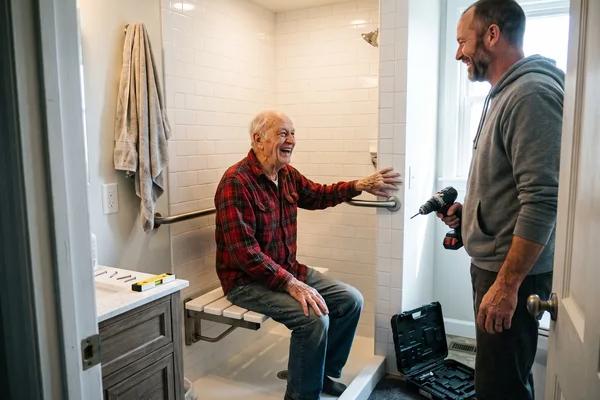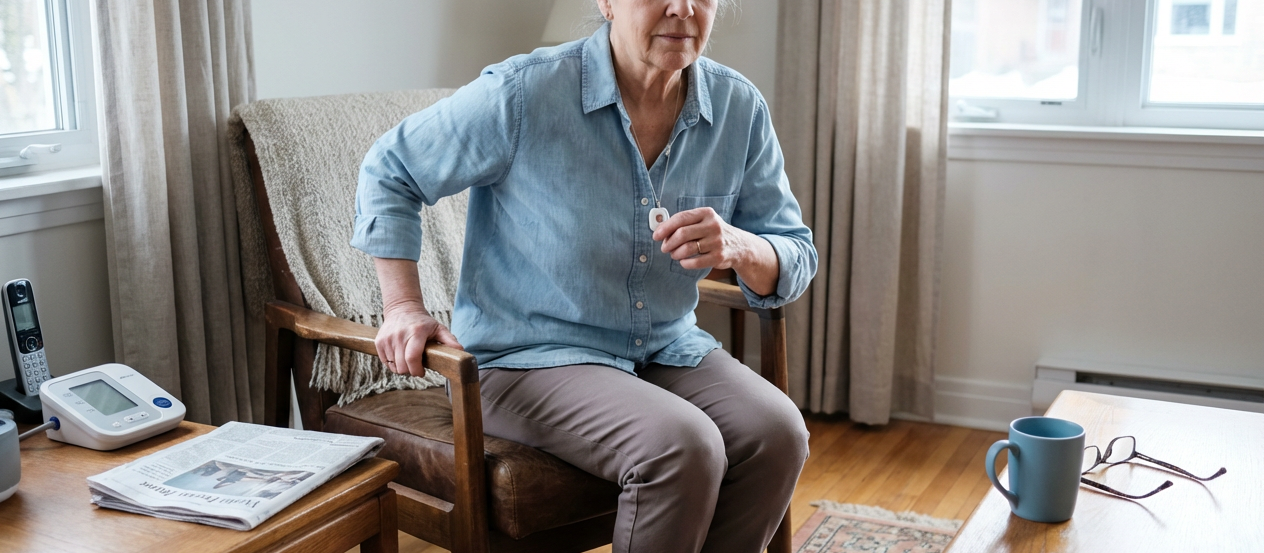
Let's be brutally honest: for many older adults in Canada, the fear of a fall isn't just a worry—it is a daily calculation. The Public Health Agency of Canada reports that up to 30% of seniors fall every year.
But the fall itself isn't always the biggest danger. The true threat is the "long lie"—lying on the floor for hours, unable to move or speak, waiting for help that doesn't know it needs to come. This is where technology stops being a luxury and starts being a lifeline.
Automatic fall detection bridges the terrifying gap between an accident and the arrival of EMS. It ensures that if a fall occurs—and you are unable to press a button due to unconsciousness or shock—the alarm is triggered automatically. However, not all sensors are created equal.
Understanding the mechanics behind this technology is the only way to trust that your device will actually work when gravity takes over.
Key Takeaways
- It's not magic, it's physics: Devices use triaxial accelerometers to measure G-force and impact speed in real-time.
- Position matters: Pendants worn on the chest (sternum) are scientifically proven to detect falls more accurately than wrist-worn devices.
- Silence is dangerous: If you can't speak, a monitored system dispatches help. A non-monitored system just texts a family member who might be asleep.
- False alarms happen: High sensitivity means better safety. A device that never false alarms is likely missing actual falls.
- The Holo Alert Advantage: Our algorithms are tuned to filter out daily noise while capturing the distinct signature of a dangerous fall.
The Physics of Falling: How the Sensors Actually "See" You
Automatic fall detection is a process of continuous, vigilant monitoring. Your device—whether a pendant or clip—is constantly "listening" to the physics of your body. It isn't recording video; it is capturing data points on how you move through space.
Most generic systems use a basic accelerometer. But to truly protect a senior living an active life, you need more data. This is why Holo Alert devices utilize sensor fusion.
1. The Accelerometer (Measuring the Impact)
This sensor tracks acceleration on three axes: up/down, left/right, and forward/backward. It looks for a specific sequence:
- The Drop: A momentary sensation of weightlessness (0g) as you lose balance.
- The Spike: A sharp spike in G-force (often above 3g) when your body hits the floor.
2. The Gyroscope (Measuring the Angle)
Impact isn't enough. If you clap your hands hard, that creates a G-force spike. A gyroscope measures your orientation. It confirms that your body position has rapidly changed from vertical (standing) to horizontal (lying down). This is the critical "confirmation" step that cheap devices often miss.
The Holo Alert Difference: While generic options rely on simple impact thresholds, Holo Alert processes both impact and orientation simultaneously. This creates a high-definition picture of the event, drastically reducing the chance that a hard sit-down on the couch is mistaken for a medical emergency.
Looking for peace of mind? Shop the Holo Alert Pro.
The Brains Behind the Device: Algorithms and Decision Logic
Sensors provide raw data, but the algorithm provides the intelligence. Without smart logic, a device might treat a bumpy car ride down a rural Canadian road as a medical emergency. Advanced systems use "State-Machine Logic."
The device looks for a narrative arc: Normal Activity → Free Fall → Impact → Lying Flat → Stillness. Crucially, the algorithm looks for that post-fall period of stillness. If you fall but immediately stand up and start walking, the system assumes you are okay. If you remain motionless, it escalates the alert to a Priority 1 emergency.
Why Wrist Devices Often Fail
Many seniors turn to standard smartwatches for safety, but this often introduces more risk than protection. The wrist is the most active part of the body, constantly moving during everyday tasks like cooking, cleaning, or working outdoors, which creates excessive motion noise that can confuse fall detection sensors.
A dedicated pendant worn on the chest sits closer to the body's center of gravity, allowing the system to capture cleaner, more accurate movement data. This improves fall detection reliability while also supporting longer battery life that lasts days or even weeks, rather than requiring daily charging that can easily be forgotten.
In an emergency, a dedicated pendant connects directly to a 24/7 live Canadian monitoring team instead of relying on family members to notice or answer a call. Advanced detection is further improved through the combined use of accelerometers and gyroscopes, whereas many generic smartwatches rely on accelerometer data alone, reducing accuracy when it matters most.
The Truth About False Alarms (And Why You Should Accept Them)
One of the biggest hesitations we hear from customers is the fear of false alarms. A false positive occurs when the device thinks a fall happened, but you are fine—perhaps you dropped the device on a table or "plonked" heavily onto a sofa.
Here is the hard truth: Accuracy is a trade-off. To catch 100% of falls (Sensitivity), a device must be "twitchy." To have zero false alarms (Specificity), a device must be "numb." A device that never beeps when you drop it is likely too numb to detect a slow slide down a wall.
How We Mitigate This
Holo Alert includes a "Grace Period." If the device detects a fall, it will beep or vibrate for up to 30 seconds before calling the monitoring centre. This gives you time to cancel the alarm if you are okay. It is a small price to pay for the certainty that a real fall will be caught.
Why the Response Model Matters More Than the Hardware
Even the best sensors in the world are useless if the alert goes nowhere. In Canada, you have two choices: unmonitored or monitored. With an unmonitored system, the device texts a list of family members. But what if your daughter is in a meeting? What if your son has his phone on silent? A text message cannot perform CPR.
With a monitored medical alert system like Holo Alert, the signal goes to a certified Canadian monitoring centre. An operator attempts to speak to you through the device immediately. If you cannot speak—a common occurrence after a stroke or severe fall—they don't wait. They follow a strict protocol to dispatch EMS to your exact GPS location.
Don't leave your safety to chance. Secure your protection with Holo Alert today.
Frequently Asked Questions
How does automatic fall detection actually work in a wearable device?
Wearable devices use internal sensors called accelerometers and gyroscopes to continuously measure the speed and angle of your movements. The device's processor uses algorithms to look for a specific pattern: a sudden drop (free fall), a hard impact, and a rapid change in orientation. If this pattern is detected, the device triggers an alarm to call for help automatically.
What does the physics of fall detection devices mean for real-world accuracy?
Real-world falls are "messier" than lab tests. A senior might slide down a wall or faint and crumble slowly, which may not create the sharp "impact spike" sensors look for. Because of this, no device is 100% accurate. However, wearing a specialized device on your chest significantly increases the odds of detection compared to wrist wearables.
How common are false alarms, and what causes them?
False alarms are relatively common because sensors can mistake vigorous activities for falls. Triggers include dropping the device on a hard surface or sudden braking in a car. Most high-quality systems provide a pre-alert sound (beeping), giving you a 20 to 30-second "grace period" to cancel the alarm before emergency services are contacted.
Can adjusting sensitivity settings reduce false positives?
Yes, but it is a trade-off. Lowering sensitivity reduces nuisance alarms but increases the risk that a softer, slower fall goes undetected. Holo Alert devices are pre-configured to a "Goldilocks" zone—sensitive enough to catch serious falls, but smart enough to ignore most daily activities.
Which type of fall detection is best for seniors living alone?
For seniors living alone, a monitored wearable pendant is the superior choice. Unlike a smartphone that might be left on a charger, a pendant is worn on the body. It connects to a 24/7 operator who can dispatch EMS even if you are unable to speak, ensuring you are never truly alone.
How does Holo Alert handle false alarms and emergency response?
Holo Alert uses Canadian-tuned algorithms to minimize false alarms. If an alarm goes through, it connects to a live operator. If it was a false alarm, simply tell the operator you are okay. If you cannot respond, we dispatch local emergency services to your GPS location immediately.
Why Waiting Isn't an Option
Technology has transformed the abstract fear of falling into a manageable risk. Automatic fall detection acts as a silent guardian, providing the reassurance that if the unexpected happens, connection to help is immediate. But remember: this technology only works if you have it before the fall happens.
Don't wait for a hospital stay to realize you need protection. Equip yourself or your loved one with a system that balances technical precision with human compassion. With Holo Alert, you aren't just buying a device; you are securing independence.