Let's be honest: a medical alert system that stops working at your front door isn't a safety net—it's a leash. For decades, Canadian seniors were forced to rely on landline-tethered buttons that offered zero protection the moment they walked to the mailbox or drove to the grocery store. Today, that standard is no longer acceptable.
The choice between a traditional Home Medical Alert System and a modern GPS Mobile System is the difference between limited coverage and total freedom. You aren't just buying a gadget; you are deciding how much independence you—or your aging parents—can safely maintain. While a fixed home unit offers simplicity for the housebound, active seniors facing Canadian winters and urban isolation need more. They need a device that travels with them.
Key Takeaways
- The Range Trap: Home systems fail once you leave your yard; GPS systems work anywhere in Canada with cellular coverage.
- The Battery Trade-off: Home buttons last years without maintenance, whereas GPS pendants require charging every few days (similar to a mobile phone).
- Connection Security: GPS units use 4G LTE networks to bypass landlines, ensuring you are connected even if the phone lines go down.
- The Holo Alert Advantage: Modern solutions like Holo Alert combine the ruggedness of a home system with the tracking precision of GPS, eliminating the need to choose between the two.
The Core Difference: Tethers vs. Freedom
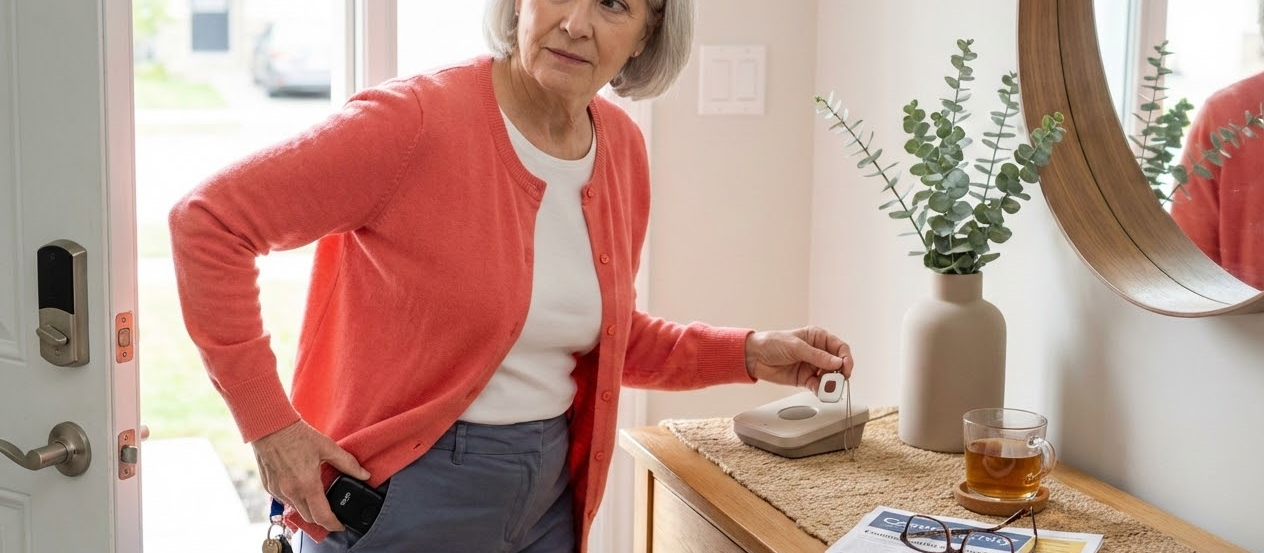
To make the right decision, you must understand the hardware limitations. A traditional home medical alert system relies on a base station plugged into a wall. The wearable button communicates via radio frequency to that base. It is a "short-leash" technology. If you fall in the kitchen, it works. If you fall three blocks away on an icy sidewalk, it is a dead piece of plastic.
In sharp contrast, a GPS mobile medical alert system is a self-contained communication powerhouse. It holds its own SIM card, speaker, microphone, and location technology. It does not need a base station. Whether you are visiting family in another province or walking in a local park, the device connects directly to cellular networks to reach emergency responders.
This is where Holo Alert changes the narrative. We recognized that active seniors shouldn't be penalized for leaving the house. Our systems utilize advanced cellular triangulation to ensure that your "safety net" extends across the entire country, not just your living room.
Is your current safety plan outdated? Upgrade to the Holo Alert GPS system today.
Critical Feature Comparison
When your safety is on the line, technical specifications matter. Here is how the two systems stack up regarding the features that actually save lives.
1. Location Accuracy
Home systems are dumb devices; they don't know where you are. They simply tell the monitoring centre to send an ambulance to your registered home address. If you aren't home, help goes to the wrong place. GPS systems utilize satellites, WiFi triangulation, and cellular data to pinpoint your exact coordinates. This is non-negotiable for seniors at risk of wandering or those who may suffer a medical event in a public space.
2. Connectivity and "Dead Zones"
Traditional systems often rely on copper landlines—infrastructure that is rapidly degrading across Canada. GPS units operate on robust 4G LTE networks (like TELUS or Rogers). While rural "dead zones" can affect GPS units, they are generally far more reliable than aging phone lines during power outages.
3. Fall Detection
Automatic fall detection is vital. In home systems, this is often an expensive add-on requiring a separate pendant. In modern GPS units, accelerometers are built directly into the device. Holo Alert takes this further by integrating smart algorithms that reduce false alarms while ensuring sudden drops are detected instantly, even if the user is unconscious.
| Feature | Holo Alert (GPS) | Standard Home System |
|---|---|---|
| Coverage Area | ✅ Canada-wide (Anywhere with cell service) | ❌ Home & Yard Only (~1000 ft) |
| Location Tracking | ✅ Real-time GPS Coordinates | ❌ None (Fixed Address Only) |
| Connection | ✅ 4G LTE Cellular (Wireless) | ⚠️ Landline or Fixed Base Station |
| Maintenance | ⚠️ Requires charging every 3-5 days | ✅ Battery lasts years (No charging) |
| Fall Detection | ✅ Built-in Smart Sensors | ⚠️ Often requires separate pendant |
Who Actually Needs Which System?
Marketing brochures often complicate this choice, but it comes down to a realistic look at your lifestyle.
The Homebound User
If a senior has very limited mobility, rarely leaves the home without a caregiver, and struggles with memory tasks like charging a device, a Home System is acceptable. The "set it and forget it" battery life removes the burden of daily maintenance. However, this assumes they never walk to a neighbour's house alone.
The Active Canadian Senior
For the vast majority of modern seniors, a GPS system is the only logical choice. If you drive, take transit, walk for exercise, or simply refuse to be confined to your property, a home system is dangerous because it gives a false sense of security. Holo Alert is designed specifically for this demographic—robust enough to handle active lifestyles but simple enough to use in a crisis.
This is also critical for families concerned about missing seniors or those with early-stage dementia. The ability to verify a location via GPS provides a layer of protection that a landline unit simply cannot match.
Don't let a fall define your future. Secure your independence with Holo Alert.
The Cost of Protection
Price is always a factor, but it shouldn't be the only one. Home systems are generally the lower-cost option because the technology is older and simpler. You are paying for a radio signal, not a data plan. GPS systems typically carry a higher monthly subscription because they require a cellular data connection to transmit voice and location data.
However, consider the hidden value: a GPS unit often replaces the need for a landline entirely. Many Holo Alert customers cancel their expensive home phone service, actually saving money while upgrading their safety to a mobile, medical alert solution.
Canadian Reliability: Why Holo Alert Wins
In Canada, geography is the ultimate test. We have "urban canyons" in cities like Toronto where buildings block signals, and vast rural stretches in the Prairies. Generic systems drop calls in these environments. Holo Alert overcomes these challenges by utilizing a hybrid approach. We combine GPS satellite data with WiFi triangulation to find you even when satellites are blocked.
Furthermore, our partnership with major Canadian networks ensures that if there is a signal to be found, your device will find it. While competitors force you to manage cumbersome "hybrid" setups with multiple pieces of hardware, Holo Alert streamlines protection into a single, discreet device.
Frequently Asked Questions
How do GPS vs home medical alert systems differ in real-world use?
The main difference is mobility. A home system stops working at your property line. A GPS system works anywhere in Canada with cellular service, making it the only safe option for seniors who leave their house for any reason.
Are mobile medical alert devices reliable in rural parts of Canada?
Yes, provided there is cellular service. Holo Alert devices connect to major networks like TELUS and Rogers. However, in deep rural "dead zones" where a cell phone shows zero bars, a GPS unit cannot transmit. In those specific rare cases, a landline system is required.
Does the Holo Alert GPS device require a landline?
No. The Holo Alert GPS unit has its own built-in cellular connection. You do not need a landline, a cell phone, or WiFi for the device to call for help.
How often do I need to charge a GPS medical alert?
Battery life varies by usage, but most GPS pendants, including Holo Alert, require charging every 3 to 5 days. We recommend building this into a daily routine, such as charging it while you sleep or watch the evening news.
Don't Leave Your Safety at the Front Door
The era of being tethered to a wall socket is over. You have worked your whole life to enjoy your retirement, and you shouldn't have to fear walking to the park or visiting friends. A home-based system might save a few dollars, but it cannot save you if you fall outside its limited range.
Holo Alert offers the protective power of a monitoring centre tucked discreetly in your pocket. It is the superior choice for Canadian seniors who refuse to compromise on their freedom. Choose the system that goes where you go.