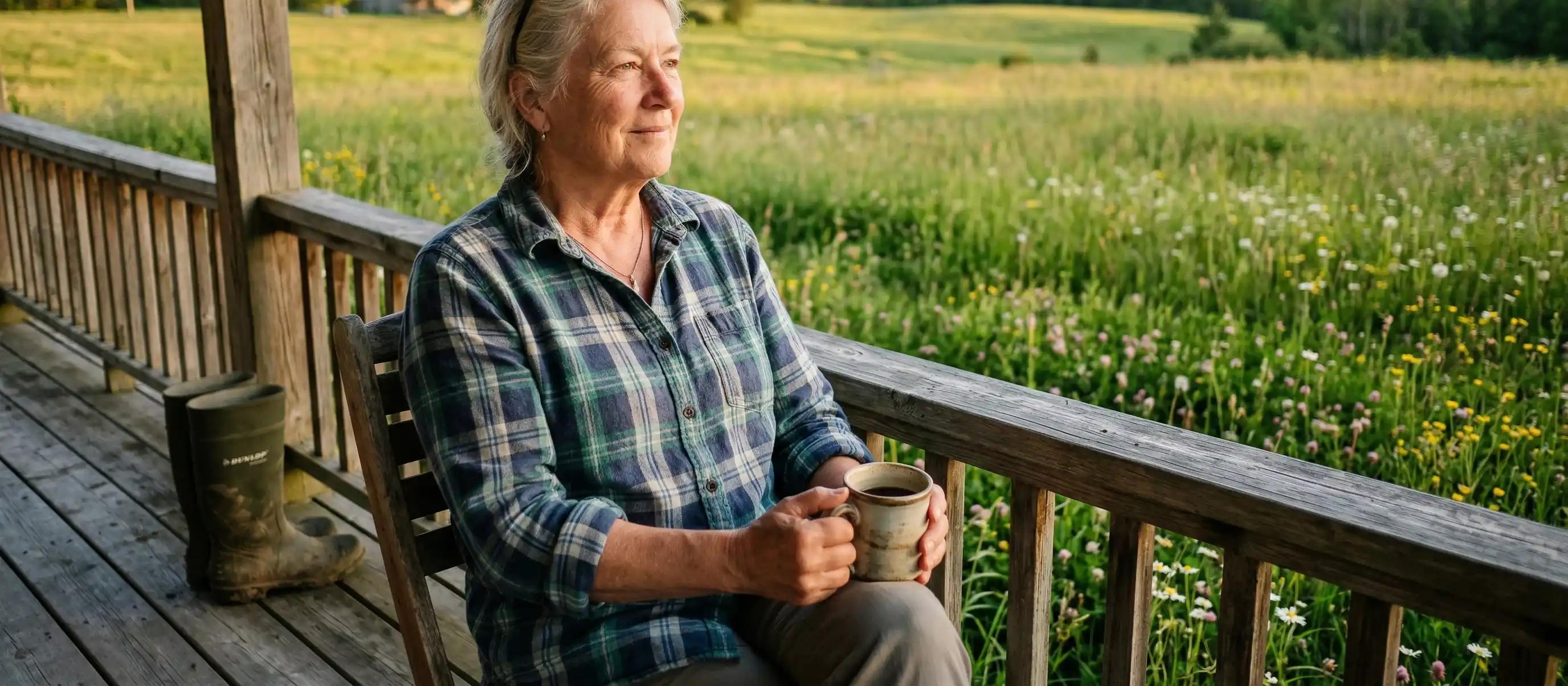
Your parent lives on the same property they've called home for 30 years. They know every neighbour by name. The nearest hospital is 45 minutes away on a good day, and in February, "good days" are rare.
This is the reality for millions of Canadian families. 81% of Canadians aged 50 and older want to stay in their own home as long as possible, according to the National Institute on Ageing's 2025 survey. In rural communities, that desire runs even deeper. The home isn't just a building. It's land, it's history, it's independence.
But rural aging comes with risks that most safety advice never addresses. Longer ambulance waits. Fewer doctors. Roads that close without warning. Cell coverage that disappears between towns. This guide covers what makes aging in place in rural Canada different, and what you can do to close the gap between where your family lives and where help begins.
Table of Contents
- Why Rural Aging in Place Is Different
- The Biggest Safety Risks for Rural Seniors
- How to Make a Rural Home Safer for Aging in Place
- Building a Rural Safety Network
- What to Look for in a Medical Alert System for Rural Canada
Why Rural Aging in Place Is Different
Rural Canada is aging faster than its cities. 23% of rural Canadians are aged 65 or older, compared to 18% in urban areas. In Ontario alone, seniors make up nearly a quarter of the rural population and maintain 35% of rural households.
Yet the services these communities depend on are stretched thin, and in some cases, disappearing entirely.
Only 8% of Canada's physicians practise in rural areas, despite those areas being home to 18% of the population. Primary care access is declining in rural communities four times faster than in cities. In Rural Ontario, 525,000 residents lack access to primary care, 65% of municipalities have no walk-in clinics, and over 600 emergency departments had temporary closures in 2023 alone due to staffing shortages.
The 2025 NIA Ageing in Canada Survey put numbers to what rural families already feel: only 41% of rural residents report they can access healthcare in a timely way, compared to 61% of people living in cities.
This isn't a gap. It's a canyon. And it shapes every safety decision a rural family makes.
The Biggest Safety Risks for Rural Seniors
Falls With Delayed Response
Falls are the leading cause of injury-related hospitalizations for Canadians 65 and older. In 2022, 78,076 fall-related hospitalizations were recorded nationally, and 89% of all injury hospitalizations in this age group were caused by falls. Between 2017 and 2022, fall-related deaths rose 51%.
In rural settings, the danger isn't just the fall itself. It's what happens next.
Research shows that rural seniors have 36% higher odds of fall-related injuries than their urban counterparts. When an ambulance takes 14 minutes to arrive instead of 6, and the nearest trauma centre is another hour beyond that, a hip fracture on a cold kitchen floor becomes a compounding emergency. Cold exposure, dehydration, and shock set in while help is still on the way.
A 2024 Alberta study confirmed the crisis: 65% of high-acuity patients experienced EMS response delays of 30 minutes or more. For rural patients, those numbers skew even longer.
Fall detection technology can help bridge that gap by alerting a monitoring centre the moment a fall is detected, even when the person can't call for help themselves.
Important: Fall detection does not detect all falls. Gradual slides, slow collapses, or certain movements may not trigger an alert. Customers should press the SOS button manually if able.
Medical Emergencies and Limited Cell Coverage
When seconds count, connectivity matters. And in rural Canada, coverage isn't guaranteed.
The Auditor General of Canada's 2023 report found that while urban areas have essentially 100% LTE coverage, rural and remote areas sit at 96.3% for household coverage. That number drops further on roads, trails, and farmland between homes. In provinces like Newfoundland and Labrador, rural LTE coverage falls to 83%.
The Auditor General specifically flagged that gaps in mobile cellular connectivity along rural highways pose direct safety concerns for people needing emergency services. If a senior falls outdoors on their property or has a medical event while driving to town, a dead zone can mean no call gets through.
Medical alert devices that operate on wireless networks can provide a layer of protection here. Devices using 4G networks with location services connect through the same infrastructure as cell phones but are purpose-built for emergencies. They work independently, with no smartphone, Wi-Fi, or landline required.
To understand how different network technologies affect reliability in rural areas, see our guide to medical alert network technology in Canada.
Important: Location accuracy varies and may be affected by network availability, indoor environments, and other factors.
Social Isolation and Mental Health
Rural isolation isn't just emotional. It's a measurable health risk.
43% of Canadians aged 50 and older are at high risk of social isolation, according to the 2025 NIA survey. While isolation rates are similar between rural and urban populations on paper, the structural barriers in rural communities are far more limiting: geographic distance, no public transit, fewer community programs, and lower internet access.
The consequences are serious. A Statistics Canada longitudinal study found that low social participation was significantly associated with increased mortality for both men and women. A 2025 Ontario study found that moderately lonely seniors transitioned to home care 52% faster than their non-lonely peers. Research from the Canadian Longitudinal Study on Aging confirmed that social isolation is directly linked to cognitive decline in older adults.
Staying connected matters as much as staying safe. For practical strategies, read our guide on overcoming loneliness in older adults.
Winter and Extreme Weather
Canada is warming at twice the global average, but that doesn't mean winters are getting easier. It means they're getting more unpredictable.
Between 2011 and 2023, Canada recorded an average of 129 cold-related deaths per year, with that number increasing 4.1% annually. Seniors aged 65 and older account for 43% of all cold-related deaths. A BC study found the highest hypothermia mortality rates occurred in rural and remote areas.
Power outages hit rural communities harder and last longer. A 2024 NERC report flagged Saskatchewan at high risk and Quebec and the Maritimes at elevated risk of electricity shortfalls during cold snaps. For seniors in all-electric homes, a prolonged outage during a polar vortex isn't an inconvenience. It's life-threatening.
Road closures compound every other risk. Interior Health's climate vulnerability assessment noted that snow, ice, flooding, and wildfire-related closures prevent ambulances from reaching patients in time, particularly in communities that rely on single-access routes like bridges or mountain passes.
Our winter safety guide for Canadian seniors covers seasonal preparation in detail, including backup heating, emergency kits, and communication plans.
How to Make a Rural Home Safer for Aging in Place
Rural properties have challenges that a typical home safety checklist won't cover. Long driveways, outbuildings, uneven terrain, wood stoves, well water systems, and septic tanks all add complexity. Here's what matters most.
Make the home findable in an emergency. Ensure the civic address is clearly posted at the road in reflective numbers. If the driveway is long or shared, add directional signage. First responders can't help if they can't find the house.
Prioritize the path between bed and bathroom. This is where most indoor falls happen. Motion-activated nightlights, grab bars, and non-slip flooring in the bathroom are the highest-impact changes you can make.
Prepare for power failures. Stock a 72-hour emergency kit with flashlights, batteries, a battery-powered radio, shelf-stable food, water, medications, and warm blankets. If the home uses a well and pump, have water stored. Consider a generator with a transfer switch installed by a licensed electrician.
Address outdoor hazards. Keep walkways, steps, and ramps in good repair. Install handrails on all exterior steps. In winter, arrange for snow clearing on paths and around exits. Uneven ground between the house and garage, garden, or mailbox is a fall risk year-round.
Create a communication backup. If cell coverage is weak at the property, a landline or satellite phone provides a reliable fallback. Keep a charged phone in the bedroom and another in the main living area.
Quick-win checklist for rural homes:
- Reflective house number visible from the road
- Grab bars in bathroom and beside bed
- Motion-sensor lights on all exterior doors and interior hallways
- Non-slip strips on outdoor steps
- Fire extinguisher accessible on every level
- Generator or backup heat source tested annually
- 72-hour emergency supply kit refreshed every season
- List of medications, emergency contacts, and health card number posted on the fridge
For a full walkthrough, see the complete aging in place checklist for Canadian homes.
Building a Rural Safety Network
In rural communities, your safety net is often your neighbours. Formalizing that network turns goodwill into reliable protection.
Set up a daily check-in system. This can be as simple as a morning text or a wave through the window. Agree with one or two nearby neighbours to check in by a set time each day. If there's no response, someone comes to the door.
Know your local resources. Many provinces operate telehealth lines staffed by nurses 24/7 (Ontario's Health811, BC's HealthLink 811, Alberta's Health Link). These are a critical first step when a trip to the ER means a two-hour round trip.
Explore community paramedicine. British Columbia leads the country with 95 community paramedic positions across 105 communities, conducting proactive home visits for chronic disease monitoring and fall prevention. Nova Scotia's pilot program reduced emergency department visits by 40% among participating adults. Ask your local health authority if community paramedicine is available in your area.
Look into federal and provincial programs. The federal Age Well at Home initiative has funded over 80 pilot projects, including rural-specific programs in Nova Scotia, Ontario, Newfoundland, and Nunavut. VON Canada operates volunteer visiting programs that match trained volunteers with isolated seniors for regular companionship.
Use a caregiver app to keep distant family connected. If your children or siblings live in another city or province, a caregiver app that shares location, activity, and alert status can replace the daily phone call with real-time peace of mind. It doesn't replace being there, but it closes the information gap.
For families managing care from a distance, our guide on long-distance caregiving for parents in another province covers communication strategies, legal preparation, and how to coordinate care remotely.
What to Look for in a Medical Alert System for Rural Canada
Not every medical alert system is built for rural life. In-home systems that rely on a base station and landline won't help your parent in the garden, the barn, or on the road to town. Here's what to prioritize.
Wireless connection, no landline required. Many rural homes no longer have active landlines. A medical alert that connects through a 4G wireless network works anywhere there's cellular coverage, without depending on home internet or a phone line.
Location services. When a senior presses the SOS button away from home, the monitoring centre needs to know where they are. GPS-enabled mobile devices provide approximate location, which is critical on rural properties where the house may be hundreds of metres from the road.
Fall detection. Automatic fall detection alerts the monitoring centre even when the person can't press a button. For someone living alone on a rural property, this is one of the most important safety features available.
Two-way voice. The device itself should allow the wearer to speak directly with a monitoring operator. No fumbling for a phone. No searching for a number. One button, one connection.
Canadian monitoring centres. Response time matters. A system monitored by Canadian operators who understand local geography, weather patterns, and emergency services can coordinate a faster response than an overseas call centre.
Water resistance. Falls in the bathroom are among the most common. A device rated IP67 or higher is shower-safe and won't fail when it's needed most.
Holo Alert's devices check all of these boxes: 4G wireless, location services, fall detection, two-way HD voice, IP67 water resistance, and 24/7 monitoring from Canadian centres in Dartmouth, Montreal, Edmonton, and Moncton. Every plan includes a 10-day risk-free guarantee, and there's no landline, smartphone, or Wi-Fi required.
To compare your options, call 1-888-445-0192 or visit holoalert.ca.
Important: Holo Alert does not replace 911 or emergency medical services.
Living Rural Is Worth Protecting
Choosing to age in a rural community isn't a compromise. It's a statement about the life you've built and the independence you've earned. The land, the quiet, the space to breathe. These things matter.
The risks are real, but they're not insurmountable. A safer home, a stronger network, and the right technology can close the gap between where you live and where help begins.
Start with one step today. Post that reflective house number. Set up a check-in with a neighbour. Talk to your parent about what would give them, and you, more peace of mind.
For a complete walkthrough of home modifications and safety planning, explore our aging in place checklist for Canadian homes. And if you're ready to explore medical alert options designed for Canadian families, call 1-888-445-0192 to speak with someone who can help.