Returning home after a stroke isn't just a milestone; for many Canadian families, it is a source of terrifying anxiety. The transition from the controlled environment of a hospital or rehabilitation centre to the unpredictability of your own home creates a dangerous gap in care.
The harsh reality is that the risk of a recurrent stroke or a debilitating fall is highest in the first few months of recovery. You cannot rely on luck or the hope that a survivor can reach a phone in an emergency. Motor skills are often compromised, and speech may be slurred, rendering a standard 911 call impossible.
Developing a comprehensive home safety plan is not about moving a few rugs; it is about constructing a defensive perimeter around your loved one. This guide will walk you through securing the home, understanding the critical timeline, and why an automatic system like Holo Alert is the only reliable lifeline when every second counts.
Key Takeaways
- The "Phone" Trap: Stroke survivors often cannot operate standard phones or keypads during an emergency due to paralysis or confusion; automated alerts are mandatory.
- The 30-Day Danger Zone: The first month home carries the highest risk for recurrence and falls—vigilance must be at its peak.
- Bathroom Hazards: This is the most dangerous room in the house. Waterproof protection is non-negotiable.
- TIA Warning Signs: A "mini-stroke" is a massive red flag. Immediate intervention prevents a full-blown medical catastrophe.
- Caregiver Burnout: A safety plan must protect the caregiver's mental health as much as the survivor's physical health.
Understanding TIA Warning Signs: It's Not a "Close Call"
A Transient Ischemic Attack (TIA), or "mini-stroke," is a pre-tremor to a potential earthquake. While symptoms like one-sided weakness, slurred speech, or sudden vision loss may vanish within 24 hours, they are not to be ignored. They signal an imminent threat of a full stroke.
If a TIA occurs at home, your safety plan must bypass the "wait and see" approach. It requires immediate rapid transport to a hospital. This is where the mobile vs in-home medical alert system distinction becomes vital. If a survivor experiences a TIA in the garden or bathroom, they likely cannot reach a landline.
The Holo Alert Difference
In the confusion of a TIA, a survivor may not be able to articulate their location or symptoms to a 911 dispatcher. Holo Alert devices are equipped with GPS location tracking, ensuring that even if the user cannot speak, emergency services are dispatched to their exact location immediately.
The Recovery Timeline: When is the Risk Highest?
Recovery is not linear, and safety needs shift dramatically over the first year. Understanding this timeline allows you to anticipate risks before they turn into accidents. Recovery after a serious health event typically unfolds in distinct phases, each with its own risks and priorities.
The acute phase, spanning the first 0–48 hours, focuses on medical stabilization, as the risk of complications such as blood clots is highest. This is followed by the subacute phase over the next 0–3 months, which represents the most critical period overall - strict fall prevention measures and continuous 24/7 monitoring are essential.
During early recovery (3–6 months), individuals often begin returning to home routines; however, insurance coverage may start to taper off, increasing reliance on personal home-safety technology. The intermediate phase from 6–12 months is marked by growing independence, where the emphasis shifts to enabling safe movement while still maintaining a reliable safety net. Beyond one year, the long-term phase centers on lifelong maintenance, with sustainable fall-detection and safety protocols becoming part of everyday living.
A Step-by-Step Home Safety Checklist
A vague plan is a failed plan. You must systematically assess the home environment against the survivor's specific deficits. Is their right side weak? Is their balance compromised? Here is how to lock down the home.
1. Evaluate Mobility & Communication
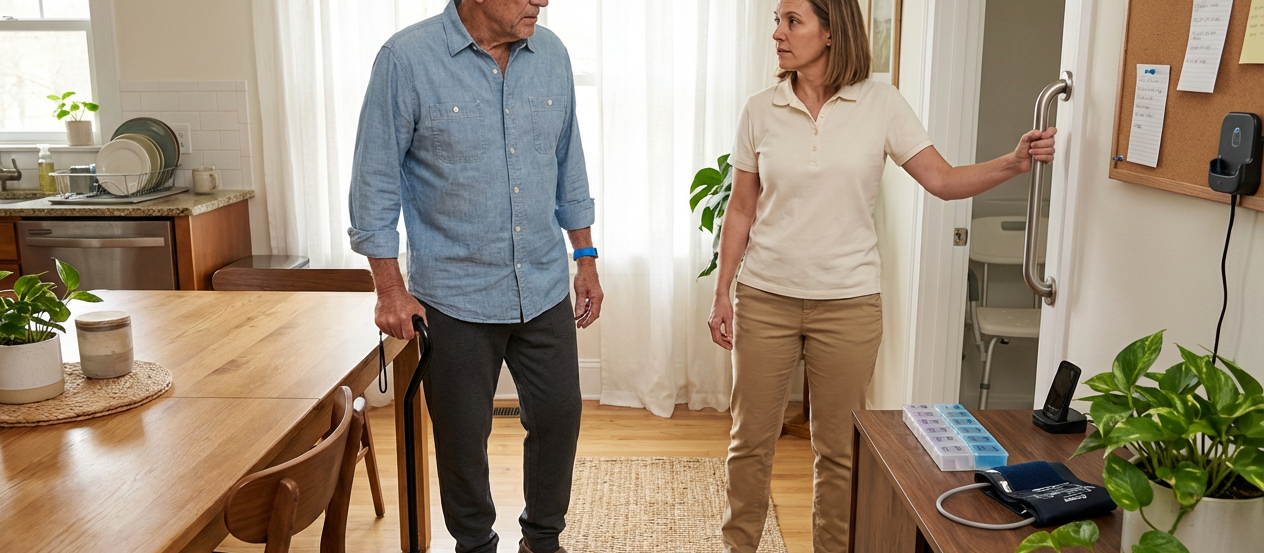
Assess how the survivor moves. If they rely on a walker or cane, pathways must be widened. More importantly, assess communication. If the survivor has aphasia (difficulty speaking), a standard telephone is a paperweight in an emergency. You need a one-touch or no-touch solution.
2. The Bathroom: The Danger Zone
Statistics show the bathroom is where most catastrophic falls occur. Installing grab bars is the bare minimum. You must ensure the survivor has access to help while naked and wet—a scenario where most people do not carry a cell phone.
The Holo Alert Difference
A fall in the shower can leave a survivor unconscious or unable to move. Holo Alert pendants are fully waterproof. We recommend waterproof medical alert systems that stay on the body in the shower, ensuring that a slip on wet tiles triggers an immediate call for help. Your loved one cannot call for help if they are unconscious. Ensure they are protected with automatic fall detection.
The First 30 Days: Strict Safety Precautions
The first month home is the "red zone" for hospital readmission. Fatigue sets in quickly, and a tired survivor is a fall-prone survivor. During these 30 days, assume stability is compromised.
Medication Management
Missed blood thinners or blood pressure medication can trigger a second stroke instantly. Cognitive fog often makes it difficult for survivors to remember doses. Automated dispensers or strict caregiver logging is essential.
Fall Prevention
Do not rely on the survivor's judgment of their own strength. Smart fall detection technology is critical here. If they try to get out of bed at night and collapse, you need to know immediately, not in the morning.
Furniture Arrangement
Hemiparesis (weakness on one side) changes how a person navigates a room. Clear decorative obstacles. If the survivor cannot see well on their left side, ensure all critical items (water, medication, alert button) are positioned on their right.
Emergency Response: Why 911 Isn't Enough
When a medical emergency occurs, seconds determine the amount of brain tissue lost. A home safety plan must include a protocol that works when the survivor is confused or unable to speak.
The Information Gap
When you call 911, they may not know the caller is a recent stroke survivor on blood thinners. Holo Alert bridges this gap. Our operators have access to the user's medical profile and can relay critical data to EMS immediately, ensuring paramedics arrive prepared to treat a stroke, not just a "sick person."
Reporting Condition Changes
Caregivers must watch for "red flag" symptoms: increased confusion, sudden fatigue, or new weakness. These are not just "bad days"; they are medical events. Don't risk a delayed response. Give emergency responders the data they need instantly.
Caregiver Roles and Canadian Resources
Caregivers are the backbone of recovery, but they are also at risk of burnout. In Canada, we are fortunate to have the Age Well at Home Initiative and other provincial resources, but the day-to-day burden falls on the family.
Coordinate and Log
You are the project manager of your loved one's health. Keep a daily log of recovery notes. This documentation is invaluable for neurologists to adjust therapy programs. Use technology to support you—Holo Alert's caregiver app notifies you if your loved one wanders or falls, allowing you to step away from the home with peace of mind.
Why Holo Alert is the Superior Choice for Stroke Survivors
Standard medical alert systems often fail stroke survivors because they require manual activation. If a survivor suffers a recurrent stroke, they may lose the motor function required to press a button.
- Automatic Detection: Holo Alert detects falls and unusual inactivity automatically. It calls for help even when the user cannot.
- Voice-to-Voice Console: The device acts as a speakerphone. Our operators can speak directly to the survivor to assess their consciousness and calm them down.
- Caregiver Integration: We don't just call an ambulance; we call you. The family is kept in the loop instantly.
Frequently Asked Questions
How soon does rehabilitation start after a stroke?
Rehabilitation typically begins within 24 to 48 hours while the patient is still in the hospital. Early mobilization is critical to prevent clots and pneumonia, setting the stage for the home-based recovery that follows.
Why is the first month at home considered high risk?
The first 30 days carry the highest risk for recurrent strokes and falls. Survivors are adjusting to new physical limitations and heavy medication regimens. This is the period where continuous monitoring, such as that provided by Holo Alert, is most critical.
What if the stroke survivor cannot speak during an emergency?
This is a common issue known as aphasia. Standard 911 calls are ineffective here. Holo Alert systems utilize GPS tracking and automatic fall detection, meaning help is sent to the exact location based on the device's signal, even if no word is spoken.
Can I use Holo Alert in the shower?
Yes. The bathroom is a high-risk zone for stroke survivors due to slippery surfaces. Holo Alert devices are waterproof and designed to be worn in the shower where falls are most likely to occur.
Don't Leave Recovery to Chance: Secure Their Safety Now
Building a home safety plan for a stroke survivor is not just about organizing furniture; it is about saving a life. The risks of falls, isolation, and recurrent strokes are real, but they are manageable with the right strategy. By understanding the warning signs and equipping your loved one with Holo Alert's automatic protection, you are not just hoping for the best—you are ensuring it.
Take the first step in protecting your family's future. Get your Holo Alert system today.